Solutions · Digital & Smart O&M
Asset Life Extension Programs: digital retrofit paths for aging RO systems
Instrument upgrades, control modernization, and selective membrane strategy—extend asset life without pretending the train is new.
Use this guide within its scope
This page supports technical research and option comparison and is marked 2026. Illustrative values are not a quotation, completed process design, certification conclusion, or performance guarantee. Check current regulations, feed data, tests, and OEM records.
Problem
Binary 'replace everything' quotes ignore the margin left in hydraulics and civil if instrumentation and controls catch up.
Technology
Condition assessment + staged retrofit waves with KPI gates at each tranche.
Results
Deferred full replacement with documented reliability gains and lower stranded cost.
Engineering decision card
Use when
Binary 'replace everything' quotes ignore the margin left in hydraulics and civil if instrumentation and controls catch up.
Evaluate first
Condition assessment + staged retrofit waves with KPI gates at each tranche.
Inputs still required
Feed source and variability, capacity, target quality, operating hours, discharge or reuse boundary, available space, and utilities.
Comparison output
Deferred full replacement with documented reliability gains and lower stranded cost. The final decision still needs feed data, mass balance, and any necessary testing.
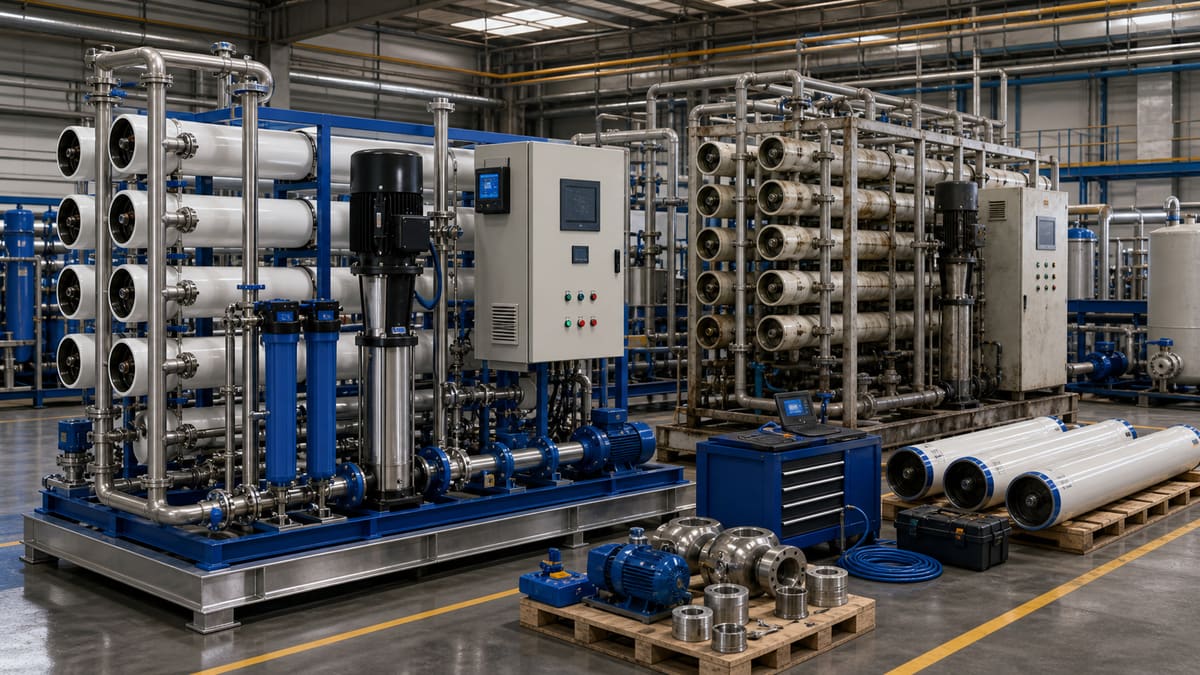
The Imperative for Digital Transformation in RO
RO systems are the backbone of clean water production in countless industrial facilities, from power generation to pharmaceuticals. Yet, many of these critical assets operate with outdated monitoring, reactive maintenance, and fragmented supply chain processes. This leads to:
- Suboptimal Performance: Reduced permeate quality, lower recovery rates, and increased energy consumption due to membrane fouling or degradation that goes undetected or unaddressed promptly.
- Uncertainty and Risk: Higher incidence of unexpected breakdowns, leading to costly emergency repairs, production interruptions, and missed output targets.
- Inefficient Resource Use: Over-reliance on scheduled, rather than condition-based, maintenance for membrane cleaning or replacement, wasting chemicals and shortening asset lifespan.
- Supply Chain Vulnerability: Slow, manual spare parts procurement processes that fail to anticipate needs, resulting in long lead times and increased inventory holding costs or critical shortages.
Traditional vs engineering evaluation path
Consider the critical task of managing membrane performance and ordering essential spares for an aging RO plant.
| Traditional way | engineering evaluation path way |
|---|---|
| Reactive Maintenance & Manual Data: Operators manually log pressure drops and conductivity readings once per shift. Performance degradation is often only noticed when permeate quality visibly declines or energy consumption spikes, weeks after the onset. | Predictive Analytics & Real-Time Data: Continuous online monitoring of specific flux, normalized pressure drop, and salt rejection. AI algorithms detect anomalous trends indicative of early-stage fouling or scaling within hours, triggering immediate alerts and prescriptive recommendations. |
| Scheduled Membrane Cleaning: Membrane cleanings are performed on a fixed schedule (e.g., quarterly) regardless of actual fouling severity. This can lead to premature chemical usage (wasting ~20% of chemicals) or insufficient cleaning, shortening membrane life and requiring additional manual labor to schedule and execute. | Condition-Based Optimization: Predictive models analyze real-time data to forecast optimal cleaning windows, precisely when efficiency gains outweigh chemical and operational costs. This can extend time between cleanings by 20-30%, saving chemicals and labor, and extending overall membrane lifespan. |
| Slow, Reactive Spare Parts Ordering: Replacement membranes or critical spare parts (e.g., high-pressure pump seals) are ordered only after significant performance loss or failure. Lead times for specialized membranes can be 4-6 weeks, risking prolonged downtime and causing production shortfalls of up to 50,000 m³/day of pure water. | Intelligent, Proactive Supply Chain: AI-driven demand forecasting, based on asset health and degradation models, automatically triggers orders for critical spares before they are needed. Integrates with supplier networks for just-in-time delivery. Lead times for replacement membranes reduced to less than 1 week, minimizing inventory holding costs while ensuring parts availability and zero production loss. |
| Expert Dependency & Ad-hoc Troubleshooting: Diagnosing complex issues requires flying in specialists, leading to delays (often 3-5 days for travel) and significant expenses, impacting uptime and operational budget. | Remote Diagnostics & Prescriptive Guidance: engineering evaluation path platform provides remote experts with real-time, comprehensive data. Prescriptive maintenance insights guide local teams through troubleshooting, resolving 70% of issues remotely or with clear, step-by-step instructions, cutting diagnosis and resolution time by 80%. |
Q1: What kind of ROI can we expect from a digital retrofit for an aging RO system?
A1: Typical RO digital retrofits demonstrate significant ROI through multiple avenues: extending membrane life by 15-30%, reducing energy consumption by 5-10% due to optimized performance, cutting chemical usage for cleanings by 20%+, and drastically reducing unplanned downtime—often eliminating critical production losses entirely. Payback periods typically range from 18 to 36 months, driven by improved asset efficiency and reduced operational expenditures.
Related equipment & product lines
These categories typically support the approach above—open any line to compare brands and models.
- Instrumentation & SensorsOnline measurement and control: flow, level, pressure, and water-quality sensors indexed from the Lenntech instrumentation hub.View category →
- RO MembranesReverse osmosis membrane elements for municipal and industrial desalination.View category →
- InvertersVariable-frequency drives and inverter systems for variable-speed motor control.View category →
For a closer review, use the engineering inquiry form to share feed, capacity, target, and project stage. Submission does not constitute a completed design or performance commitment.