Solutions · Digital & Smart O&M
Membrane Autopsy & Cleaning Advice: evidence-led CIP when fouling is non-obvious
Layer microscopy, compositional hints, and operating history—so the next clean targets the real foulant, not the usual recipe.
Use this guide within its scope
This page supports technical research and option comparison and is marked 2026. Illustrative values are not a quotation, completed process design, certification conclusion, or performance guarantee. Check current regulations, feed data, tests, and OEM records.
Problem
Repeated CIP without diagnosis polishes symptoms while the underlying foulant profile drifts.
Technology
Structured sampling, photography standards, and cross-reference to online sensor narratives.
Results
Higher recovery after cleans and fewer 'mystery' replacements that were actually fixable.
Engineering decision card
Use when
Repeated CIP without diagnosis polishes symptoms while the underlying foulant profile drifts.
Evaluate first
Structured sampling, photography standards, and cross-reference to online sensor narratives.
Inputs still required
Feed source and variability, capacity, target quality, operating hours, discharge or reuse boundary, available space, and utilities.
Comparison output
Higher recovery after cleans and fewer 'mystery' replacements that were actually fixable. The final decision still needs feed data, mass balance, and any necessary testing.
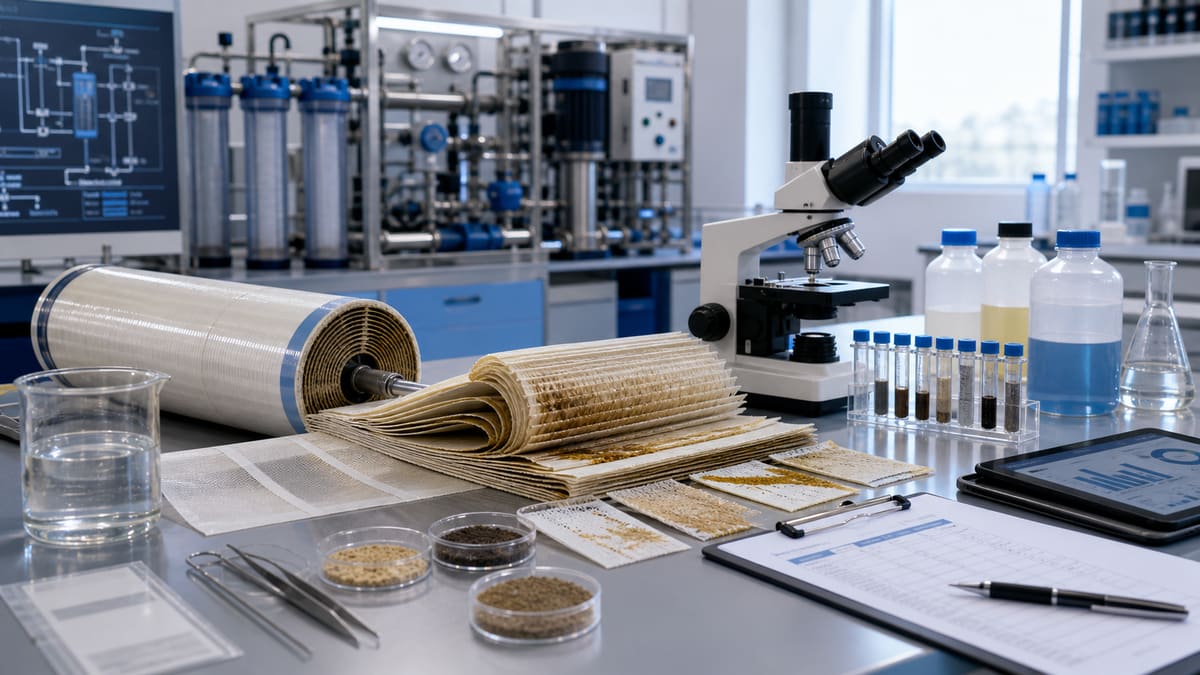
The Hidden Costs of Unseen Fouling
Membrane systems are the workhorses of many industrial processes, but their efficiency can silently erode due to complex, often invisible, fouling. This 'non-obvious' fouling isn't always reflected in standard operational parameters until it's too late, leading to increased trans-membrane pressure, higher energy consumption, reduced permeate flow, and ultimately, shorter membrane lifespan. Without a precise diagnosis, cleaning strategies become guesswork, wasting chemicals, labor, and valuable production time. this approach brings clarity to this complexity, empowering operators with actionable intelligence.
Traditional vs engineering evaluation path
When faced with declining membrane performance and non-obvious fouling, the approaches diverge significantly, impacting everything from diagnosis time to long-term operational costs.
| Traditional way | engineering evaluation path way |
|---|---|
| Problem: Gradual performance decline, cause unknown. Operators suspect fouling but lack specific data. | Problem: engineering evaluation path AI-driven analytics detect subtle shifts in normalized flux, flagging potential non-obvious fouling trends weeks in advance. |
| Diagnosis: Guesswork cleaning cycles (e.g., acid wash, then caustic wash) based on generic procedures. Manual collection of operational data, often incomplete. | Diagnosis: Comprehensive data ingestion from plant SCADA (flow, pressure, conductivity, ORP) combined with external lab analyses (membrane autopsy results, feed water analysis) and engineering evaluation path proprietary machine learning algorithms. |
| Outcome: Cleaning cycles are inefficient, often missing the root cause. Prolonged low performance (e.g., 2-3 weeks of suboptimal operation) leads to higher energy costs and potential irreversible damage, necessitating early membrane replacement. Spare parts ordered reactively. | Outcome: Precise, customized Clean-in-Place (CIP) recommendations based on identified foulant type and location. Optimized cleaning reduces downtime to 2-3 days, extends membrane life by up to 20%, and ensures optimal chemical use. Proactive spare parts planning driven by predictive insights. |
| Cost & Risk: Significant operational expenditure on chemicals, energy, and labor for ineffective cleaning. High risk of unplanned shutdowns and premature capital expenditure on new membranes due to irreversible fouling. | Cost & Risk: Reduced operational costs through optimized cleaning and extended asset life. Minimized risk of unplanned outages, leading to predictable budgeting and enhanced operational certainty. |
Data Security & Trust
- Dedicated Data Environments: Your data is isolated and never commingled with other clients.
- Granular Access Controls: You define who sees what, with auditable user activity logs.
- Compliance Ready: Designed to support industry-specific regulatory requirements.
- Regular Security Audits: Our systems undergo continuous monitoring and third-party penetration testing.
The Foundation of Truth: Online Instrumentation & Sensors
This continuous stream of data, far beyond what manual checks can provide, forms the bedrock for our predictive analytics, ensuring that every piece of advice is precise, timely, and directly relevant to your operational reality.
engineering evaluation path Differentiation: Coordinated Intelligence for the Entire Lifecycle
By bridging the gap between raw data, expert analysis, and tangible supply chain actions, this approach transforms complex technical challenges into streamlined, predictable outcomes, bolstering your operational resilience and economic efficiency.
FAQ
Q: How does this evidence-led approach specifically reduce my operational costs? A: By precisely identifying the type and extent of fouling, this approach eliminates guesswork from your cleaning regimen. This means using the right chemicals at the right concentration for the right duration, reducing chemical consumption, energy waste from suboptimal operation, and labor hours for ineffective cleaning. Crucially, it extends membrane lifespan, delaying costly capital expenditure on replacements and minimizing the risk of unplanned shutdowns.
Related equipment & product lines
These categories typically support the approach above—open any line to compare brands and models.
- Instrumentation & SensorsOnline measurement and control: flow, level, pressure, and water-quality sensors indexed from the Lenntech instrumentation hub.View category →
- RO MembranesReverse osmosis membrane elements for municipal and industrial desalination.View category →
- Replacement Parts / SparesGeneral replacement parts for treatment systems and subassemblies.View category →
For a closer review, use the engineering inquiry form to share feed, capacity, target, and project stage. Submission does not constitute a completed design or performance commitment.