Solutions · Digital & Smart O&M
Predictive Maintenance for RO Membranes: AI-guided adaptive CIP cycles
Move from calendar CIP to data-driven cleaning: normalized ΔP, flux, and quality trends with advance spares planning—less downtime, lower chemical wear.
Use this guide within its scope
This page supports technical research and option comparison and is marked 2026. Illustrative values are not a quotation, completed process design, certification conclusion, or performance guarantee. Check current regulations, feed data, tests, and OEM records.
Problem
Cleaning too early wastes chemistry; too late bakes in fouling—teams lack a trusted rule tied to real instrument trends.
Technology
Trend features on normalized NDP, mass balance, and conductivity—plus lead-time aware spares logic through the engineering evaluation network.
Results
Shorter unplanned outages, documented decisions for audits, and CIP cycles that track actual fouling—not the calendar.
Engineering decision card
Use when
Cleaning too early wastes chemistry; too late bakes in fouling—teams lack a trusted rule tied to real instrument trends.
Evaluate first
Trend features on normalized NDP, mass balance, and conductivity—plus lead-time aware spares logic through the engineering evaluation network.
Inputs still required
Feed source and variability, capacity, target quality, operating hours, discharge or reuse boundary, available space, and utilities.
Comparison output
Shorter unplanned outages, documented decisions for audits, and CIP cycles that track actual fouling—not the calendar. The final decision still needs feed data, mass balance, and any necessary testing.
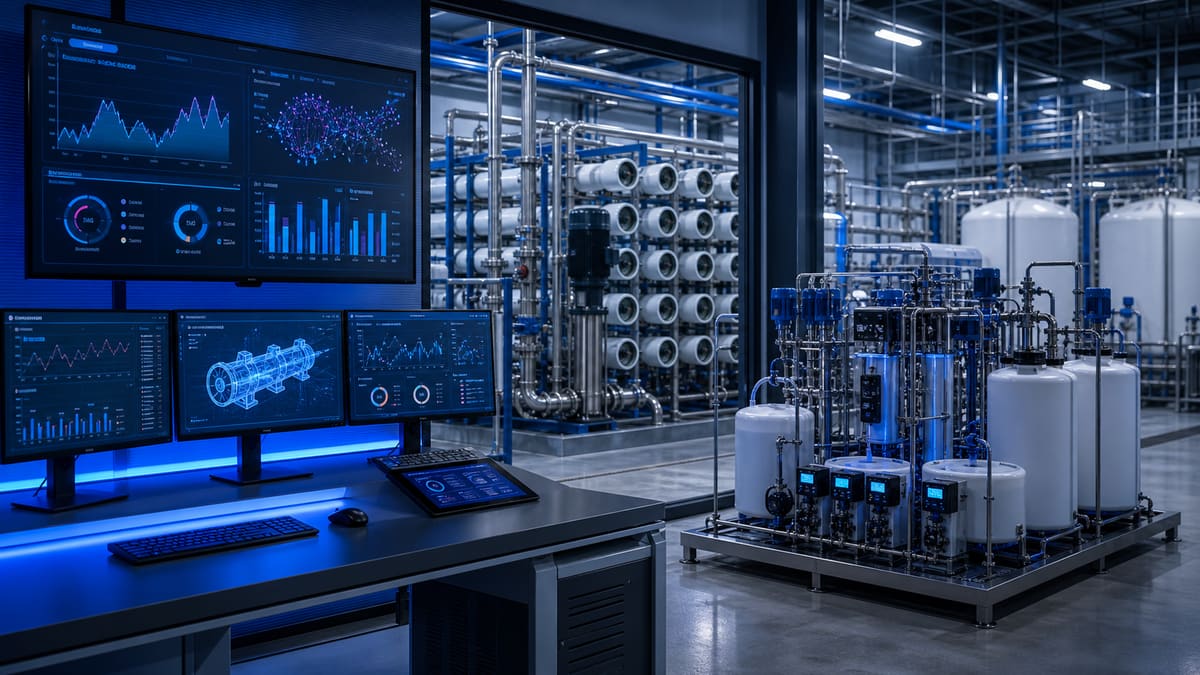
Predictive Maintenance for RO Membranes: AI-Guided Adaptive CIP Cycles
Optimizing the operation of Reverse Osmosis (RO) membrane systems is critical for consistent water quality and cost efficiency. Unplanned shutdowns due to membrane fouling or suboptimal cleaning cycles directly impact production targets and drive up operational expenses. this approach’s AI-guided adaptive Clean-in-Place (CIP) cycles bring a new level of operational certainty to your RO assets, ensuring peak performance and enhancing overall supply chain efficiency by proactively managing consumables and uptime.
The Challenge of Membrane Fouling
Membrane fouling remains one of the most significant operational challenges in RO systems. It leads to increased operating pressures, higher energy consumption, reduced permeate flux, and premature membrane degradation. Traditional approaches often rely on fixed cleaning schedules or reactive cleaning once performance has already significantly deteriorated, leading to inefficiencies and unnecessary costs.
Traditional vs engineering evaluation path
The decision to clean RO membranes has traditionally been a balancing act, often leaning towards reactive measures or conservative schedules. this approach redefines this by leveraging real-time data and AI to transform CIP from a scheduled chore into a precisely timed, adaptive process.
| Traditional way | engineering evaluation path way |
|---|---|
| - Fixed schedule or reactive: CIP performed on a rigid timetable (e.g., monthly) or only when severe performance decline is evident (e.g., 15% drop in normalized permeate flow). | - AI-driven prediction: Real-time data (flow, pressure, conductivity, temperature, differential pressure, ORP) feeds an AI model that forecasts fouling trends with high accuracy. |
| - Operator experience: Reliance on manual data logging, visual inspections, and subjective operator experience to initiate and optimize cleaning. | - Adaptive CIP cycles: AI recommends the optimal timing and intensity for CIP, precisely balancing cleaning efficacy with chemical/energy use. Proactive intervention before significant performance loss. |
| - Higher OPEX: Fixed chemical doses and cleaning durations often lead to excessive chemical and energy consumption, and frequent partial cleanings may not fully restore performance. | - Optimized resources: Dynamic adjustment of cleaning chemicals, dosage, and duration based on membrane condition, significantly reducing chemical and energy consumption by 20-30%. |
| - Risk & Uncertainty: Shorter membrane life due to irreversible fouling, unplanned downtime for emergency cleaning, and variable water quality increase operational risk. | - Extended asset life & certainty: Maximized membrane lifespan (up to 15-25% extension), minimized unplanned downtime, consistent water quality, and predictable operations. |
FAQ
Q: What is the tangible ROI for implementing this approach's predictive RO membrane maintenance, especially concerning chemical and membrane life? A: The ROI is substantial and often realized within the first year. By optimizing CIP cycles, you can expect 15-25% longer membrane lifespan, leading to reduced capital expenditure on replacements. Chemical consumption typically drops by 20-30%, alongside energy savings from lower operating pressures. These direct savings, combined with minimized downtime and consistent water quality, translate into a rapid return on investment.
Related equipment & product lines
These categories typically support the approach above—open any line to compare brands and models.
- Instrumentation & SensorsOnline measurement and control: flow, level, pressure, and water-quality sensors indexed from the Lenntech instrumentation hub.View category →
- RO MembranesReverse osmosis membrane elements for municipal and industrial desalination.View category →
- Replacement Parts / SparesGeneral replacement parts for treatment systems and subassemblies.View category →
For a closer review, use the engineering inquiry form to share feed, capacity, target, and project stage. Submission does not constitute a completed design or performance commitment.