Solutions · Digital & Smart O&M
Remote Engineering Diagnostics: AR and live video for global expert reach-in
See what the operator sees: guided inspections, markup on live video, and structured close-out—without waiting for the next flight.
Use this guide within its scope
This page supports technical research and option comparison and is marked 2026. Illustrative values are not a quotation, completed process design, certification conclusion, or performance guarantee. Check current regulations, feed data, tests, and OEM records.
Problem
Email photos lose scale, lighting, and context—misdiagnosis becomes the default remote outcome.
Technology
Session-based AR/video workflows with checklists tied to instrument readings and safety boundaries.
Results
First-time-right guidance on valve lineups, wiring checks, and sensor placement—documented for the CMMS.
Engineering decision card
Use when
Email photos lose scale, lighting, and context—misdiagnosis becomes the default remote outcome.
Evaluate first
Session-based AR/video workflows with checklists tied to instrument readings and safety boundaries.
Inputs still required
Feed source and variability, capacity, target quality, operating hours, discharge or reuse boundary, available space, and utilities.
Comparison output
First-time-right guidance on valve lineups, wiring checks, and sensor placement—documented for the CMMS. The final decision still needs feed data, mass balance, and any necessary testing.
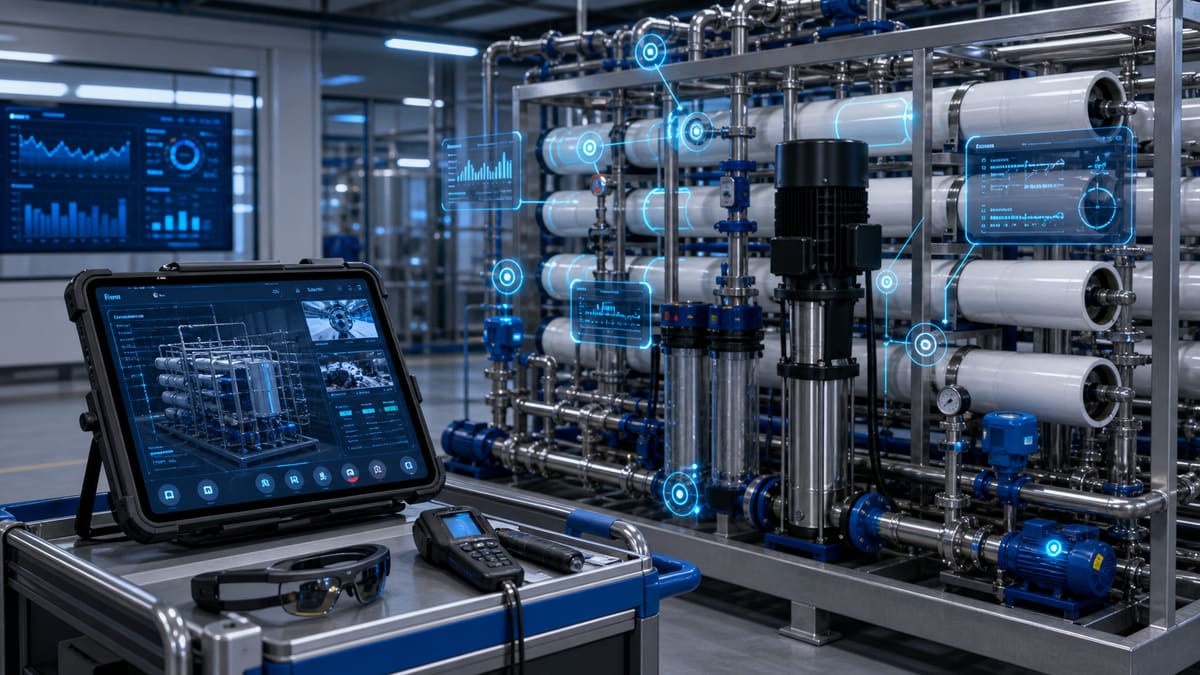
Traditional vs engineering evaluation path
Consider a complex reverse osmosis (RO) membrane system in a remote facility experiencing unexpected pressure drops and fluctuating permeate quality. Timely diagnosis is crucial to prevent irreversible membrane damage and maintain water supply.
| Traditional way | engineering evaluation path way |
|---|---|
| Problem: Plant operator suspects membrane fouling but lacks specific expertise for advanced diagnosis. | Problem: Same scenario. Plant operator initiates remote support request. |
| Expert travels: 2-5 days for visa, flights, and ground transport. | On-site technician wears AR headset, initiates live video call with engineering evaluation path expert. |
| High travel costs: Flights, accommodation, per diems, often multiple experts. | Expert sees exactly what technician sees (real-time video, augmented annotations). |
| Downtime: System runs sub-optimally or is offline awaiting expert arrival, leading to production loss and potential long-term damage. | Expert guides technician step-by-step: visually highlights specific valves, instruments, or areas for inspection using AR overlays. |
| Documentation: Manual notes, photos; potential for miscommunication or lost context after expert departs. | Expert leverages historical data (SCADA, asset history), real-time sensor readings, and guides technician through diagnostic procedures. |
| Diagnosis confirmed, precise spare parts identified, and next steps initiated within hours, not days. |
Unleashing Global Expertise, Locally
- Annotate the real world: Overlay digital instructions, schematics, or highlighted components directly onto the technician's view via AR.
- Access contextual data: Integrate live SCADA feeds, historical maintenance records, and digital twins directly into the diagnostic workflow.
- Guide precise actions: Verbally direct the technician while simultaneously showing them exactly what to do, eliminating ambiguity and reducing errors.
- Record and document: Automatically log diagnostic sessions, complete with video, audio, and expert annotations, creating an invaluable knowledge base for future reference and training.
This capability is critical for complex assets like high-pressure pumps, sophisticated filtration skids, or advanced instrumentation arrays where specialized knowledge is scarce and downtime is costly. It also facilitates efficient commissioning, allowing remote engineers to oversee and validate new installations without being physically present.
Instrumentation and Data Context
Effective remote diagnostics are fundamentally dependent on reliable, real-time data from your plant's instrumentation. Without accurate readings from online instruments—such as flow meters, pressure transducers, conductivity probes, ORP sensors, and level indicators—even the best visual information from AR can only provide a partial picture. These sensors provide the objective "truth" that augments the subjective visual inspection, allowing remote experts to correlate observed issues with process parameters. This integrated view ensures that diagnoses are not just visual but data-driven, leading to more precise and effective solutions.
Data Security and Trust
- Data at rest encrypted: All stored session recordings and metadata are encrypted.
- Role-based access control (RBAC): Granular permissions ensure only authorized personnel can access specific data streams or past sessions.
- Auditable logs: Comprehensive audit trails track all user activities and data access.
- Compliance-ready architecture: Designed to support regulatory requirements for data handling in critical infrastructure.
engineering evaluation path Differentiation: Holistic Problem Solving
This holistic approach ensures that problems are not just diagnosed remotely but are solved efficiently, from expert consultation through to part replacement and operational validation.
Related equipment & product lines
These categories typically support the approach above—open any line to compare brands and models.
- Instrumentation & SensorsOnline measurement and control: flow, level, pressure, and water-quality sensors indexed from the Lenntech instrumentation hub.View category →
- Replacement Parts / SparesGeneral replacement parts for treatment systems and subassemblies.View category →
- Pilot Units TestingPilot rigs and trial modules for process validation and feasibility studies.View category →
For a closer review, use the engineering inquiry form to share feed, capacity, target, and project stage. Submission does not constitute a completed design or performance commitment.