Solutions · Digital & Smart O&M
VMI (Vendor Managed Inventory): near-zero on-site stock for cartridges and treatment chemicals
Consumption-led replenishment for large plants: fewer stockouts, less dead inventory, and auditable handoffs between procurement and operations.
Use this guide within its scope
This page supports technical research and option comparison and is marked 2026. Illustrative values are not a quotation, completed process design, certification conclusion, or performance guarantee. Check current regulations, feed data, tests, and OEM records.
Problem
Plants either hoard cash in shelves or run out mid-batch—procurement and operations rarely share one signal.
Technology
Vendor-managed cadence tied to usage telemetry and agreed min/max policies.
Results
Working capital freed without sacrificing uptime; fewer emergency air-freight stories.
Engineering decision card
Use when
Plants either hoard cash in shelves or run out mid-batch—procurement and operations rarely share one signal.
Evaluate first
Vendor-managed cadence tied to usage telemetry and agreed min/max policies.
Inputs still required
Feed source and variability, capacity, target quality, operating hours, discharge or reuse boundary, available space, and utilities.
Comparison output
Working capital freed without sacrificing uptime; fewer emergency air-freight stories. The final decision still needs feed data, mass balance, and any necessary testing.
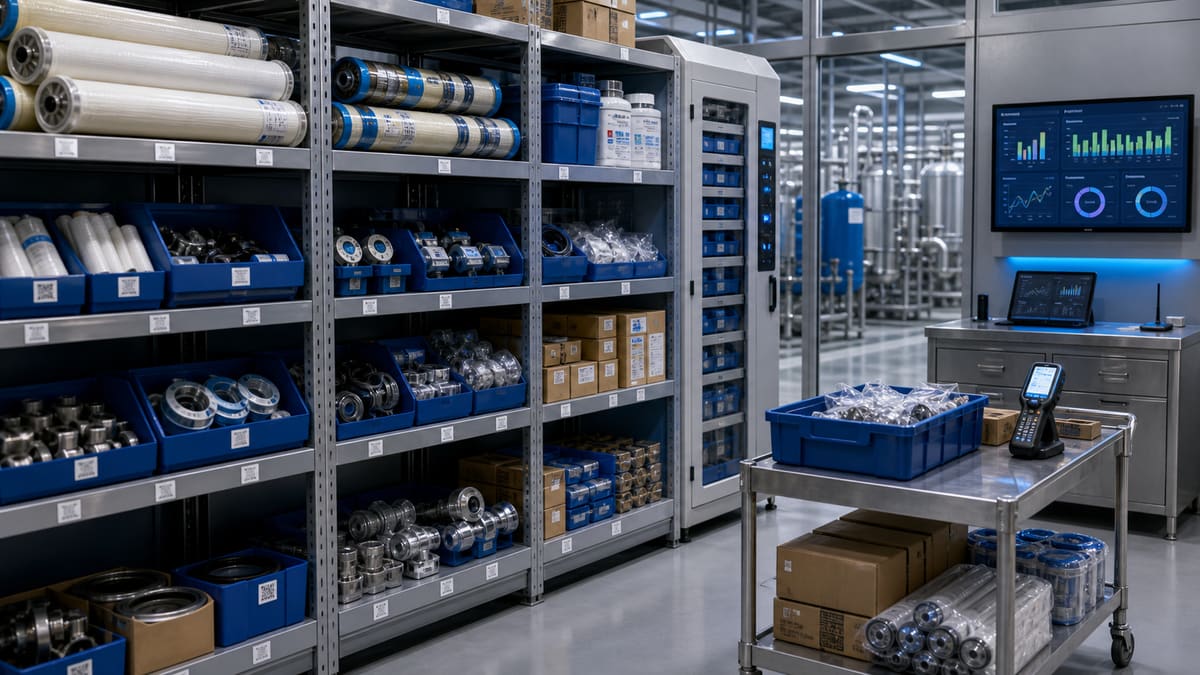
VMI (Vendor Managed Inventory): Near-Zero On-Site Stock for Cartridges and Treatment Chemicals
Achieving both operational certainty and supply-chain efficiency in water treatment plants often feels like a balancing act. Vendor Managed Inventory (VMI) fundamentally shifts this paradigm, transforming material procurement from a reactive burden into a proactive, data-driven service. For critical consumables like filter cartridges and treatment chemicals, VMI ensures that essential supplies are always available when needed, minimizing on-site stock and optimizing capital expenditure.
Traditional vs engineering evaluation path
| Traditional way | engineering evaluation path way |
|---|---|
| Reactive ordering: Manual inventory checks, often leading to rush orders or stockouts. | Proactive replenishment: Consumption data from online sensors triggers automated reorder points, ensuring timely delivery. |
| High on-site stock: Large safety stocks held on-site to mitigate long lead times and unpredictable usage, tying up capital and storage space. | Near-zero on-site stock: Optimized delivery schedules reduce physical inventory to minimal buffers, freeing up capital and space. |
| Fragmented data: Disconnected purchasing, logistics, and operational data, making it hard to predict future needs or optimize inventory. | Integrated intelligence: Consolidated consumption, inventory, and logistics data provides end-to-end visibility and predictive analytics. |
Data Security & Trust in 2026
- AES-256 encryption for all data in transit and at rest.
- Role-based access control (RBAC) ensures only authorized personnel can view or modify specific data points.
- Regular security audits and penetration testing by independent third parties.
- Compliance with industry standards (e.g., ISO 27001, NIST frameworks).
Instrumentation & Sensors: The Foundation of Smart VMI
These instruments provide the "truth from the field," enabling a closed-loop system where physical consumption automatically triggers intelligent replenishment, minimizing human error and maximizing efficiency.
Related equipment & product lines
These categories typically support the approach above—open any line to compare brands and models.
- Instrumentation & SensorsOnline measurement and control: flow, level, pressure, and water-quality sensors indexed from the Lenntech instrumentation hub.View category →
- Activated CarbonPowdered and granular activated carbon (PAC/GAC) for adsorption of organics, odor, and trace contaminants.View category →
- Ion Exchange ResinsCation/anion and mixed bed resin solutions for demineralization and polishing.View category →
For a closer review, use the engineering inquiry form to share feed, capacity, target, and project stage. Submission does not constitute a completed design or performance commitment.