Solutions · Industry Solutions
Cooling tower blowdown recovery: cut makeup and chemical load
Treat CT blowdown for chloride, cycles of concentration, and scaling risk: RO, softening, and chemical programs that protect metallurgy while recovering water.
Use this guide within its scope
This page supports technical research and option comparison and is marked 2026. Illustrative values are not a quotation, completed process design, certification conclusion, or performance guarantee. Check current regulations, feed data, tests, and OEM records.
Problem
Rising cycles drive chloride and scaling stress on metallurgy; discharging blowdown wastes water and salts while tightening permits squeeze disposal options.
Technology
Side-stream softening or RO on blowdown, controlled cycles with real-time conductivity, and biocide strategies compatible with reuse trains.
Results
Lower fresh makeup, fewer corrosion events, and documented water balance for ESG and utility reporting.
Engineering decision card
Use when
Rising cycles drive chloride and scaling stress on metallurgy; discharging blowdown wastes water and salts while tightening permits squeeze disposal options.
Evaluate first
Side-stream softening or RO on blowdown, controlled cycles with real-time conductivity, and biocide strategies compatible with reuse trains.
Inputs still required
Feed source and variability, capacity, target quality, operating hours, discharge or reuse boundary, available space, and utilities.
Comparison output
Lower fresh makeup, fewer corrosion events, and documented water balance for ESG and utility reporting. The final decision still needs feed data, mass balance, and any necessary testing.
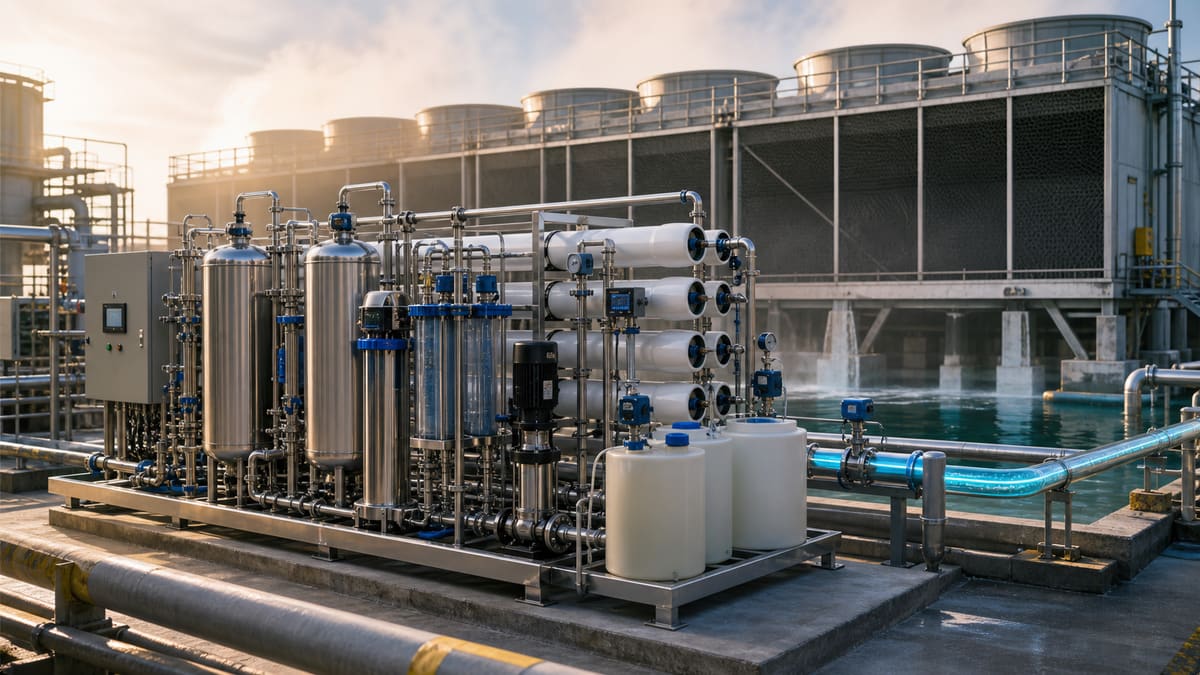
Cooling towers are vital for heat rejection in countless industrial processes, from power generation and manufacturing to data centers. However, as water evaporates, non-volatile dissolved solids (TDS), chlorides, and scaling species concentrate within the circulating water. This necessitates a controlled discharge, known as blowdown, to prevent severe scaling, corrosion, and biological fouling within the tower and heat exchangers. Historically, this blowdown has been routed to drain, representing a significant loss of water and treated chemicals. this approach’s advanced solutions enable effective recovery of this blowdown, transforming a waste stream into a valuable resource.
Industry Challenges and Regulatory Drivers
The concentration of TDS, chloride, and particularly scaling species like calcium, magnesium, silica, and sulfates, is an inherent operational challenge for cooling towers. While essential, blowdown acts as the system's relief valve; insufficient blowdown inevitably leads to rapid scale formation and under-deposit corrosion, compromising heat transfer efficiency and equipment lifespan. Conversely, excessive blowdown wastes significant volumes of water and the associated treatment chemicals.
Industries face increasing pressure to reduce their environmental footprint and operational costs. Scarce water resources, escalating municipal water tariffs, and stringent local environmental discharge permits (which often impose limits on effluent TDS, chlorides, and specific pollutants) are driving the demand for cooling tower blowdown recovery. Projects focused on reusing blowdown must overcome several technical hurdles, including high scaling potential, biofouling risks from cooling water biocides, and metallurgical compatibility limits on elevated chloride levels in reused streams.
Water Quality Targets for Permeate Reuse
The target water quality for recovered cooling tower blowdown depends entirely on its intended reuse. Common reuse applications include:
- Return to Cooling Tower (Makeup): The most common and direct reuse. Permeate quality must be low in TDS, hardness, and silica to prevent excessive concentration and scaling within the tower, thereby increasing cycles of concentration. Conductivity targets are typically below 100-200 µS/cm, with hardness below 1 mg/L as CaCO₃.
- General Utility Water: For non-critical processes like washdowns or irrigation. Quality requirements are less stringent but still necessitate significant TDS rejection.
- Boiler Feedwater Makeup (after further polishing): Requires very high purity, often demanding conductivity below 1 µS/cm, silica below 20 ppb, and hardness essentially zero. This usually necessitates post-RO ion exchange or EDI. (Refer to ASME/IAPWS standards for specific boiler feedwater quality guidelines).
- Process Water: Quality is highly specific to the industrial process.
this approach rigorously characterizes both the makeup water and the cooling tower blowdown stream to define achievable maximum cycles of concentration for the tower and optimal permeate quality for reuse, always with metallurgist sign-off on chloride limits where applicable.
Pretreatment: The Foundation of Reliable Operation
Given the high concentration of suspended solids, scaling precursors, and potential biofouling agents in cooling tower blowdown, meticulous pretreatment is paramount to protect downstream membrane systems.
Post-Treatment (Optional)
- Degasification: If RO permeate is returned directly to the tower, or used as boiler feed, it may require degasification to remove dissolved CO₂, which can lower pH and increase corrosivity.
- Ion Exchange (IX) or Continuous Electrodeionization (CEDI): For applications requiring ultrapure water (e.g., boiler feed, process water), further polishing using mixed-bed ion exchange or CEDI will reduce conductivity to sub-µS/cm levels and remove residual trace ions. CEDI uses an electric field and ion-selective membranes to continuously regenerate ion-exchange resin, producing high-purity water without the need for chemical regenerants. It generates a small concentrate stream and a very dilute electrode rinse stream.
- UV Sterilization: As a final safeguard for microbial control before reuse, a UV reactor can be installed.
Risks and Common Engineering Mistakes
- Inadequate Pretreatment: The single most common cause of RO membrane failure and poor performance in blowdown recovery. Failure to address high SDI, hardness, and biofouling leads to rapid membrane scaling and biofouling.
- Overly Aggressive Recovery Rates: Pushing RO recovery rate beyond the limits dictated by LSI and silica solubility in the concentrate stream will inevitably lead to severe scaling.
- Incorrect Chemical Selection: Use of incompatible antiscalants, or biocides that damage polyamide membranes, can cause irreversible membrane damage.
- Poor Water Balance Management: Failure to accurately characterize makeup and blowdown, or to properly manage blend points for permeate return, can lead to new operational challenges in the cooling tower.
- Neglecting Material Compatibility: Reusing higher-chloride streams without considering the metallurgy of downstream equipment can lead to accelerated corrosion.
Related equipment & product lines
These categories typically support the approach above—open any line to compare brands and models.
- RO MembranesReverse osmosis membrane elements for municipal and industrial desalination.View category →
- ChemicalsAntiscalants, cleaners, and process chemicals for water treatment operations.View category →
- Cooling TowersCooling tower treatment and related process support equipment.View category →
- Instrumentation & SensorsOnline measurement and control: flow, level, pressure, and water-quality sensors indexed from the Lenntech instrumentation hub.View category →
For a closer review, use the engineering inquiry form to share feed, capacity, target, and project stage. Submission does not constitute a completed design or performance commitment.