Solutions · Industry Solutions
Landfill leachate: ammonia, organics, and refractory COD
Old vs new landfill leachate: MBR, biological ammonia control, oxidation, activated carbon, and RO concentrate management.
Use this guide within its scope
This page supports technical research and option comparison and is marked 2026. Illustrative values are not a quotation, completed process design, certification conclusion, or performance guarantee. Check current regulations, feed data, tests, and OEM records.
Problem
Aging landfills shift leachate to more recalcitrant, high-ammonia matrices; naive RO projects fail on fouling and concentrate disposal.
Technology
Biological front ends, MBR polish, targeted oxidation, GAC adsorption, and RO only with pretreatment and concentrate plan.
Results
Permit compliance with realistic opex and a defined concentrate destiny.
Engineering decision card
Use when
Aging landfills shift leachate to more recalcitrant, high-ammonia matrices; naive RO projects fail on fouling and concentrate disposal.
Evaluate first
Biological front ends, MBR polish, targeted oxidation, GAC adsorption, and RO only with pretreatment and concentrate plan.
Inputs still required
Feed source and variability, capacity, target quality, operating hours, discharge or reuse boundary, available space, and utilities.
Comparison output
Permit compliance with realistic opex and a defined concentrate destiny. The final decision still needs feed data, mass balance, and any necessary testing.
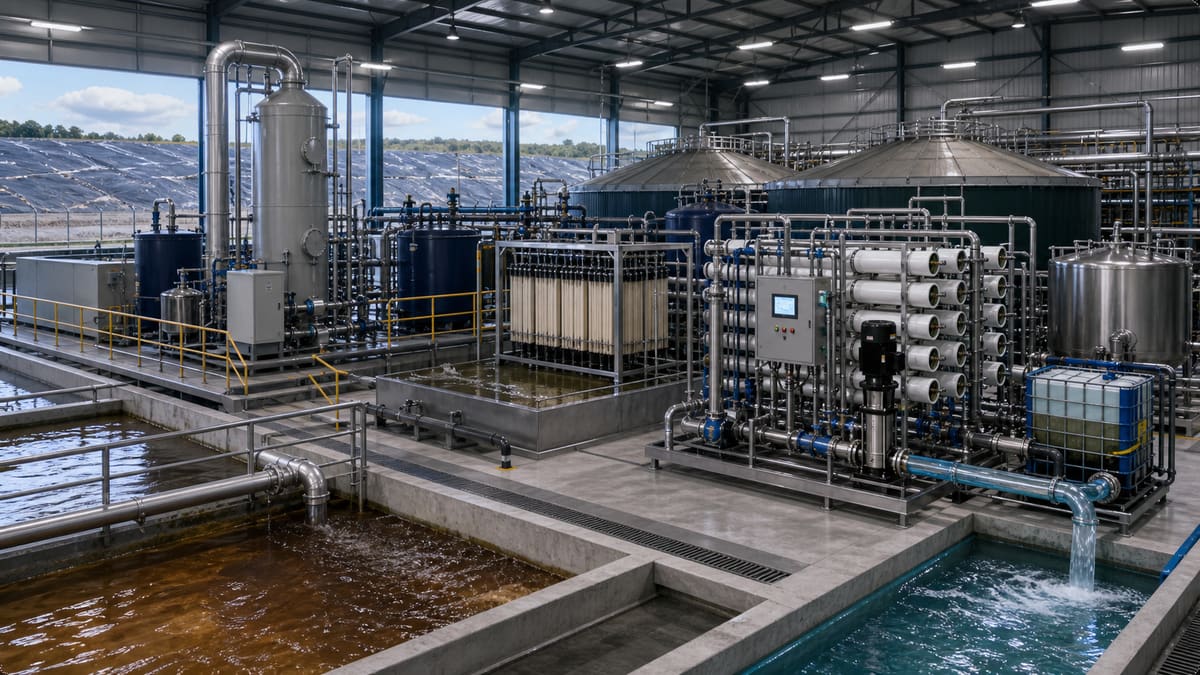
Landfill Leachate: Ammonia, Organics, and Refractory COD – engineering evaluation path Advanced Treatment Solutions
Landfill leachate represents one of the most challenging wastewaters to treat, characterized by its highly variable and complex composition. This matrix changes significantly over the lifespan of a landfill, evolving from young, high-BOD (Biochemical Oxygen Demand) flows to mature streams dominated by high concentrations of ammonia, refractory COD (Chemical Oxygen Demand), heavy metals, and emerging contaminants like PFAS (Per- and Polyfluoroalkyl Substances). Effective treatment is crucial for environmental protection, compliance with stringent discharge regulations, and potential resource recovery.
Industry Context & Regulatory/Compliance Drivers
The highly heterogeneous nature of landfill leachate presents a significant challenge. Its composition is influenced by waste type, age, precipitation, and landfill management practices. Regulatory frameworks worldwide, such as local environmental agency discharge permits, the EU's Industrial Emissions Directive (IED), or the US EPA's effluent guidelines, increasingly demand sophisticated treatment to mitigate environmental impact. These regulations often impose strict limits on parameters like ammonia-nitrogen (NH₃-N), BOD₅, COD, TSS (Total Suspended Solids), heavy metals, and increasingly, specific organic micropollutants and PFAS compounds.
Water Quality Targets
Water quality targets for treated leachate vary depending on the ultimate destination:
- Direct Discharge: Compliance with local authority limits, typically requiring BOD₅ < 20-30 mg/L, COD < 100-200 mg/L, NH₃-N < 10-20 mg/L, TSS < 10-30 mg/L, and often specific limits for heavy metals and conductivity.
- Sewer Discharge: May have less stringent requirements but still needs significant pollutant reduction.
- Reuse (e.g., irrigation, industrial process water): Demands higher quality, often approaching drinking water standards for specific parameters, requiring advanced polishing.
- Re-injection to Landfill: Requires careful consideration of scaling and compatibility with the landfill's geochemistry to avoid long-term operational issues.
Achieving these targets consistently, despite fluctuating raw leachate quality, is the core objective of this approach's engineering.
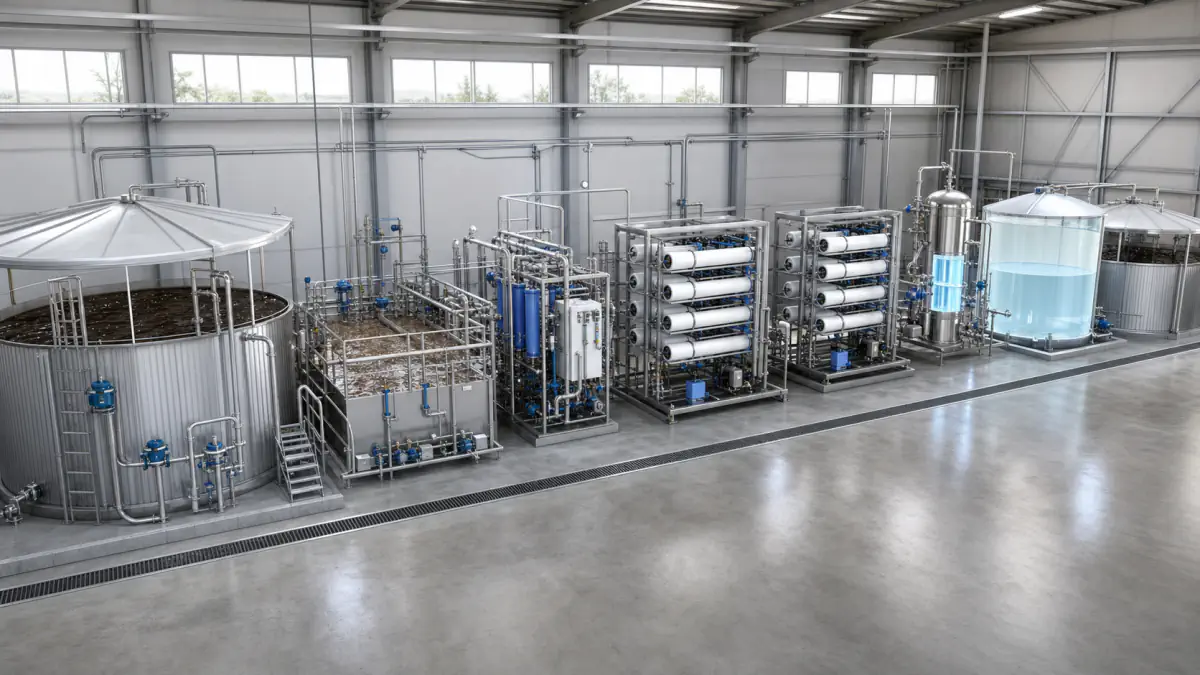
Process Train Description: engineering evaluation path Multi-Barrier Approach
-
Pre-treatment & Equalization: Initial screening (e.g., 2-3 mm) removes gross solids. An equalization tank is crucial to buffer variations in flow, pH, and pollutant load, providing a consistent feed for downstream biological processes. pH adjustment may be applied here.
-
Advanced Oxidation Processes (AOPs) & Adsorption: Following biological treatment, refractory COD, color, and emerging contaminants (including PFAS) often remain.
- AOPs: Processes like ozonation, UV/H₂O₂ (ultraviolet with hydrogen peroxide), or Fenton's oxidation effectively break down complex, recalcitrant organic molecules that biological processes cannot handle. This significantly reduces the organic fouling potential for downstream RO membranes.
- Adsorption: Granular Activated Carbon (GAC) or Powdered Activated Carbon (PAC) adsorption is highly effective for removing residual trace organics, micropollutants, and PFAS compounds, especially when regulatory limits are stringent.
-
Concentrate Management: The concentrate stream from RO is a major consideration. this approach engineers solutions for concentrate disposal, which may include:
- Recirculation to landfill: Careful evaluation of scaling potential and impact on landfill geochemistry.
- Evaporation/Crystallization: For zero liquid discharge (ZLD) scenarios, though capital and operating costs are high.
- Further treatment: For specific pollutant removal before off-site disposal.
- Energy Recovery Devices (ERD): For high-pressure RO systems, especially those treating high-salinity leachate, ERDs can significantly reduce specific energy consumption (kWh/m³ permeate) by recovering hydraulic energy from the concentrate stream and transferring it back to the feed.
Operations, Monitoring, and CIP Philosophy
this approach's operational philosophy for leachate treatment centers on proactive maintenance and data-driven decision-making. Continuous monitoring of critical parameters is essential:
- Transmembrane Pressure (TMP): For UF and MBR, increasing TMP indicates membrane fouling.
- Normalized Permeate Flow (NPF): For RO, tracking NPF allows early detection of membrane fouling or scaling, distinguishing it from changes due to temperature or pressure fluctuations.
- Differential Pressure (ΔP): Across RO stages and pre-filters, indicating fouling.
- Water Quality: Conductivity, pH, ORP, turbidity, and online analyzers for NH₃-N and COD ensure consistent performance and regulatory compliance.
Risks and Common Engineering Mistakes
- Underestimating Leachate Variability: Failing to account for wide fluctuations in flow, organic load, ammonia, and salinity leads to undersized or improperly designed systems.
- Inadequate Pretreatment: Placing RO directly after minimal pretreatment is a common, costly mistake. High SDI, organic load, and biological activity will rapidly foul RO membranes, leading to frequent CIP, high chemical usage, and premature membrane replacement.
- Concentrate Disposal Oversight: Not planning for the concentrate stream from RO leads to significant long-term operational and cost implications.
- Biofouling: Leachate is rich in nutrients, making biofouling a constant threat. Inadequate biocide dosing, poor system design, or insufficient CIP can lead to irreversible membrane damage.
- Scaling: High recovery RO systems on leachate are prone to inorganic scaling (CaCO₃, CaSO₄, SiO₂). Incorrect antiscalant selection or dosage, or ignoring LSI trends, results in scale formation and reduced performance.
- Energy Consumption: Treatment of high-strength leachate, particularly with high-pressure RO, can be energy-intensive. Neglecting energy efficiency measures increases operational expenditure and ESG impact.
Frequently Asked Questions
Q: Is DTRO (Disc Tube Reverse Osmosis) mandatory for leachate treatment? A: Not always. While DTRO is robust against high suspended solids and is often considered for challenging leachate, conventional spiral-wound RO elements can perform exceptionally well when the leachate is adequately pretreated by MBR and UF. DTRO typically features higher capital and operating costs; spiral-wound RO becomes a viable and often more economical option with proper upstream protection.
Q: Can we avoid biological treatment steps for ammonia removal? A: Rarely economically feasible for high ammonia concentrations. Ammonia removal via chemical means (e.g., breakpoint chlorination, air stripping) is typically far more expensive in terms of chemical consumption and energy than biological nitrification/denitrification, especially in the long term. Biological processes, particularly MBRs, offer a sustainable and cost-effective solution for significant ammonia reduction.
Related equipment & product lines
These categories typically support the approach above—open any line to compare brands and models.
- Ozone GeneratorOzone generation systems and peripherals for advanced oxidation processes.View category →
- Activated CarbonPowdered and granular activated carbon (PAC/GAC) for adsorption of organics, odor, and trace contaminants.View category →
- RO MembranesReverse osmosis membrane elements for municipal and industrial desalination.View category →
- UF ModulesUltrafiltration modules for suspended solids and colloid removal.View category →
For a closer review, use the engineering inquiry form to share feed, capacity, target, and project stage. Submission does not constitute a completed design or performance commitment.