Solutions · Industry Solutions
Mining & mineral processing: acid drainage and metals load reduction
Acid mine drainage and flotation plant water: pH adjustment, metals precipitation, solids separation, and membrane steps for sulfate and TDS management.
Use this guide within its scope
This page supports technical research and option comparison and is marked 2026. Illustrative values are not a quotation, completed process design, certification conclusion, or performance guarantee. Check current regulations, feed data, tests, and OEM records.
Problem
Low pH, metals, and sulfate stress conventional lime plants and create membrane scaling when recovery is pushed without ionic mapping.
Technology
Active and passive treatment options, high-density sludge practices, targeted metals recovery, and selective membrane/nanofiltration for sulfate where justified.
Results
Permit-stable effluent, lower sludge volumes per kg metal removed in optimized trains, and clearer solids handling paths.
Engineering decision card
Use when
Low pH, metals, and sulfate stress conventional lime plants and create membrane scaling when recovery is pushed without ionic mapping.
Evaluate first
Active and passive treatment options, high-density sludge practices, targeted metals recovery, and selective membrane/nanofiltration for sulfate where justified.
Inputs still required
Feed source and variability, capacity, target quality, operating hours, discharge or reuse boundary, available space, and utilities.
Comparison output
Permit-stable effluent, lower sludge volumes per kg metal removed in optimized trains, and clearer solids handling paths. The final decision still needs feed data, mass balance, and any necessary testing.
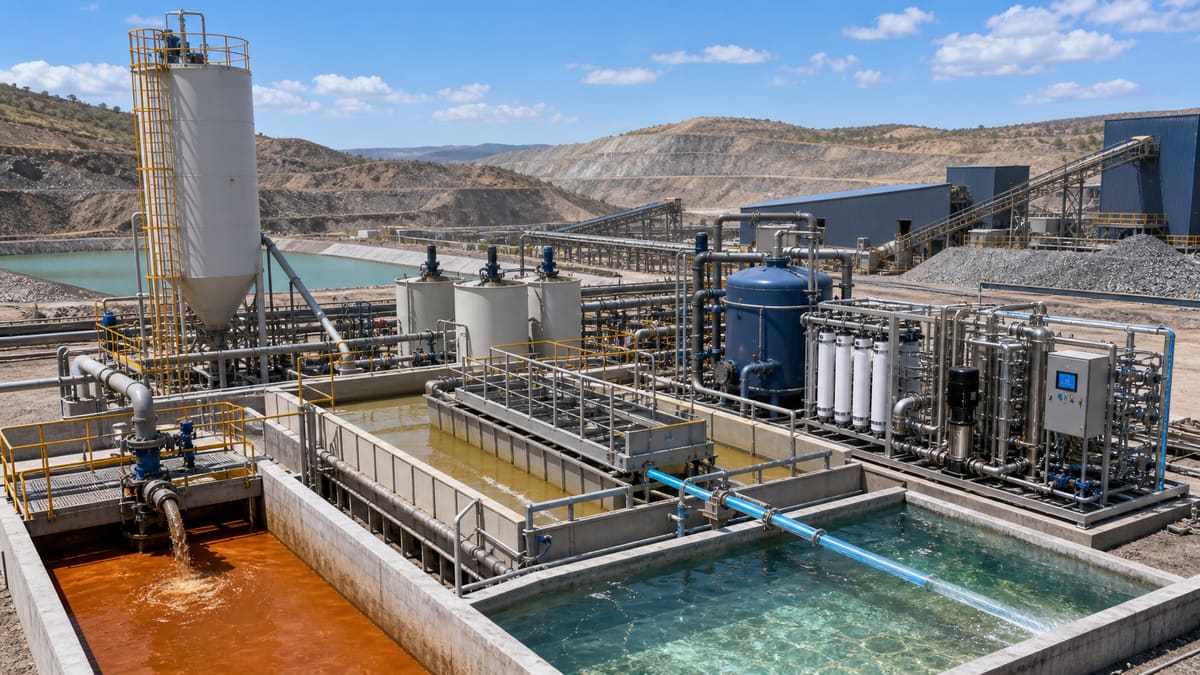
Mining & Mineral Processing: Acid Drainage and Metals Load Reduction
The mining and mineral processing sectors are foundational to modern industry, yet they confront significant environmental stewardship challenges, particularly concerning water management. The generation of acid rock drainage (ARD), process wastewaters from flotation and beneficiation, and contact water from tailings storage facilities presents a complex cocktail of pollutants. These typically include high concentrations of dissolved metals (e.g., copper, zinc, nickel, lead, arsenic, cadmium), elevated sulfate levels, and varying degrees of total suspended solids (TSS). Operational complexities are further compounded by variable flow rates influenced by seasonal rainfall and snowmelt, demanding robust and adaptable treatment solutions.
Water Quality Targets
Water quality targets in mining are multifaceted, driven by:
- Discharge Compliance: Adherence to local environmental permits, which can dictate limits for pH (typically 6.0-9.0), TSS (<10-30 mg/L), and specific metals (e.g., Cu, Zn, Ni, As often <0.1 mg/L, sometimes much lower). Sulfate limits might range from 200-2,000 mg/L.
- Process Water Reuse: Treated water may be recycled back into grinding, flotation, or dust suppression. This demands careful consideration of scaling potential (e.g., calcium sulfate, silica), corrosion risks, and the impact of dissolved ions on process chemistry.
- Ultrapure Water (UPW) for Niche Applications: While less common for bulk mining processes, some specialized mining or processing steps, such as in semiconductor materials extraction, might require UPW. For such cases, water quality would need to conform to standards like ASTM D5127-13 Type E-1.2, requiring resistivity of >16 MΩ·cm and very low TOC.
engineering evaluation path Technical Approach: From Characterization to Compliance
Our approach begins with a comprehensive understanding of the wastewater matrix. Initial characterization involves detailed composite sampling across different weather conditions to analyze the full spectrum of pollutants: dissolved and particulate metals, sulfate, silica, fluoride, and organic compounds from flotation reagents or explosives. This critical first step informs the entire process design.
Process Train Description
-
Primary Treatment: Chemical Precipitation & Solids Separation The first line of defense typically involves chemical precipitation to remove the bulk of heavy metals and suspended solids. High-density sludge (HDS) processes or integrated chemical precipitation strategies are favored due to their efficiency in metal removal and reduction in sludge volume compared to conventional lime treatment.
- Neutralization: pH adjustment with lime or caustic precipitates multivalent metal hydroxides and often calcium sulfate.
- Coagulation/Flocculation: Polymer addition aids in agglomerating fine particles and precipitates into larger flocs.
- Sedimentation/Clarification: These larger flocs are then separated via gravity. High-rate clarifiers or settlers are often employed.
-
Secondary Treatment: Advanced Solids & Colloids Removal Following primary treatment, water often requires further polishing, especially if membrane processes are downstream. The goal here is to reduce TSS and colloidal matter that could lead to fouling of subsequent membrane stages.
- Multimedia Filtration (MMF): For water with residual TSS, MMF effectively reduces turbidity.
- Ultrafiltration (UF): For challenging surface water sources or process waters with high colloidal content and an SDI₁₅ (Silt Density Index) consistently above 5, ultrafiltration is essential. UF membranes provide an absolute barrier, ensuring virtually complete removal of suspended solids, colloids, bacteria, and large organic molecules, protecting downstream reverse osmosis (RO) membranes from biofouling and particulate fouling.
-
Specialized Polishing (e.g., for Selenium or Specific Metals) For contaminants like selenium, which are not effectively removed by chemical precipitation or RO alone, specialized processes may be required. These often include biological treatment (e.g., anoxic bioreactors) or adsorptive media. These are integrated as necessary based on initial water characterization.
Related equipment & product lines
These categories typically support the approach above—open any line to compare brands and models.
- ChemicalsAntiscalants, cleaners, and process chemicals for water treatment operations.View category →
- Filtration MediaGranular and specialty media for depth filtration and polishing stages.View category →
- RO MembranesReverse osmosis membrane elements for municipal and industrial desalination.View category →
- Pumps & PumpingHigh-pressure and process pump solutions for water treatment skids and plants.View category →
For a closer review, use the engineering inquiry form to share feed, capacity, target, and project stage. Submission does not constitute a completed design or performance commitment.