Illustrated guides
How does reverse osmosis remove salt?
Start with a cutaway spiral-wound element and follow how pressurized feed becomes low-salinity permeate and concentrated reject—and why osmotic pressure, recovery, and concentration polarization set the operating boundary.
Core takeaway
RO does not simply sieve salt out. Net pressure above the osmotic-pressure difference drives water preferentially through a dense selective layer while more salt remains on the concentrate side.
Start here: osmosis and reverse osmosis move in opposite directions
Across a semipermeable membrane, water naturally moves toward the more concentrated solution. Sufficient pressure on that side reverses the water flow.
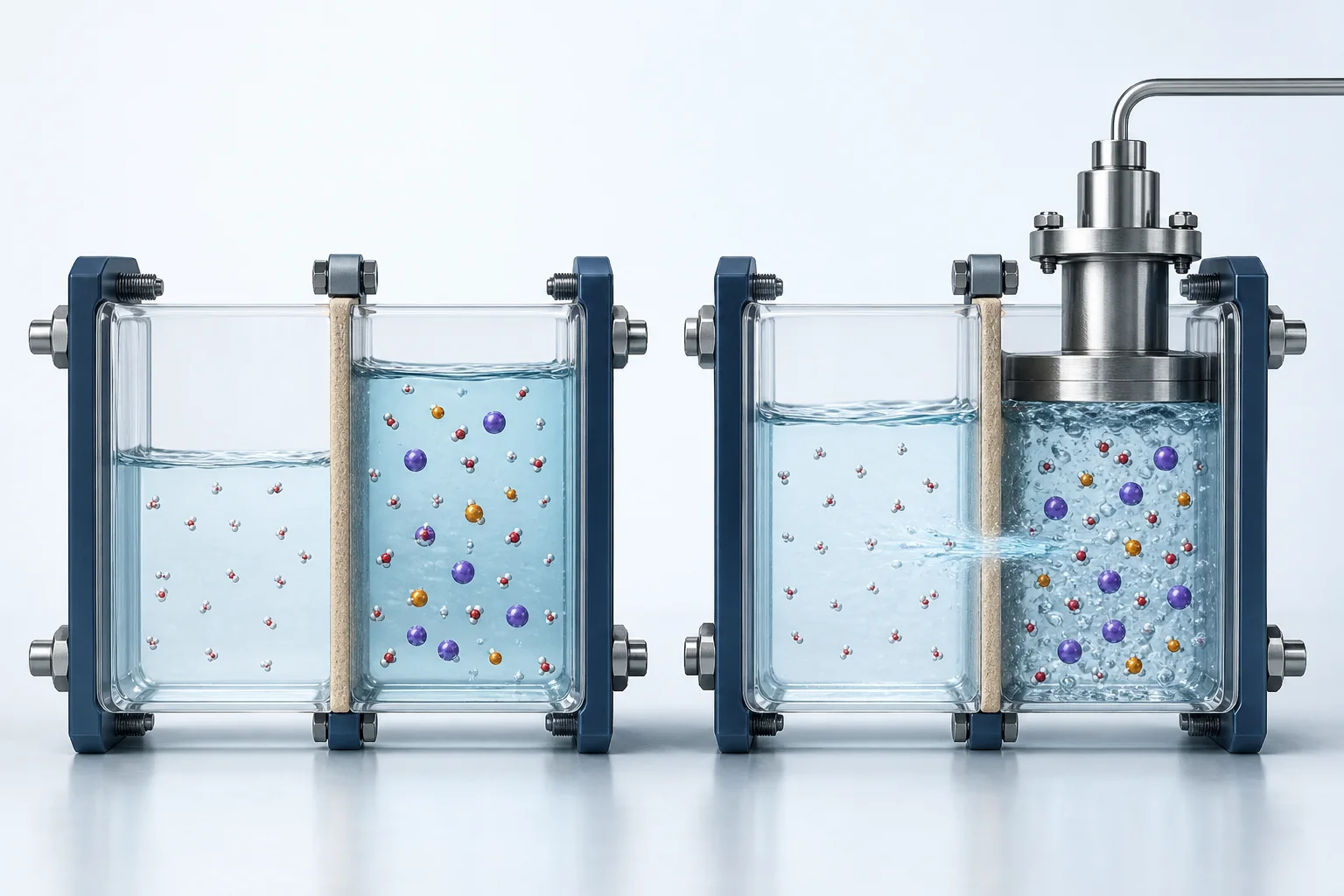 1 · Start here: osmosis and reverse osmosis move in opposite directions
Water paths inside a spiral-wound RO element
Pressurized feed moves across the membrane leaves. Some water crosses the selective layer and enters the permeate tube; the remaining stream carries retained salts out as concentrate.
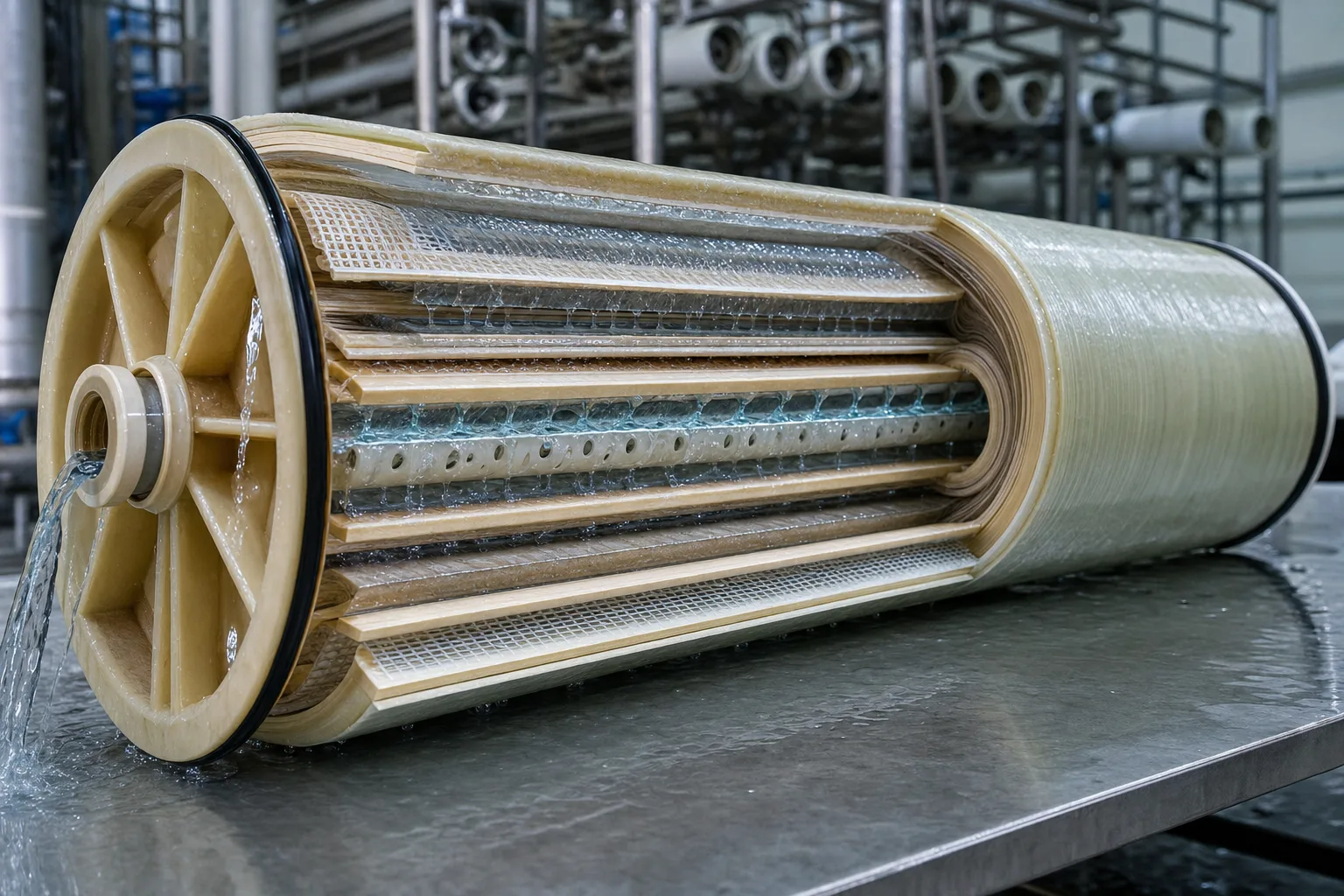 2 · Water paths inside a spiral-wound RO element
- 1. Pressurized feedThe high-pressure pump supplies pressure to overcome osmotic pressure and hydraulic losses.
- 2. Selective layerWater preferentially crosses the dense layer while most dissolved salts remain on the feed side.
- 3. Permeate tubeWater that crosses the membrane travels through the permeate spacer into the center tube.
- 4. Concentrate outletThe remaining flow leaves with a higher concentration of salts and retained contaminants.
Desalination in three steps
- 1
Pressurize and establish crossflow
A high-pressure pump sends feed into the pressure vessel. Water continues along the membrane surface instead of all striking it perpendicularly, helping carry retained salt downstream.
- 2
Water crosses the selective layer
In a common thin-film composite RO membrane, water moves through the dense polyamide layer by a solution–diffusion process; hydrated ions and many solutes have much lower permeability.
- 3
Separate permeate and concentrate
Water that crosses the membrane enters the center tube. Water that does not cross continues forward and becomes more saline concentrate.
Zoom into the membrane: why can water pass while most salt remains?
The dense polyamide selective layer is not an ordinary screen. Water can dissolve and diffuse through the material, while hydrated ions and many solutes have far lower permeability.
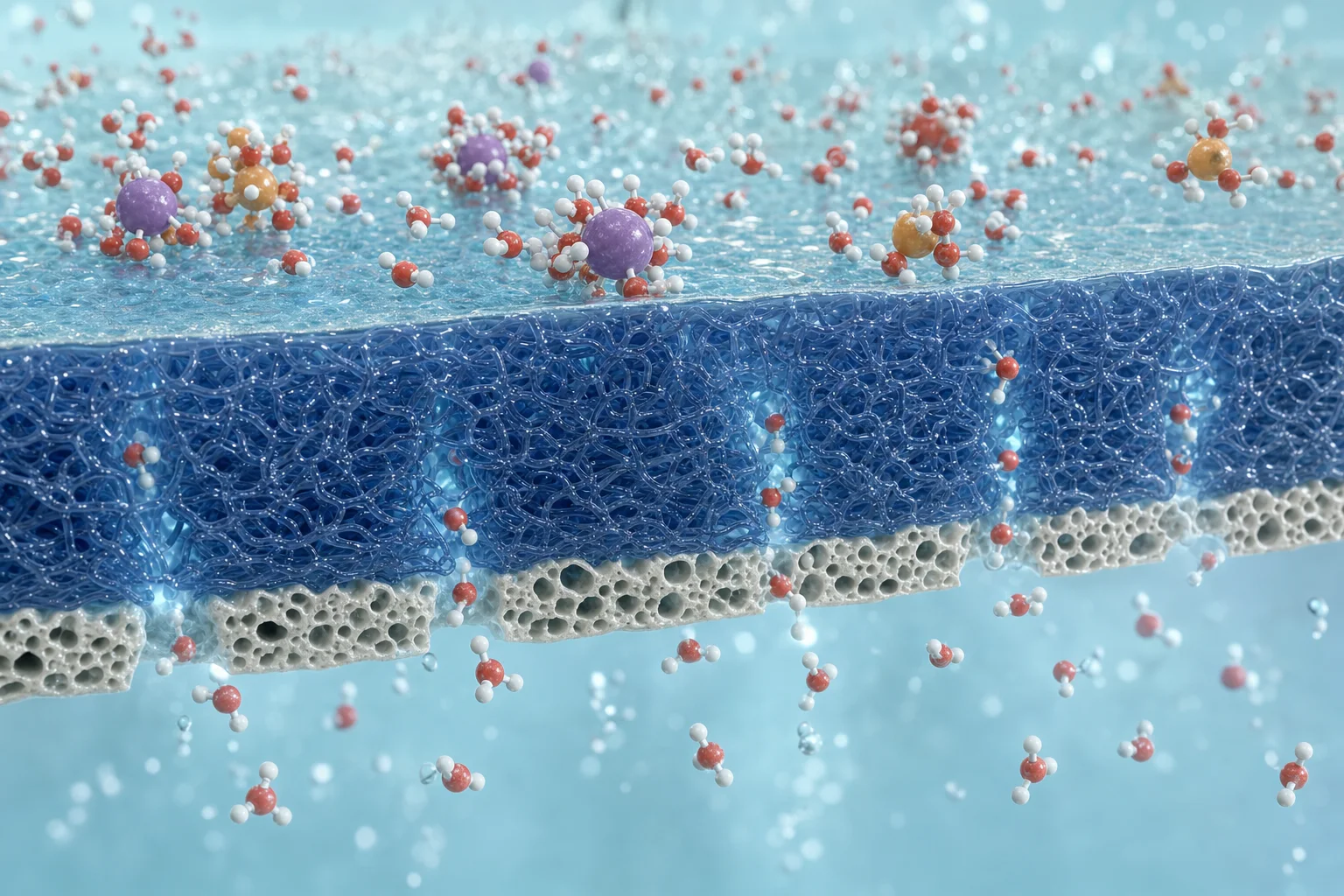 3 · Zoom into the membrane: why can water pass while most salt remains?
Pressure changes the net driving force
Natural osmosis tends to move water toward the more concentrated solution. RO applies hydraulic pressure to reverse that tendency; only the pressure remaining after osmotic-pressure difference and other losses actually drives permeate production.
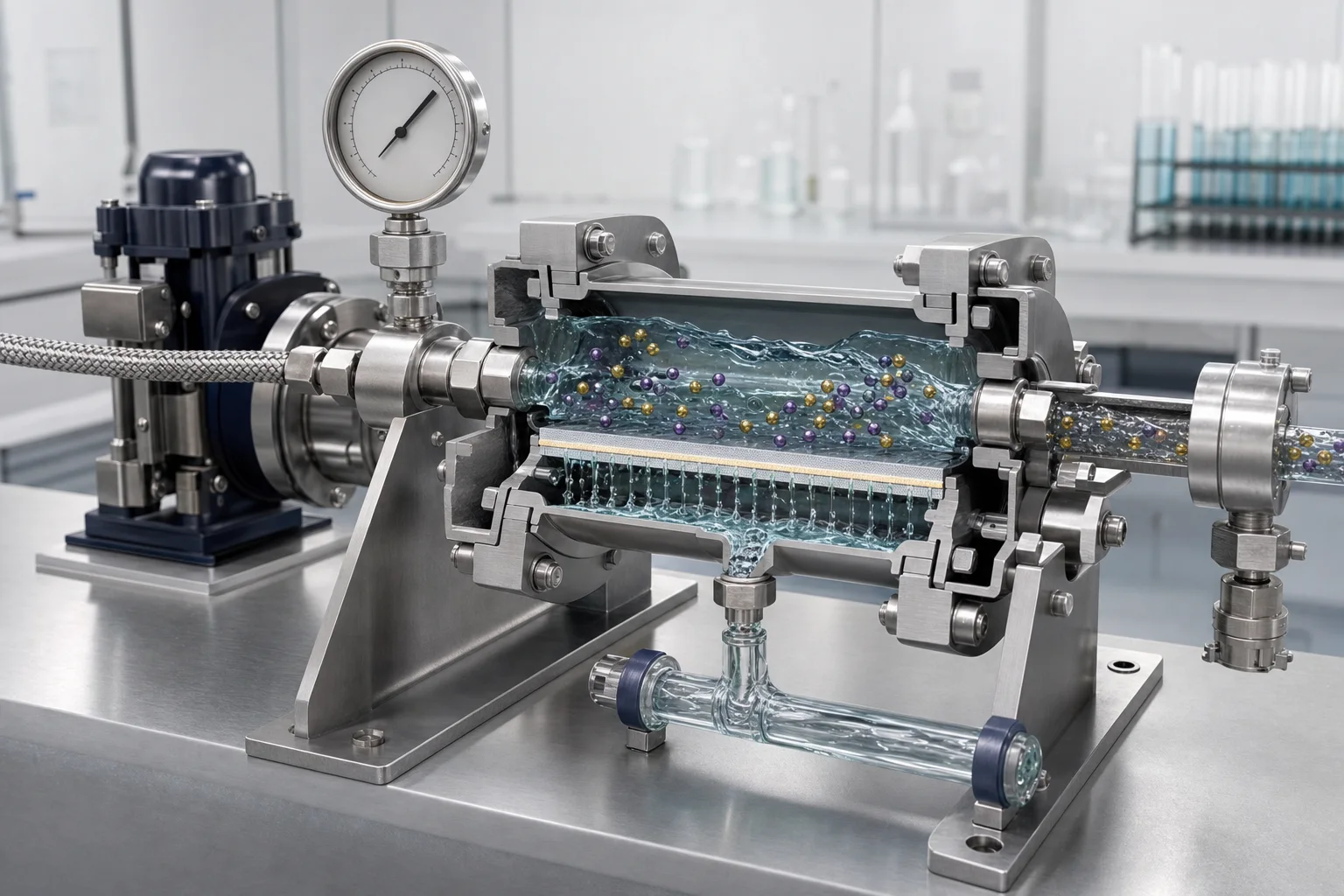 4 · Pressure changes the net driving force
Net driving pressure ≈ hydraulic pressure difference − osmotic pressure difference
This simplified relationship explains why more saline feed—and increasingly concentrated reject—requires greater applied pressure.
What happens on the concentrate side as recovery rises?
When more feed becomes permeate, the retained salt is carried by less remaining water, so concentrate salinity, concentration polarization, and scaling tendency rise. Higher recovery must be checked against feed chemistry, concentration factor, membrane flux, and scale-control limits.
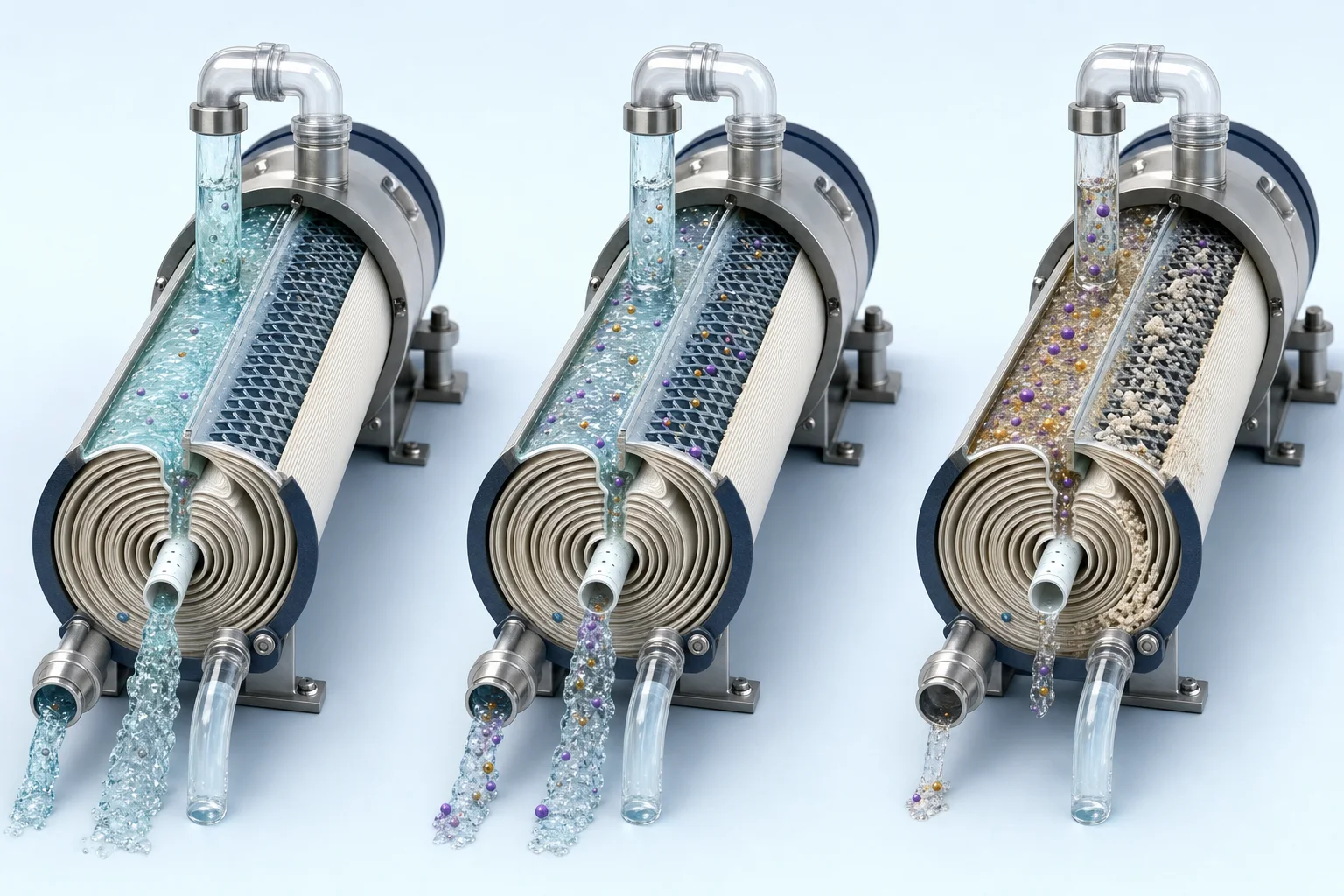 5 · What happens on the concentrate side as recovery rises?
Four variables govern real performance
Feed pressure
Too little pressure reduces permeate flow; indiscriminate pressure increases energy use, mechanical loading, and excessive-flux risk.
Salinity and osmotic pressure
Higher salinity means higher osmotic pressure and less net pressure available to drive water through the membrane.
Recovery and concentration
Higher recovery raises concentrate salinity, scaling tendency, and concentration polarization, so recovery cannot be maximized in isolation.
Temperature and membrane condition
Temperature changes water flux. Fouling, scaling, oxidation, or seal problems can affect both flow and permeate quality.
Two common misconceptions
RO is not only pore-size sieving
Treating RO as an ultrafine screen misses solution–diffusion through a dense selective layer and cannot explain why different ions and neutral molecules pass differently.
More pressure is not automatically better
Pressure is only one operating variable. Design must balance permeate quality, flux, recovery, concentration polarization, scaling risk, and energy.