Illustrated guides · Disinfection, oxidation, and micropollutants
How do advanced oxidation processes generate hydroxyl radicals?
AOPs deliberately combine energy and oxidants—such as UV/H₂O₂—to form ultrashort-lived hydroxyl radicals; photochemistry, scavenging, hydraulics, and polishing determine real removal.
Direct answer
Direct answer
Advanced oxidation is a family of processes, not one device. In UV/H₂O₂, hydrogen peroxide absorbs suitable UV photons and splits to form two hydroxyl radicals (·OH), while some light-absorbing contaminants can also undergo direct photolysis. The very short-lived, fast ·OH abstracts hydrogen, adds to double bonds, or transfers electrons near its generation point and initiates stepwise oxidation. It is not a persistent residual that can be read like chlorine or ozone; performance is inferred from target loss, probe response, oxidant residual, and energy. Only part of generated ·OH reaches a trace target because natural organic matter, bicarbonate/carbonate, nitrite, and other constituents compete, while excessive H₂O₂ can absorb photons and scavenge radicals itself. UV fluence, H₂O₂, UVT, flow, and matrix therefore have a joint optimum. AOP transforms/destroys rather than physically separates, but parent disappearance does not prove mineralization or lower toxicity; transformation products, altered DBP formation potential, and residual peroxide can require GAC/BAC or catalytic quenching. Different AOPs have different side chemistry, and conventional ·OH AOP is generally ineffective for PFOA/PFOS, so the label is not a universal treatment claim.
Four conditions make radicals useful to the target
Generating ·OH somewhere in the train does not prove enough radicals survived matrix competition and reached the target.
Energy and oxidant meet in the right place
UV spectrum/fluence must match oxidant absorption, and H₂O₂ must be mixed before the validated light field. Local overdosing or bypass wastes chemical.
Water transmits light and hydraulics distribute exposure
Low UVT, turbidity, sleeve fouling, lamp aging, and short-circuiting reduce photon use. Panel power is not delivered fluence.
Scavengers do not overwhelm the target
NOM, alkalinity, nitrite, and co-solutes consume ·OH according to concentration and kinetics. Use real water rather than pure-water constants alone.
Verify parent, products, and oxidant residual
Measure target and relevant products, DOC/TOC, residual H₂O₂, and polishing. Parent-peak loss does not prove detoxification or full CO₂ conversion.
Full-scale UV/H₂O₂ links storage/feed, rapid mixing, UV reaction, and polishing
A compatible peroxide tank supplies metering controls, three stainless UV vessels provide staged exposure, and a right-side column can quench residual or adsorb products.
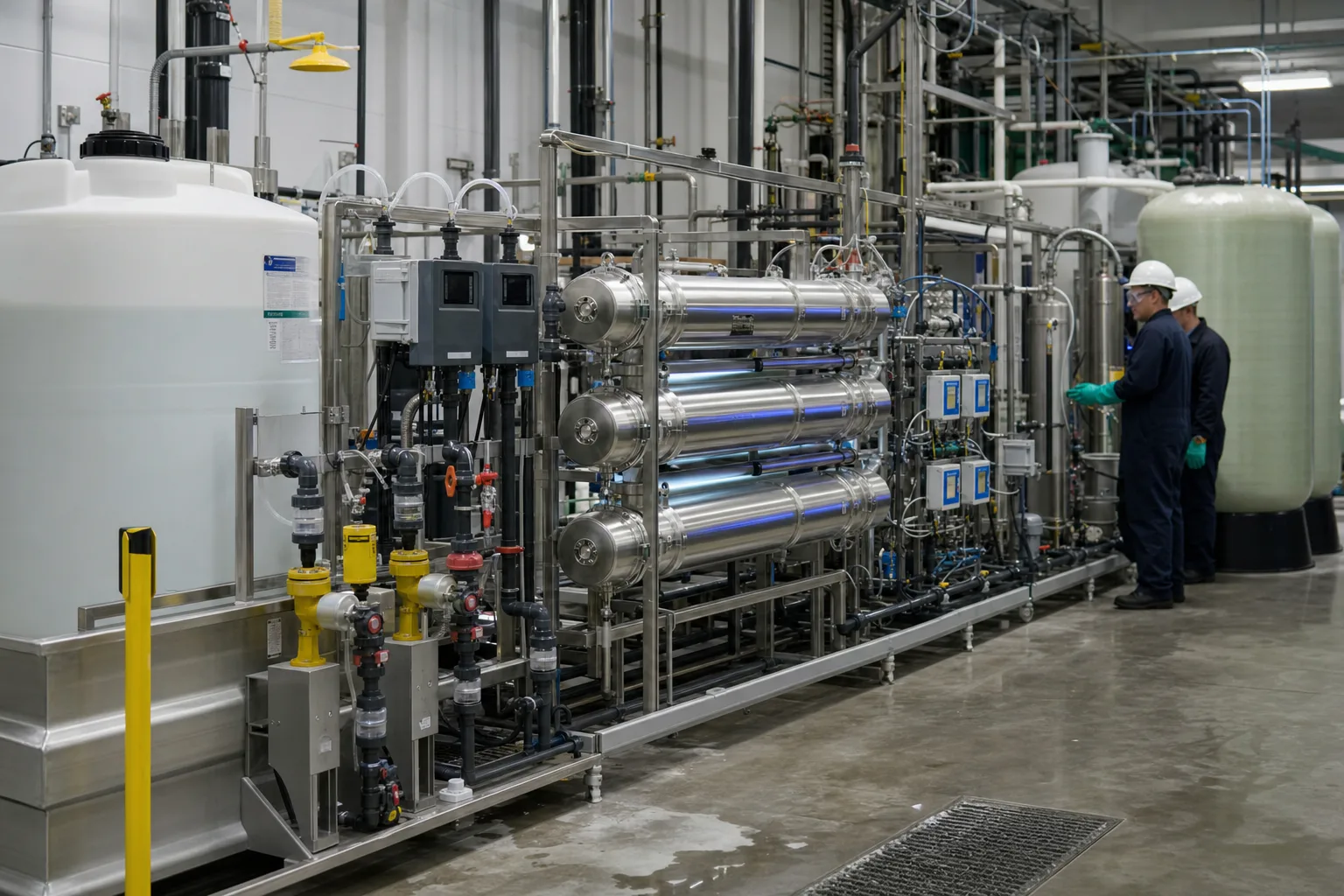 11Compatible H₂O₂ tank and containment22Metering, flow pacing, rapid mixing33Staged UV-AOP reactors44Residual quench/GAC-BAC polishing
What to identify
- 1Compatible H₂O₂ tank and containment
- 2Metering, flow pacing, rapid mixing
- 3Staged UV-AOP reactors
- 4Residual quench/GAC-BAC polishing
Figure takeaway
AOP is a treatment chain, not peroxide added before UV. Strength and pump output set mass dose, mixing precedes the light field, and residual/products need a downstream fate.
How to verify it in the field
Verify peroxide batch/strength, compatibility/containment, pump calibration and flow interlock; align unit flow, UVT, intensity/power, inlet/outlet H₂O₂, target, and polishing breakthrough.
Bench testing separates peroxide dose, UV exposure, and analytical response
A syringe accurately feeds oxidant to a photoreactor; colored samples represent raw, dose, or time points and the analyzer quantifies targets and residual.
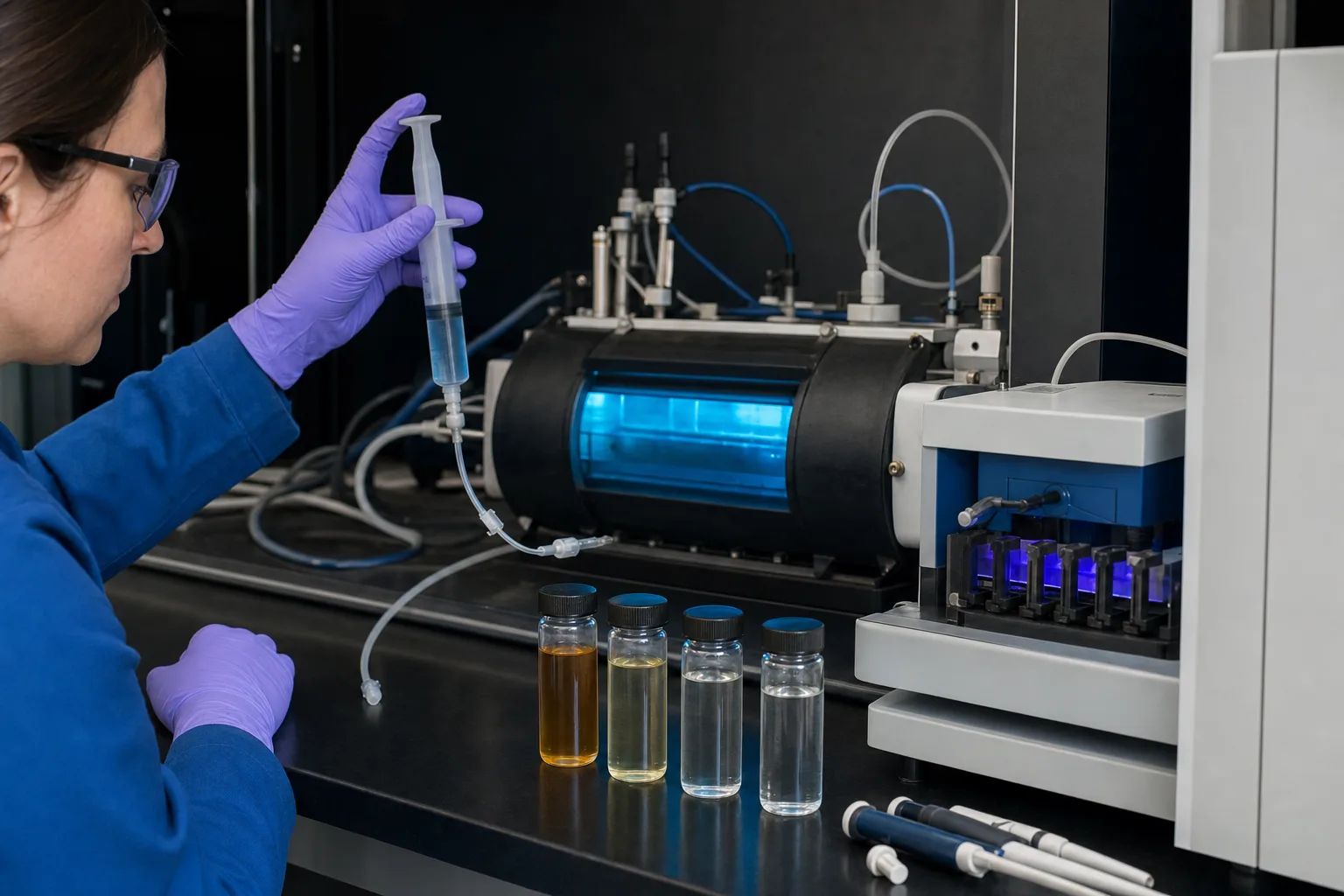 11Calibrated H₂O₂ addition22Controlled UV photoreactor33Raw and dose/time samples44Target/residual quantitative analysis
What to identify
- 1Calibrated H₂O₂ addition
- 2Controlled UV photoreactor
- 3Raw and dose/time samples
- 4Target/residual quantitative analysis
Figure takeaway
Color cannot prove radicals or target removal. Dose-response work needs dark, UV-only, peroxide-only, and combined controls under the same water, path length, and temperature.
How to verify it in the field
Measure H₂O₂, UVT, average fluence/time, target and a suitable probe; include blanks, recovery, replicates, and mass balance. ORP cannot quantify ·OH.
A pilot train shows photons, oxidant, hydraulics, and quenching together
Three transparent UV units stage exposure, duplex pumps feed oxidant, sampling/flow branches track reaction, and a blue media column provides GAC/catalytic polishing.
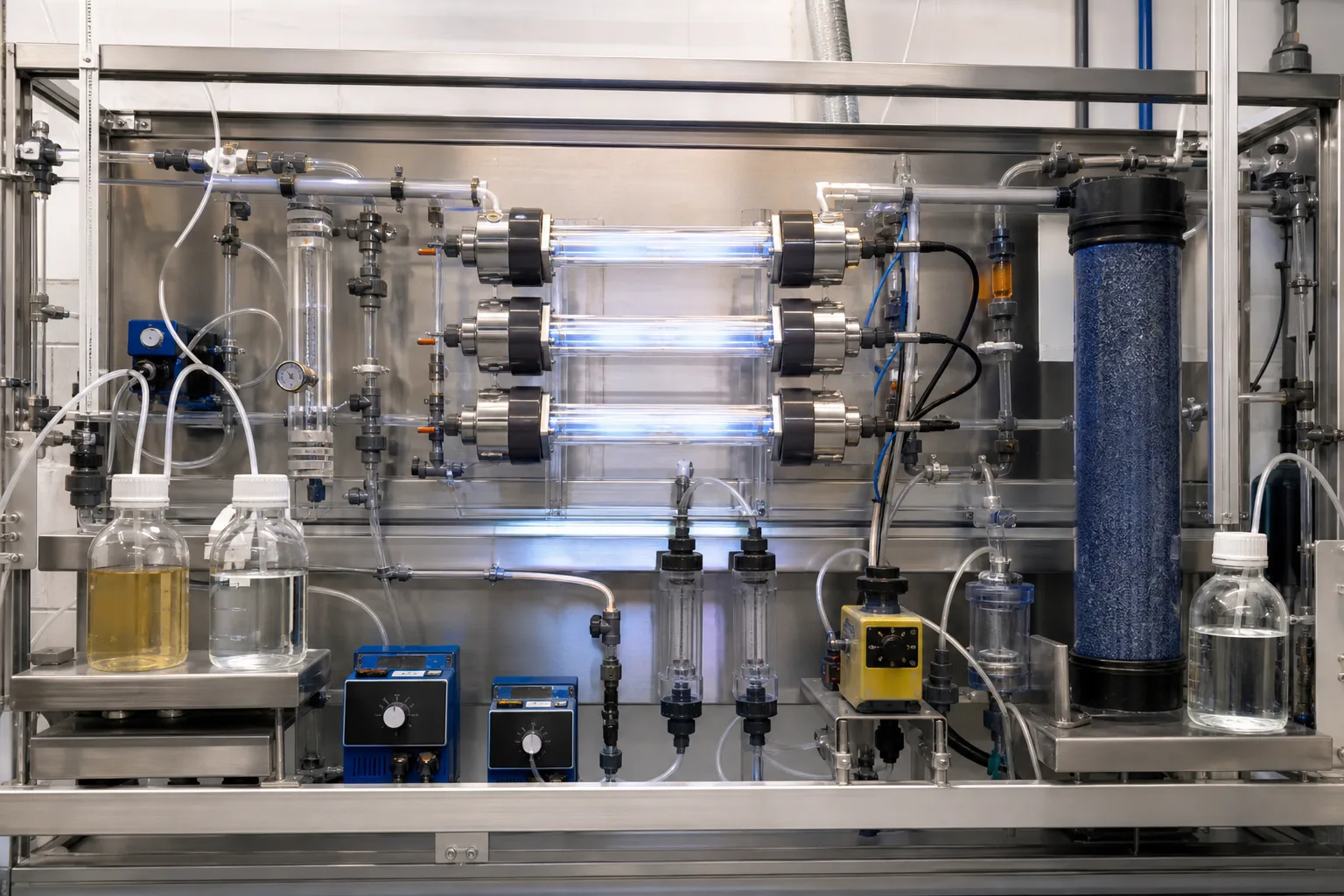 11Three-stage UV photoreactors22Oxidant metering and mixing33Flow, sampling, residual monitoring44GAC/catalytic quench column
What to identify
- 1Three-stage UV photoreactors
- 2Oxidant metering and mixing
- 3Flow, sampling, residual monitoring
- 4GAC/catalytic quench column
Figure takeaway
Pilot work applies real UVT, scavenging, and hydraulics to energy and chemical demand. Equal lamp power or H₂O₂ dose does not mean equal radical exposure across waters.
How to verify it in the field
Profile UVT, stage power/intensity, flow, H₂O₂, and target; calculate energy and chemical per log removal and verify polishing capacity.
Parallel reactors reveal underdose, balance, matrix limitation, and peroxide self-scavenging
Independent UV heads, dosing pumps, and probes treat the same water under different photon, peroxide, or matrix conditions.
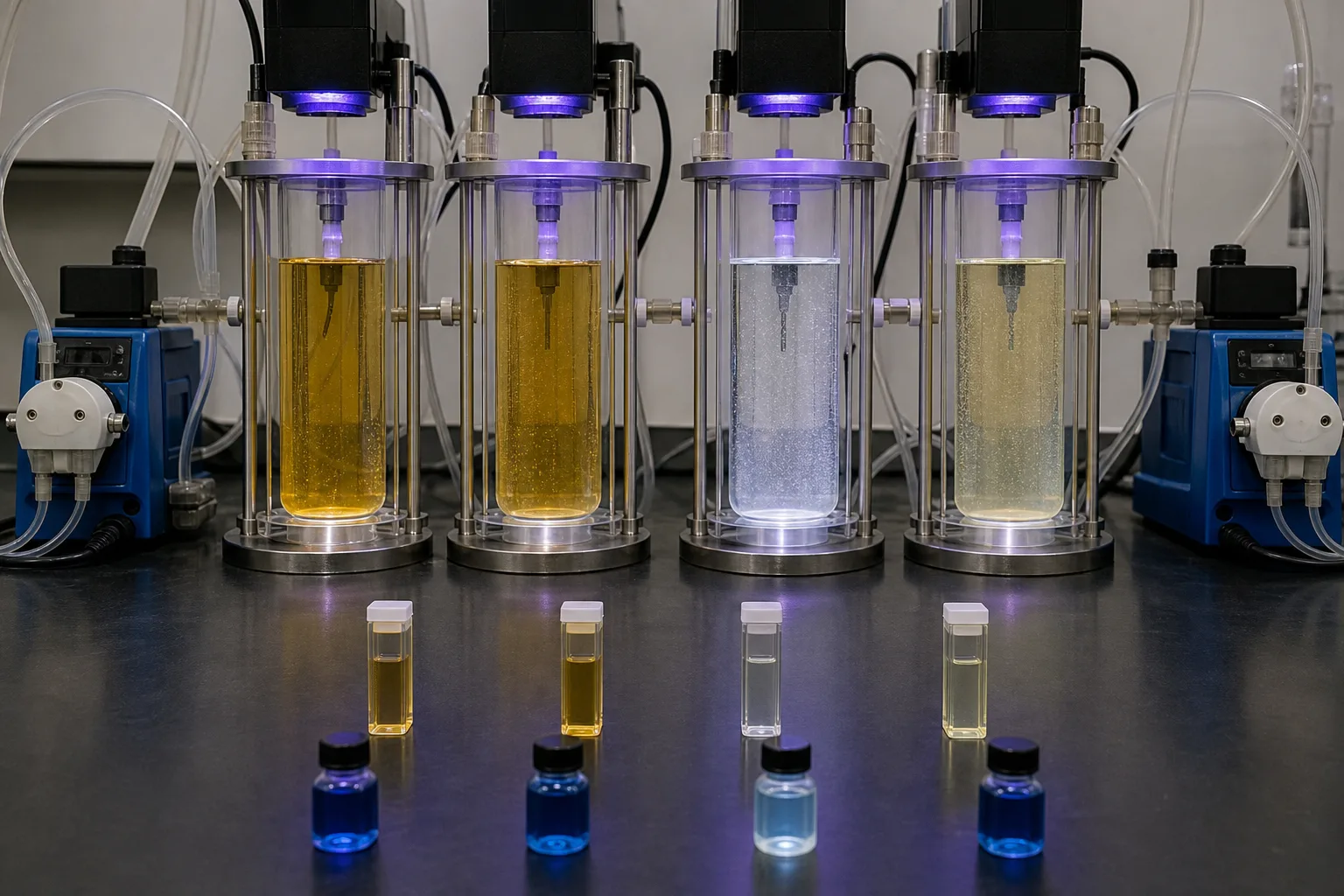 11Low UV/low H₂O₂ underdose22Balanced photon-oxidant target case33Matrix scavenging/low-UVT limit44Excess H₂O₂ self-scavenging case
What to identify
- 1Low UV/low H₂O₂ underdose
- 2Balanced photon-oxidant target case
- 3Matrix scavenging/low-UVT limit
- 4Excess H₂O₂ self-scavenging case
Figure takeaway
Increasing peroxide first supplies more precursor, then competes for ·OH and leaves residual once photons/targets become limiting. The optimum balances removal, energy, residual, and products.
How to verify it in the field
Run a two-dimensional UV×H₂O₂ matrix and quantify direct photolysis, target kinetics, residual, probe exposure, products/toxicity, and uncertainty.
Sleeve fouling, lamp aging, and UVT shifts can lower radical yield despite correct chemical feed
Technicians compare clean and discolored sleeves, removed lamps, and staged samples after electrical, chemical, and pressure isolation.
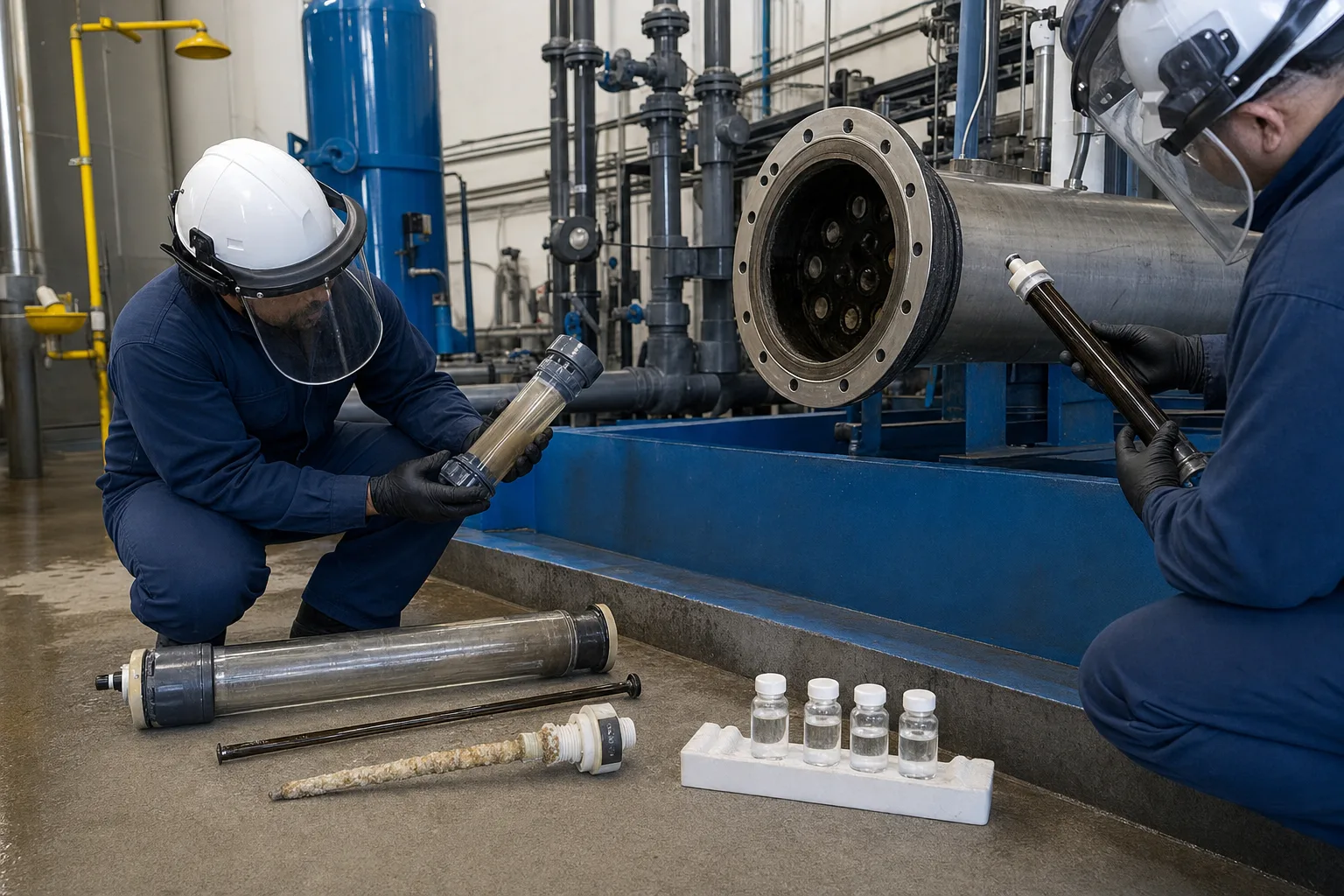 11Clean quartz sleeve22Fouled/scaled sleeve33UV lamp and end connection44Inlet-stage-outlet samples
What to identify
- 1Clean quartz sleeve
- 2Fouled/scaled sleeve
- 3UV lamp and end connection
- 4Inlet-stage-outlet samples
Figure takeaway
If photons do not reach H₂O₂, a perfect metering pump cannot create expected radicals. Diagnose optics, UVT, hydraulics, and chemical together instead of masking light failure with more peroxide.
How to verify it in the field
Lock out, depressurize/drain, isolate peroxide, compare intensity recovery, inspect sleeve/seals and lamp hours, calibrate UV/H₂O₂ instruments, and use stage samples.
Six links from chemical to target transformation
Radicals are ultrashort-lived, so every step must occur in the correct place and time.
1 Bound the water
Target + UVT + NOM/alkalinity/nitrite
Estimate photon and radical competition.
2 Meter and mix
Measured H₂O₂ × pump flow ÷ water flow
Create uniform precursor concentration.
3 Absorb photons
UV through sleeve/water → H₂O₂/target
Trigger oxidant and direct photolysis.
4 Generate and compete
H₂O₂ + hν → 2·OH → target/scavengers
Set effective radical exposure.
5 Transform stepwise
Parent → intermediates → smaller compounds/limited mineralization
Avoid equating parent loss with risk removal.
6 Quench and verify
GAC/catalyst → residual, products, target
Protect downstream and prove outcome.
Four UV-AOP subsystems
Oxidant, light field, matrix reaction, and polishing need separate evidence.
H₂O₂ storage/feed
- Role
- Safe storage, measured strength, flow-paced mixing
- Typical failure
- Decay/contamination, incompatibility, uncalibrated pump, slug or outage
- Evidence
- Batch/strength/temp, containment/materials, calibration, mixing, inlet residual
UV source/reactor
- Role
- Deliver photons under validated hydraulics
- Typical failure
- Aging, fouling, low UVT, overflow/short-circuit, sensor drift
- Evidence
- Lamp hours/state, intensity, cleaning recovery, UVT, flow/configuration, energy
Radical/target reaction
- Role
- Balance photolysis, ·OH generation, matrix competition
- Typical failure
- NOM/alkalinity/nitrite scavenging, excess H₂O₂, unreactive target
- Evidence
- Target kinetics, H₂O₂, probe, matrix, controls, electrical energy per order
Products/polishing
- Role
- Control residual, products, downstream DBP/biological risk
- Typical failure
- Residual breakthrough, exhausted GAC/BAC/catalyst, toxicity/DBPFP rise
- Evidence
- Outlet H₂O₂, products/toxicity, DOC/TOC, DBPFP, pressure/breakthrough
Set UV and H₂O₂ from targets, real water, pilot/validation, and applicable requirements—not another plant's fixed dose. Concentrated H₂O₂ is a strong oxidizer and UV systems add electrical, pressure, and radiation hazards. Conventional hydroxyl-radical AOP is generally ineffective for PFOA/PFOS.
Align three data groups each operating cycle
Chemical and optics
Peroxide batch/strength/tank temperature, pump calibration and inlet residual; UVT, lamp power/hours, sensor intensity, cleaning and recovery.
Hydraulics and scavenging
Total/unit flow, trains/valves, temperature, NOM/DOC, alkalinity/bicarbonate, nitrite, and suitable probe exposure within validation.
Target, products, cost
Parent/intermediates, TOC/DOC, outlet H₂O₂, toxicity/DBPFP, polishing, EEO, chemical use, and downtime.
Separate light, chemical, and matrix limitations
- Combined signal
- Stable H₂O₂ in/out but UV intensity falls; UVT stable and cleaning restores intensity
- Suspect first
- Sleeve/sensor-window fouling reduces photons
- Next step
- Inspect cleaning, sleeve, and sensor and recalibrate; do not compensate with more chemical
- Combined signal
- Stable intensity/flow but lower UVT and higher NOM/alkalinity/nitrite coincide with lower removal
- Suspect first
- Light absorption plus radical scavenging increased
- Next step
- Run current-water UV×H₂O₂ matrix, review source/pretreatment, and optimize or derate
- Combined signal
- Removal rises then falls as H₂O₂ increases while outlet residual climbs
- Suspect first
- Peroxide self-scavenging or photon limitation
- Next step
- Use matrix/probe/control data to reduce excess H₂O₂ or add effective photons rather than more chemical
- Combined signal
- Parent passes but residual H₂O₂, toxicity/DBPFP, or polishing breakthrough rises
- Suspect first
- Transformation or polishing is now controlling
- Next step
- Expand product/bioassay work, verify GAC/BAC/catalyst capacity, and reset envelope
Four common misconceptions
AOP is one stronger-than-ozone machine
It is a family of energy/oxidant combinations with different chemistry and side products.
Strong ·OH treats everything
Removal depends on target kinetics, competition, and reachable dose; conventional ·OH AOP can fail for PFAS.
More H₂O₂ always means more radicals
When photons limit or dose is excessive, peroxide scavenges ·OH and leaves residual.
Parent loss means mineralization and detoxification
AOP often forms intermediates, so products, toxicity, and polishing require verification.