Illustrated guide · Industrial water systems
Why must boiler water be deaerated, softened and pH-controlled?
Follow makeup and returned condensate through hardness removal, thermal deaeration, chemistry control and blowdown to see where scale, oxygen pitting and condensate corrosion begin.
Direct answer
Direct answer
A boiler removes water as steam but leaves most nonvolatile salts behind, while its heating surfaces operate at high heat flux and metal temperature. Small hardness leakage can therefore concentrate and form an insulating deposit; the metal must run hotter to pass the same heat and can eventually bulge or fail. Dissolved oxygen can pit feedwater equipment, the economizer and wet standby surfaces, while carbon dioxide can enter the condensate and lower its pH. Low pH accelerates metal dissolution, but excessive or locally concentrated caustic can also damage metal. Protection is a sequence, not one device: sodium-cycle softening exchanges Ca²⁺ and Mg²⁺ for Na⁺; RO or demineralization may still be needed for lower TDS, alkalinity or silica because softening does not remove them. A thermal deaerator heats water close to saturation at its operating pressure and distributes it through sprays, trays or packing so O₂ and CO₂ leave the water and are vented with noncondensables. A compatible oxygen scavenger may polish residual oxygen but cannot replace a malfunctioning deaerator. Feedwater, boiler-water and condensate chemistry are then controlled separately, and blowdown removes the salts that steam generation continues to concentrate. Limits are system-specific: pressure, materials, OEM requirements, makeup/condensate ratio, pretreatment and chemical program all matter. Verify the chain with hardness after the softener; deaerator pressure, temperature, vent and downstream dissolved oxygen; circuit-specific pH/alkalinity, boiler-water conductivity/TDS/silica, iron and copper; blowdown flow; and inspection of heating and return surfaces.
Four independent barriers address three different damage paths
A compliant feedwater sample is not one number; it is a controlled path from makeup and condensate to steam and blowdown.
Hardness deposits at the highest heat flux
Ca and Mg remain as steam leaves. Concentration, alkalinity, silica and local boiling promote precipitation on tubes; even a thin deposit adds resistance and raises tube-metal temperature.
Oxygen and carbon dioxide attack more than the drum
Oxygen pitting can occur in tanks, pumps, economizers and wet standby equipment. CO₂ travels with steam and may acidify condensate, so boiler-water testing alone misses important circuits.
pH is circuit- and material-specific
Feedwater, boiler water and condensate have different duties, and carbon steel, copper alloys and mixed systems have different compatible chemistry. Low pH and locally concentrated caustic can both be harmful.
Steam removes water; blowdown removes salts
Deaeration removes gases and softening exchanges hardness, but neither removes every dissolved solid. Conductivity and chemistry, mass balance and steam-quality results govern safe blowdown.
The feedwater train links hardness removal, gas removal, chemistry verification and the boiler
Treated makeup and returned condensate meet before deaeration/storage and pumping to the economizer and boiler. Sampling and instruments prove that each barrier works.
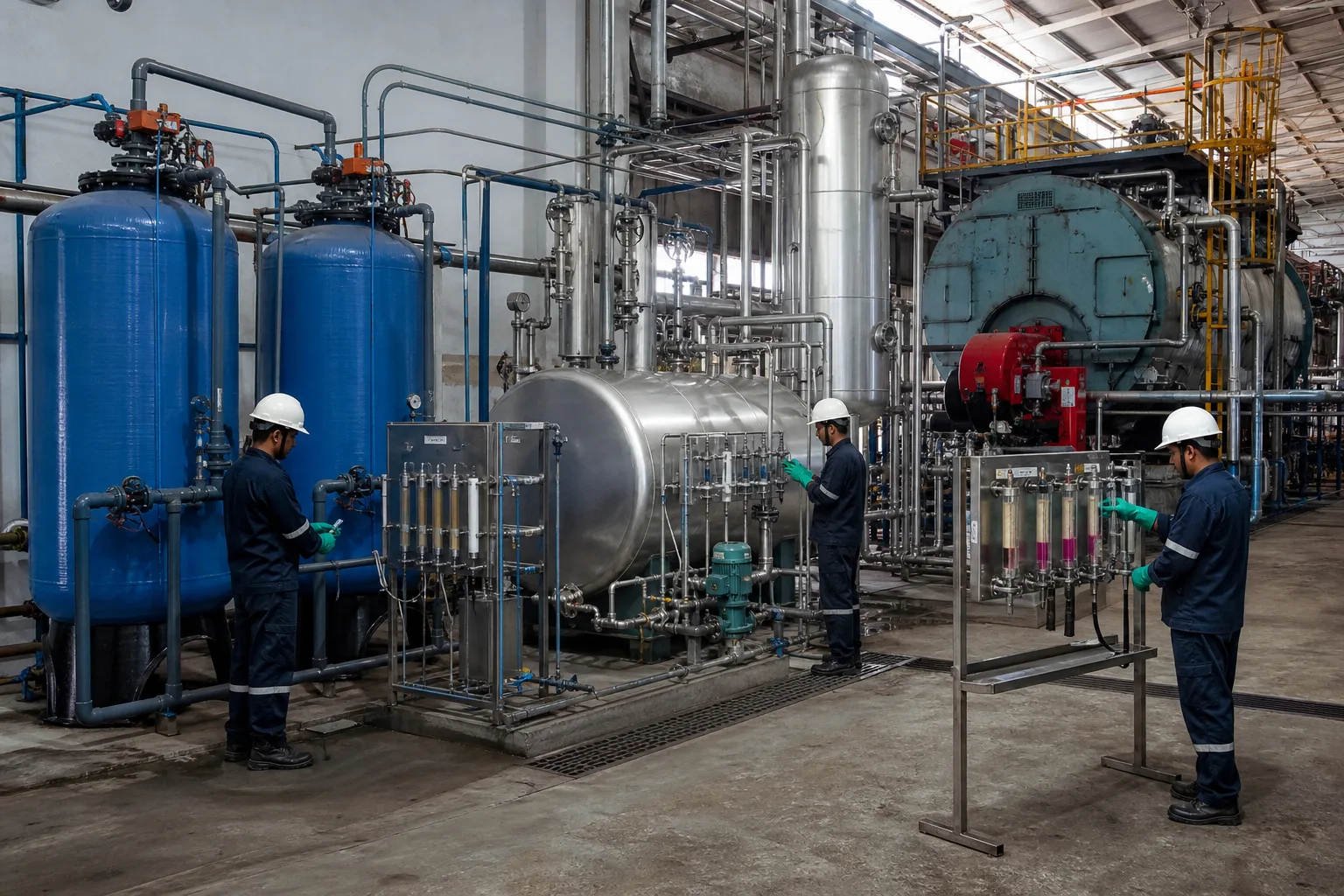 11Twin softeners remove Ca/Mg hardness22Thermal deaerator and feedwater storage33Economizer/boiler high-heat-flux surfaces44Dosing, sampling and online chemistry
What to identify
- 1Twin softeners remove Ca/Mg hardness
- 2Thermal deaerator and feedwater storage
- 3Economizer/boiler high-heat-flux surfaces
- 4Dosing, sampling and online chemistry
What this proves
Softening, deaeration, chemistry and blowdown control different hazards. A failure at any one stage leaves a characteristic downstream damage path.
Field check
Trace makeup, condensate, vent, feedwater, steam and blowdown; verify softener service/regeneration, deaerator pressure-temperature-level, dosing interlocks, sample coolers and instrument locations/calibration.
Four pipe sections separate hard scale, rust, dark deposits and a clean baseline
White scale resists heat transfer; orange rust indicates oxidation; a black deposit may be magnetite, transported oxide, oil or a composite and is not automatically a healthy film.
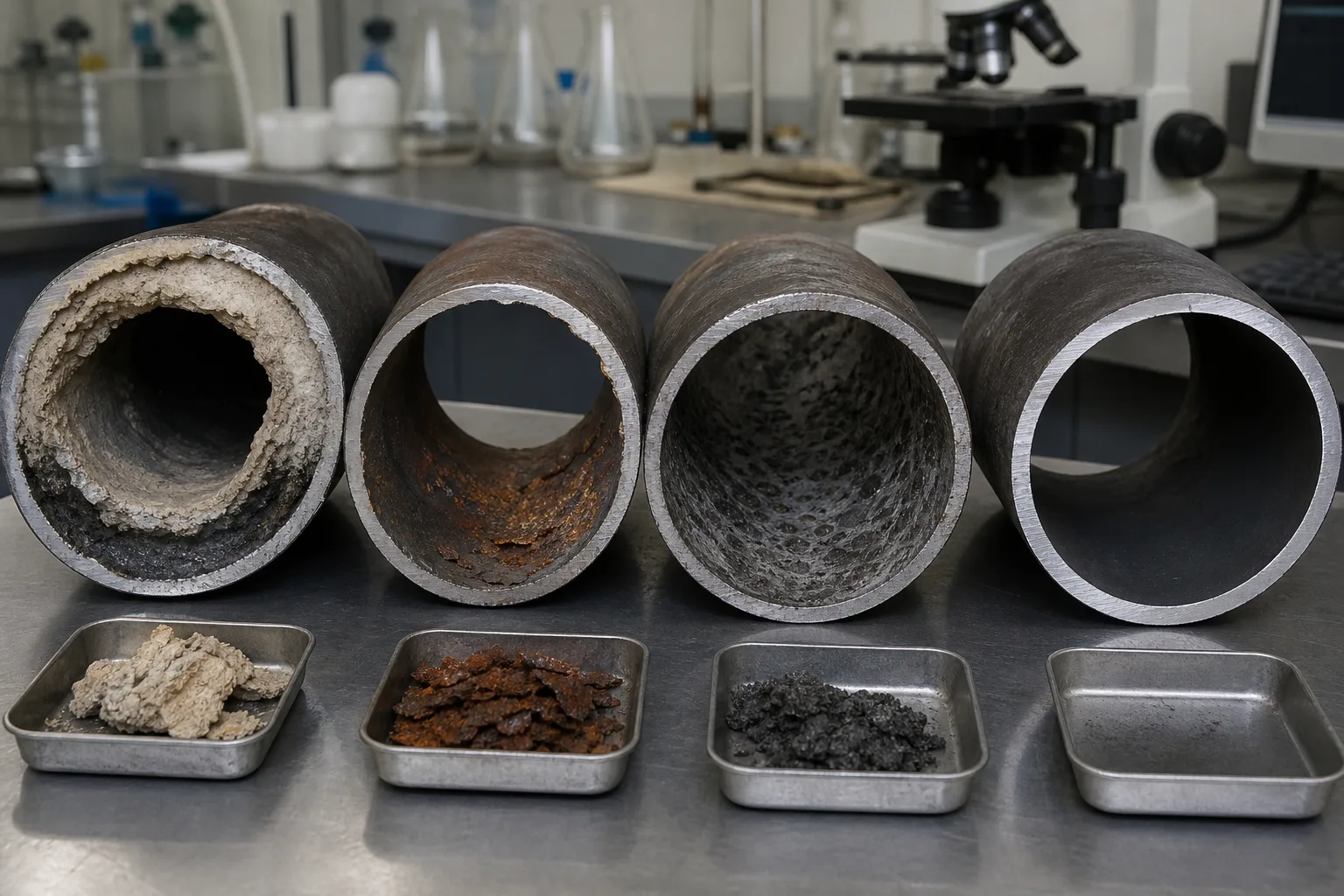 11White hardness/silica scale22Orange iron oxide and metal loss33Dark oxide or composite deposit44Clean metal baseline and texture
What to identify
- 1White hardness/silica scale
- 2Orange iron oxide and metal loss
- 3Dark oxide or composite deposit
- 4Clean metal baseline and texture
What this proves
Appearance selects the next test but does not prove the cause. Location, adhesion, mineralogy, elements, pit geometry, wall thickness and operating history must agree.
Field check
After safe isolation and cooling, map tube and flow direction, preserve deposit and substrate separately, measure scale/pits/wall, and compare results with hardness breakthrough, oxygen, pH and blowdown trends.
A transparent rig puts ion exchange, thermal deaeration, measurement and heated-tube validation in one circuit
The resin column exchanges hardness, heated contact releases gas, pH/DO probes verify the outlet and the heated loop reveals deposition or corrosion.
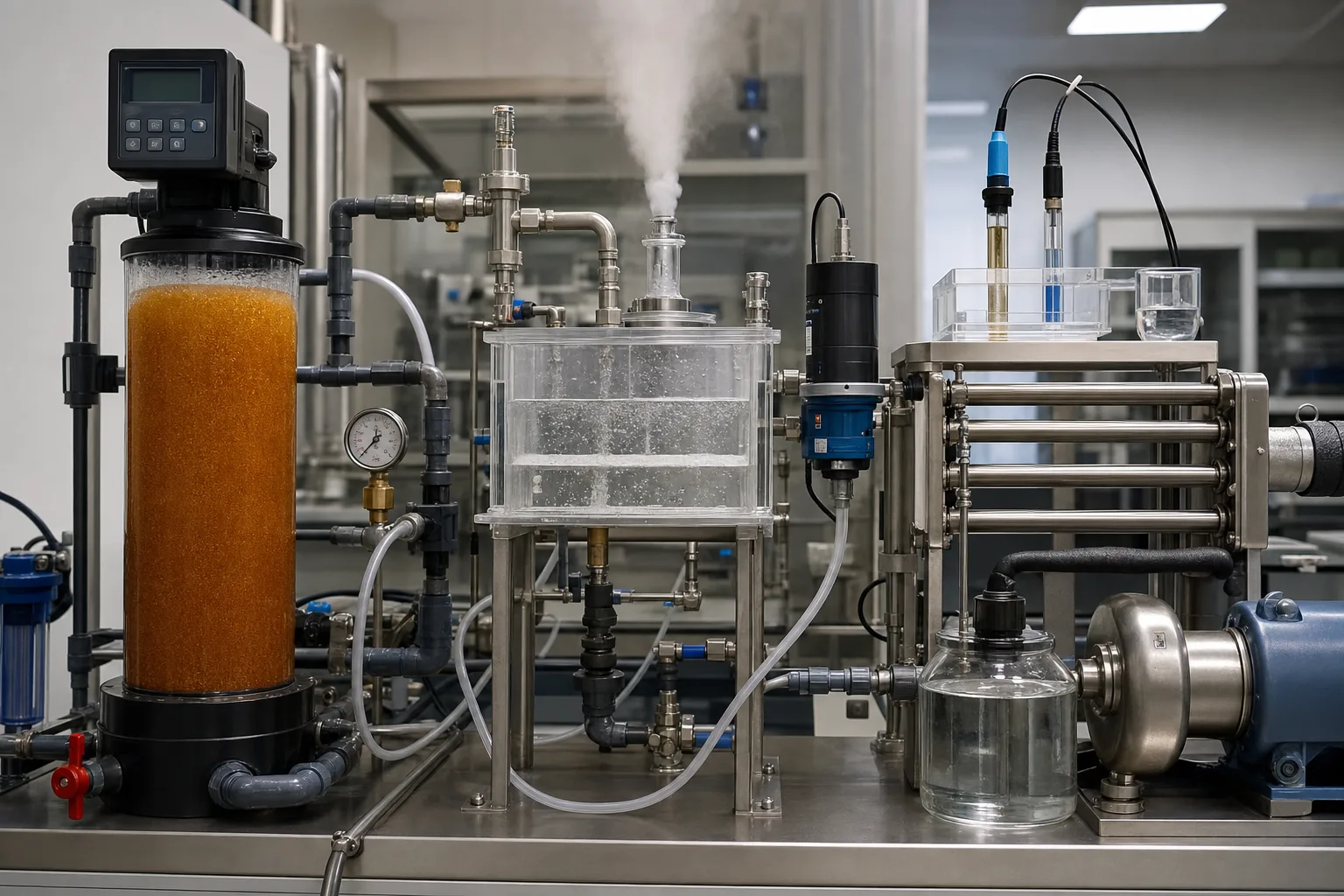 11Sodium-form ion-exchange resin22Heating, steam-water contact and vent33Downstream pH and dissolved-oxygen probes44Heated tube/heat-transfer result
What to identify
- 1Sodium-form ion-exchange resin
- 2Heating, steam-water contact and vent
- 3Downstream pH and dissolved-oxygen probes
- 4Heated tube/heat-transfer result
What this proves
Verify function at the outlet: residual hardness, not brine-tank level; dissolved oxygen and vent/temperature-pressure behavior, not visible steam; circuit chemistry and metal response, not only a running dosing pump.
Field check
Provide controlled samples for raw/softened water, deaerator outlet/feedwater, boiler water, steam condensate and return. Use suitable cooling/flow/methods and regularly compare online and laboratory results.
Four heated sections compare insulating scale, pitting, circuit corrosion and a controlled condition
Deposits, pits and rust may occur at different system locations. A clean surface is one inspection result, not a substitute for trending.
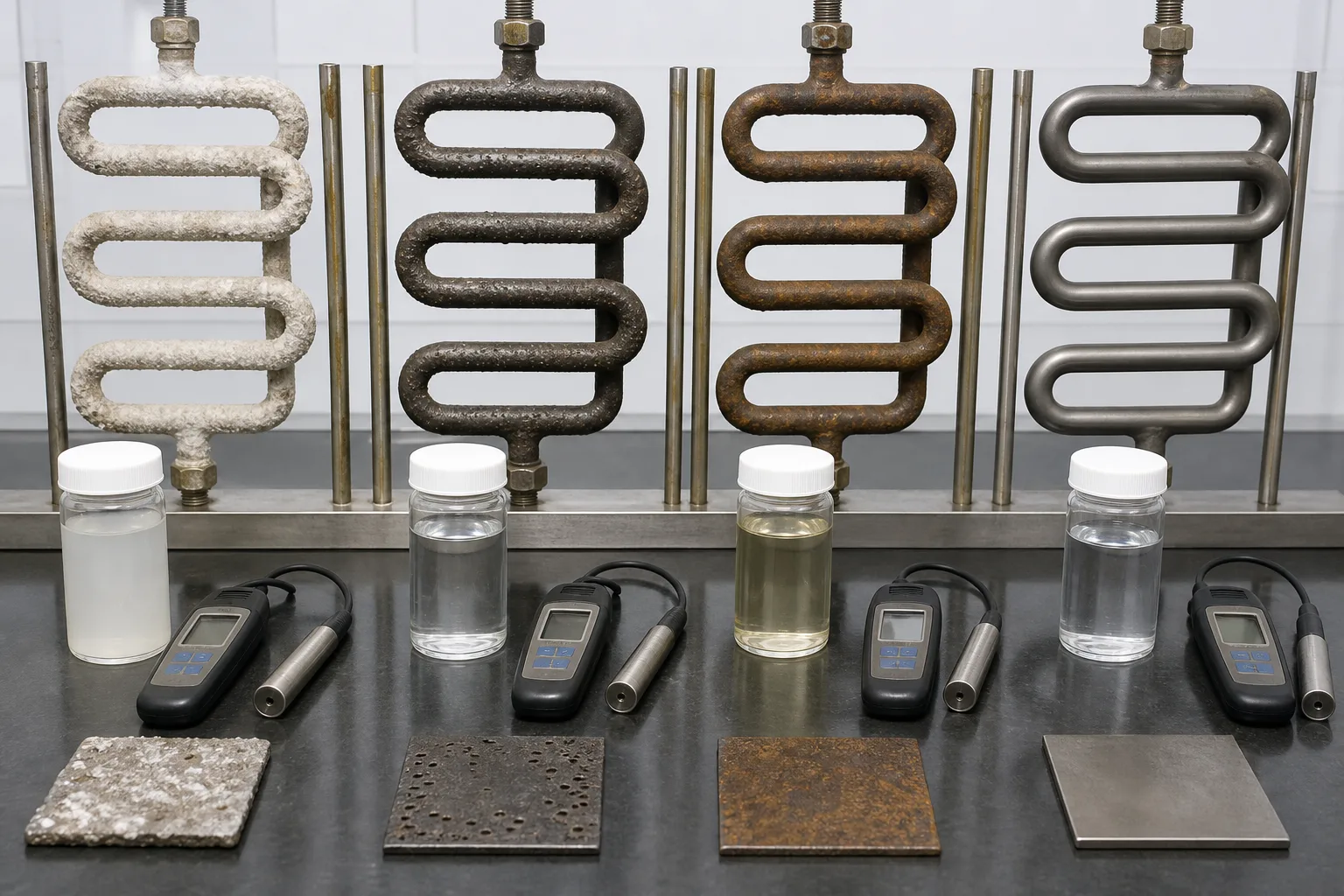 11Insulating scale and overheating risk22Oxygen-related or under-deposit pitting33Feedwater/condensate circuit rust44Chemically controlled clean comparison
What to identify
- 1Insulating scale and overheating risk
- 2Oxygen-related or under-deposit pitting
- 3Feedwater/condensate circuit rust
- 4Chemically controlled clean comparison
What this proves
Location points back to the barrier: tube scale to hardness/concentration/heat flux; economizer pits to deaeration or standby; return-line rust to CO₂, pH, contamination or air ingress.
Field check
Map specimens, coupons/probes and sampled metal; align iron/copper, oxygen, pH, hardness, conductivity and temperature. Use metallography when needed to establish water-side versus fireside origin.
An opened deaerator brings contact internals, shell flow path and inspection evidence together
The open manway exposes perforated internals that form films or droplets. In service, steam heats countercurrently and carries noncondensables to an external controlled vent, while the lower section stores deaerated water. Inspectors and samples link internal condition to operating data.
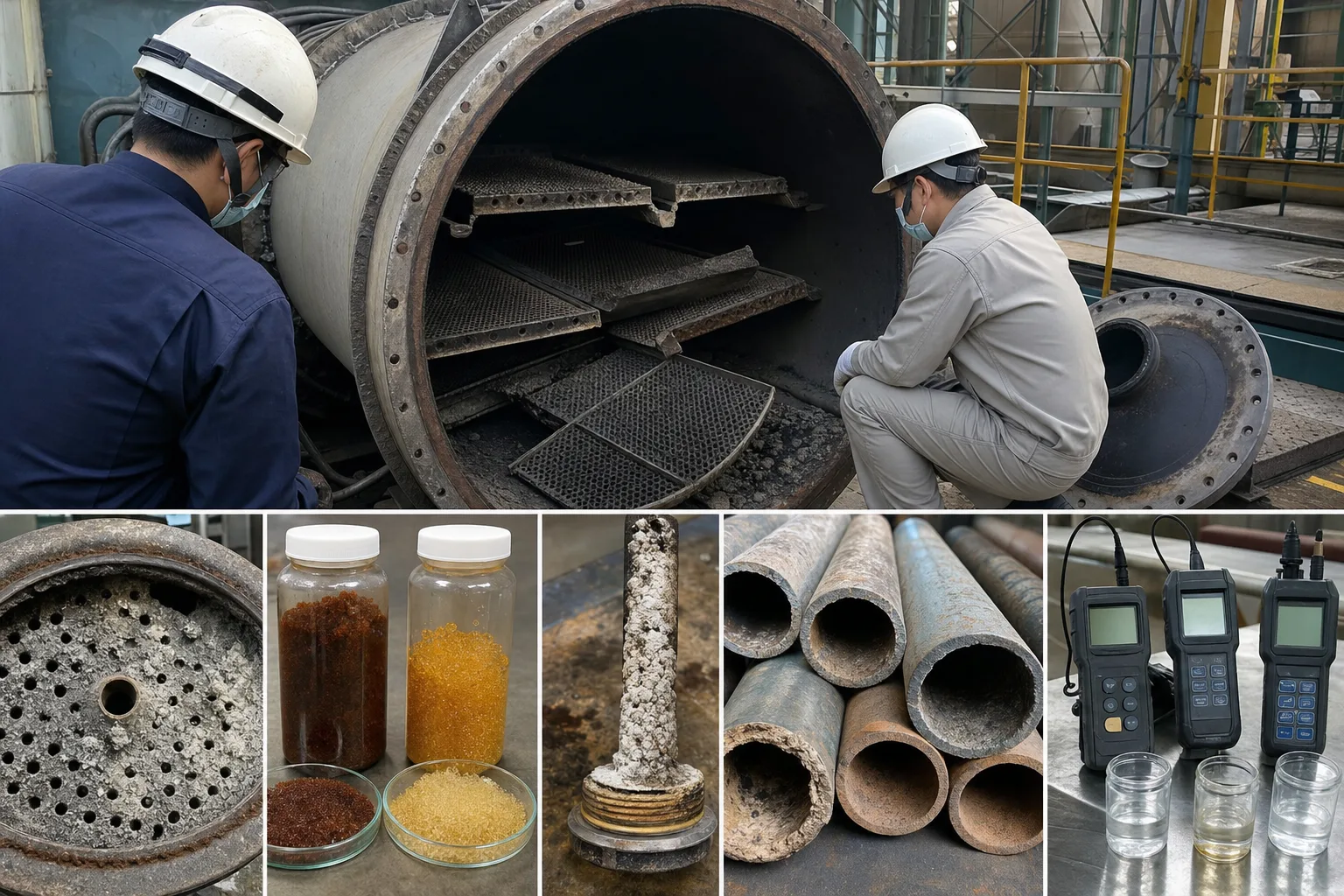 11Perforated tray/distributor contact zone22Confined-space entry and internal inspection33Open manway, shell and internal flow path44Resin, deposit, tube and meter evidence
What to identify
- 1Perforated tray/distributor contact zone
- 2Confined-space entry and internal inspection
- 3Open manway, shell and internal flow path
- 4Resin, deposit, tube and meter evidence
What this proves
A deaerator is not merely a hot tank. Saturation conditions, intimate contact and removal of noncondensables through the external vent are all required; poor venting, excessive venting, blocked trays, faulty sprays or load swings impair performance.
Field check
Use OEM pressure-temperature, vent, level and residence requirements; apply LOTO, cooling, ventilation and confined-space controls for internal inspection, then measure downstream dissolved oxygen at stable and changing load.
Eight barriers from raw water to steam
Each step controls a different input or accumulation; adjacent samples locate the failure.
1 Characterize makeup
Hardness/alkalinity/silica/TDS/organics → treatment boundary
Decide whether softening is sufficient or RO/demineralization is needed.
2 Soften/demineralize
Exchange Ca/Mg; remove more ions where required
Reduce scale and concentration load.
3 Recover condensate
Condensate → return after corrosion/contamination checks
Recover heat and water without importing process leakage.
4 Thermal deaeration
Near-saturation heat + spray/trays → vent O₂/CO₂
Reduce gaseous corrosion upstream and in the boiler.
5 Chemical polishing
Residual oxygen/circuit chemistry → compatible treatment
Supplement mechanical deaeration and protect the circuit.
6 Boiler-water control
pH/alkalinity/program chemistry + concentration
Control deposits, corrosion and steam quality for the pressure/material.
7 Blowdown/steam quality
Accumulated salts/silica/solids → blowdown
Limit concentration, foaming and carryover without excessive heat loss.
8 Verify metal results
Chemistry + iron/copper/coupons/surfaces/failures
Prove equipment protection, not only sample compliance.
Four control functions cannot substitute for one another
Identify the substance or condition to control before choosing equipment, chemicals and measurements.
Softening/demineralization
- Primary role
- Exchange Ca/Mg; RO/demineralization can further reduce TDS, alkalinity or silica
- Boundary/failure
- Exhaustion, poor regeneration or valve leakage causes breakthrough; softening alone does not lower TDS
- Priority evidence
- In/out hardness, regeneration/pressure drop/resin; full ions, conductivity and silica
Thermal deaeration
- Primary role
- Use saturation heating, contact and venting to remove O₂/CO₂
- Boundary/failure
- Wrong pressure-temperature, poor vent, plugged spray/trays, short-circuiting, load swing or downstream air
- Priority evidence
- Pressure-temperature-level/load/vent, downstream DO and internal inspection
pH/chemical control
- Primary role
- Establish compatible feedwater, boiler and condensate chemistry and polish residual oxygen
- Boundary/failure
- Wrong dose/location, local concentration, bad samples or return contamination causes corrosion/deposit/carryover
- Priority evidence
- Circuit pH/alkalinity/residuals, Fe/Cu/O₂, dosing flow, sample quality and metal condition
Blowdown/monitoring
- Primary role
- Remove accumulated salts/solids while balancing steam quality and energy/water loss
- Boundary/failure
- Too little causes concentration/carryover; too much wastes heat and chemicals; conductivity misses some limiters
- Priority evidence
- Feed/boiler/condensate analysis, blowdown flow/heat recovery, mass balance and steam purity
Operating ranges must come from boiler pressure, materials, OEM requirements and the selected treatment standard. This guide explains causality; it does not prescribe universal chemical dose, pH, dissolved-oxygen or blowdown setpoints.
Keep four time-aligned operating records
Makeup and pretreatment
Flow, full analysis, softened-water hardness, regeneration/salt/pressure drop; RO or demineralizer recovery, conductivity, silica and bypasses where fitted.
Deaerator and feedwater
Load, pressure, temperature, level, steam/vent, outlet DO, feedwater pH/conductivity, iron/copper and scavenger residual; include starts and load changes.
Boiler, steam and condensate
Circuit-specific pH/alkalinity/conductivity or TDS/silica and program parameters, steam/condensate purity, return pH/Fe/Cu and process contamination.
Blowdown and equipment
Continuous/intermittent blowdown flow and heat recovery, fuel/feed changes, scale thickness, tube wall/pits, economizer/return inspection, leaks and unplanned outages.
Use damage location to find the failed barrier
- Signal
- Intermittent hardness after softening, hard pale tube scale and rising fuel/stack temperature
- Priority hypothesis
- Regeneration or valve leakage causes hardness breakthrough, amplified by concentration and heat flux
- Next step
- Trend hardness through the regeneration cycle, inspect brine/resin/valves, analyze scale and concentration, then assess safe cleaning and tube condition
- Signal
- Deep localized feedwater/economizer pits although deaerator temperature looks normal
- Priority hypothesis
- Poor vent/contact, load shock, downstream air ingress or wet-standby corrosion
- Next step
- Check saturation relation and vent, measure downstream DO across loads, inspect sprays/trays, pump suction/seals and standby protection
- Signal
- Condensate pH falls and iron/copper rises while boiler-water values remain in range
- Priority hypothesis
- CO₂, inadequate volatile chemistry, air ingress, mixed-material incompatibility or contaminated return
- Next step
- Sample along steam/condensate branches, trace leakage and return ratio, then adjust a material-specific program rather than simply raising boiler alkalinity
- Signal
- Boiler conductivity/silica fluctuates, condensate is contaminated or drum level foams
- Priority hypothesis
- Insufficient/lagging blowdown, chemical/makeup upset or steam-separation overload
- Next step
- Validate samples/instruments, close feed-steam-blowdown mass balance, inspect blowdown valves and drum separators, and reset load-based limits
Four common misconceptions
Soft water is low-TDS water
Softening exchanges Ca/Mg for Na and normally leaves TDS, alkalinity and silica; higher-duty boilers may need RO or demineralization.
A hot deaerator must be working
Correct pressure, contact, continuous venting and load are also required, with downstream dissolved oxygen as verification.
Higher pH always means less corrosion
Compatible ranges differ by circuit and material; local caustic concentration under deposits can also damage metal.
Scavenger can replace mechanical deaeration
It normally polishes residual oxygen; using chemicals to mask equipment failure adds cost, byproducts and control risk.