Illustrated guide · Operating diagnostics
What do acid and caustic CIP remove?
Match RO/NF CIP chemistry and sequence to the deposit, control circulation and soak conditions, and accept the clean on normalized performance rather than solution color.
Direct answer
Direct answer
Acid and caustic CIP are not interchangeable strong rinses. Acid cleaners mainly dissolve acid-soluble inorganic precipitates such as calcium carbonate and some iron oxides/hydroxides. Alkaline cleaners—often aided by surfactants, chelants or dispersants—remove natural organics, oils, colloids, silica-related deposits and biological matter by desorption, emulsification and dispersion. Formula, pH, temperature, velocity, time and deposit age matter as much as the acid/alkaline label. Sulfate, barium/strontium and aged silica scales are difficult; sulfuric acid is unsuitable because calcium sulfate may precipitate. Most deposits are mixed. FilmTec guidance normally places alkaline cleaning first to open organic, colloidal and biofilm layers, followed by a thorough rinse and acid cleaning of remaining mineral scale. Acid first is reserved for a deposit known to contain only calcium carbonate or iron oxide/hydroxide. CIP must be triggered from normalized flow, salt passage and stage pressure-drop trends; selected from evidence; mixed with RO permeate or DI water; introduced at low pressure; circulated stage by stage at adequate crossflow; and monitored for pH, temperature, flow, pressure drop, color and turbidity. Replace loaded solution, rinse thoroughly and judge recovery only after stable normalized operation.
Answer four questions before choosing acid or caustic
Deposit identity and membrane compatibility drive the recipe.
What is the deposit—not merely its color?
Combine stage location, normalized trends, feed chemistry, cartridge evidence and deposit analysis to separate carbonate/metal, sulfate/silica, colloid, organic and biofilm.
What pH–temperature–time envelope does this membrane allow?
Polyamide, cellulose acetate and individual RO/NF products differ. The more extreme the pH, the lower the permitted temperature may be.
Is it a single or composite layer?
Organic and biological matrices commonly encase mineral particles. Mixed deposits generally need alkaline-first sequencing.
Was cleaning early enough and at the right hydraulics?
Aged deposits compact or recrystallize. Low flow cannot carry debris; excessive vessel pressure drop risks damage.
A field CIP controls chemicals, tank, pump/filter and an isolated membrane stage
PPE and segregated drums, a mixed temperature-controlled tank and temporary low-pressure return hoses form one controlled loop.
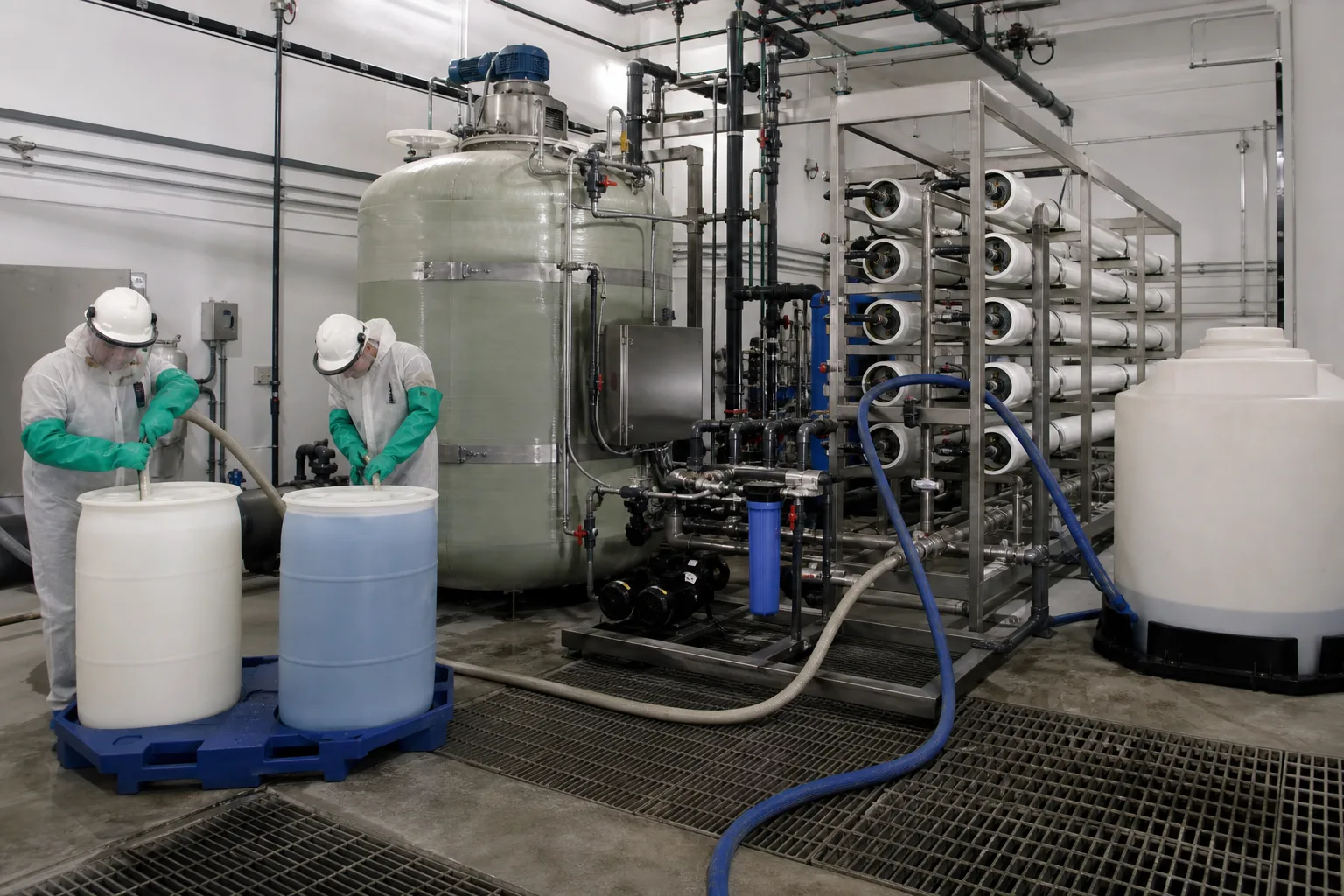 11Segregated acid/alkali and PPE22Mixed, temperature-monitored CIP tank33Pump, filter, flow/pressure and return44Isolated RO pressure-vessel stage
What to identify
- 1Segregated acid/alkali and PPE
- 2Mixed, temperature-monitored CIP tank
- 3Pump, filter, flow/pressure and return
- 4Isolated RO pressure-vessel stage
What the image proves
CIP is a chemical-hydraulic system, not chemical poured into a running RO. Containment, compatibility and waste routing are part of the job.
How to verify it
Verify SDS, isolation, valves, tank volume, filter, heat/cool, instruments, eyewash and waste receiver; prevent incompatible chemical contact.
White mineral and brown organic/biological layers follow different chemical paths
A carbonate coupon reacts in acid while a brown matrix disperses in alkaline solution; probes show chemical demand.
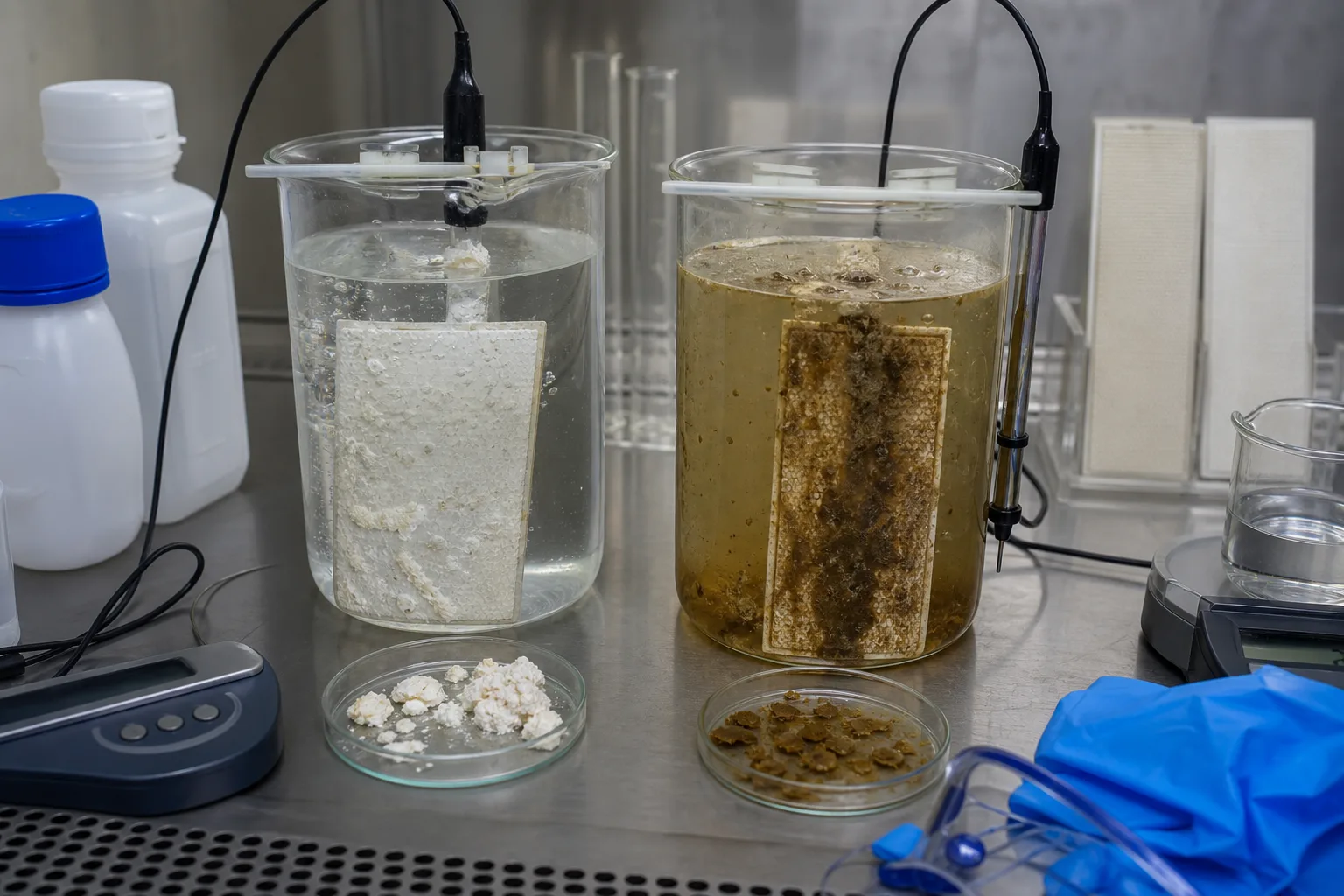 11Carbonate/metal inorganic deposit22Acid solution and pH demand33Organic/colloid/biofilm layer44Alkaline dispersant/surfactant and pH
What to identify
- 1Carbonate/metal inorganic deposit
- 2Acid solution and pH demand
- 3Organic/colloid/biofilm layer
- 4Alkaline dispersant/surfactant and pH
What the image proves
Acid favors acid-soluble minerals; alkaline chemistry favors organics and biology, but silica and sulfate cannot be classified by appearance.
How to verify it
Retain deposit and blank; use solubility, TOC/ash, elemental, microscopy or ATP tests and trend return pH.
The transparent loop shows displacement, recycle, filtration, soak and return
A mixed tank feeds one vessel through flow and pressure control; a return filter and timed samples capture removed material.
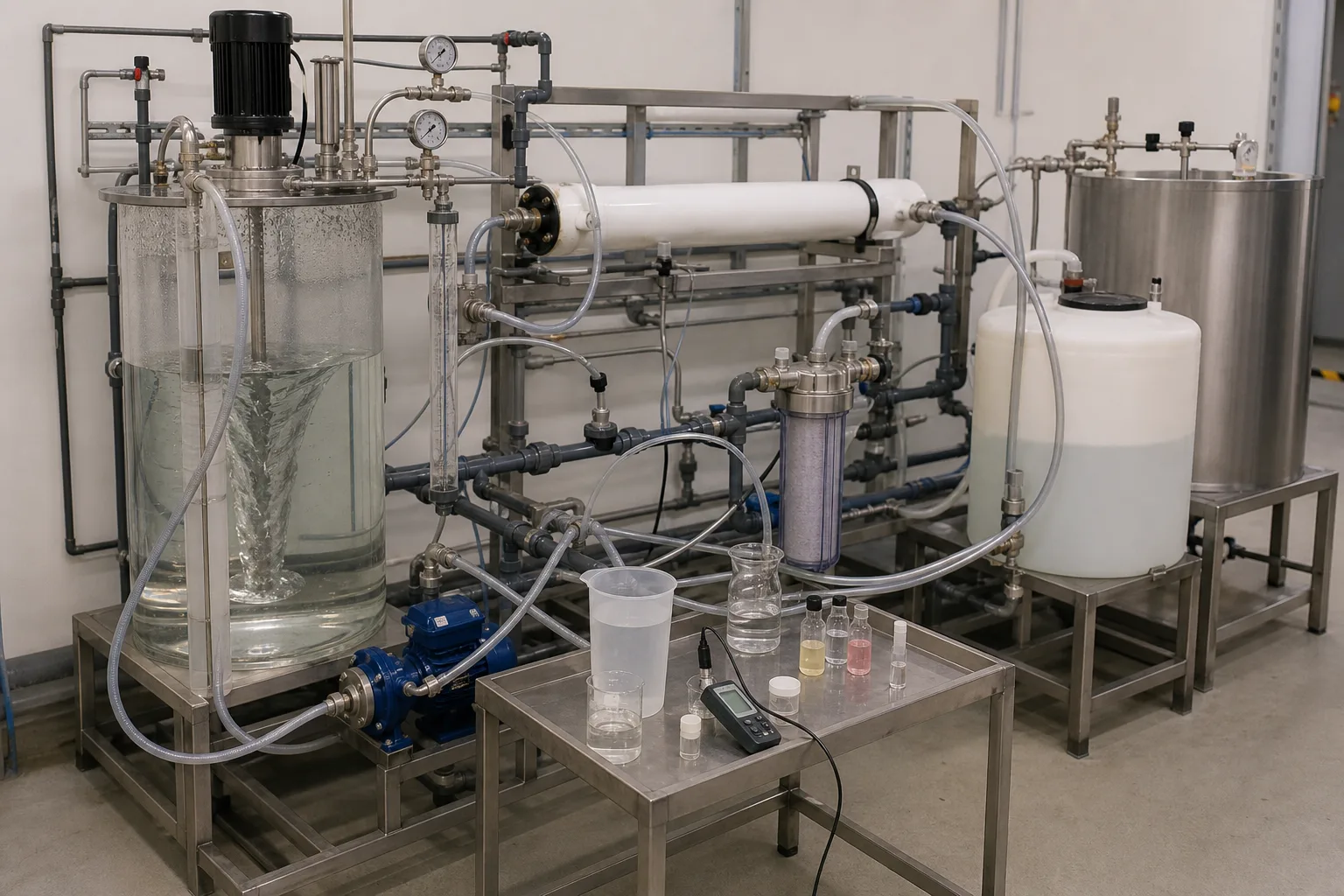 11Mixed tank pH/T inventory22Low-pressure pump and flow/ΔP33Vessel feed-to-concentrate recycle44Return filter and timed solution samples
What to identify
- 1Mixed tank pH/T inventory
- 2Low-pressure pump and flow/ΔP
- 3Vessel feed-to-concentrate recycle
- 4Return filter and timed solution samples
What the image proves
Low pressure suppresses permeation; sufficient crossflow supplies shear and transport. Both are required.
How to verify it
Displace at roughly half flow, then use the manufacturer vessel flow; monitor ΔP, clean stages separately and recirculate during soak.
Four parallel tests reveal chemistry matching and sequence effects
Untreated mixed fouling, alkaline removal, acid-first residue and the full alkaline–rinse–acid result are compared.
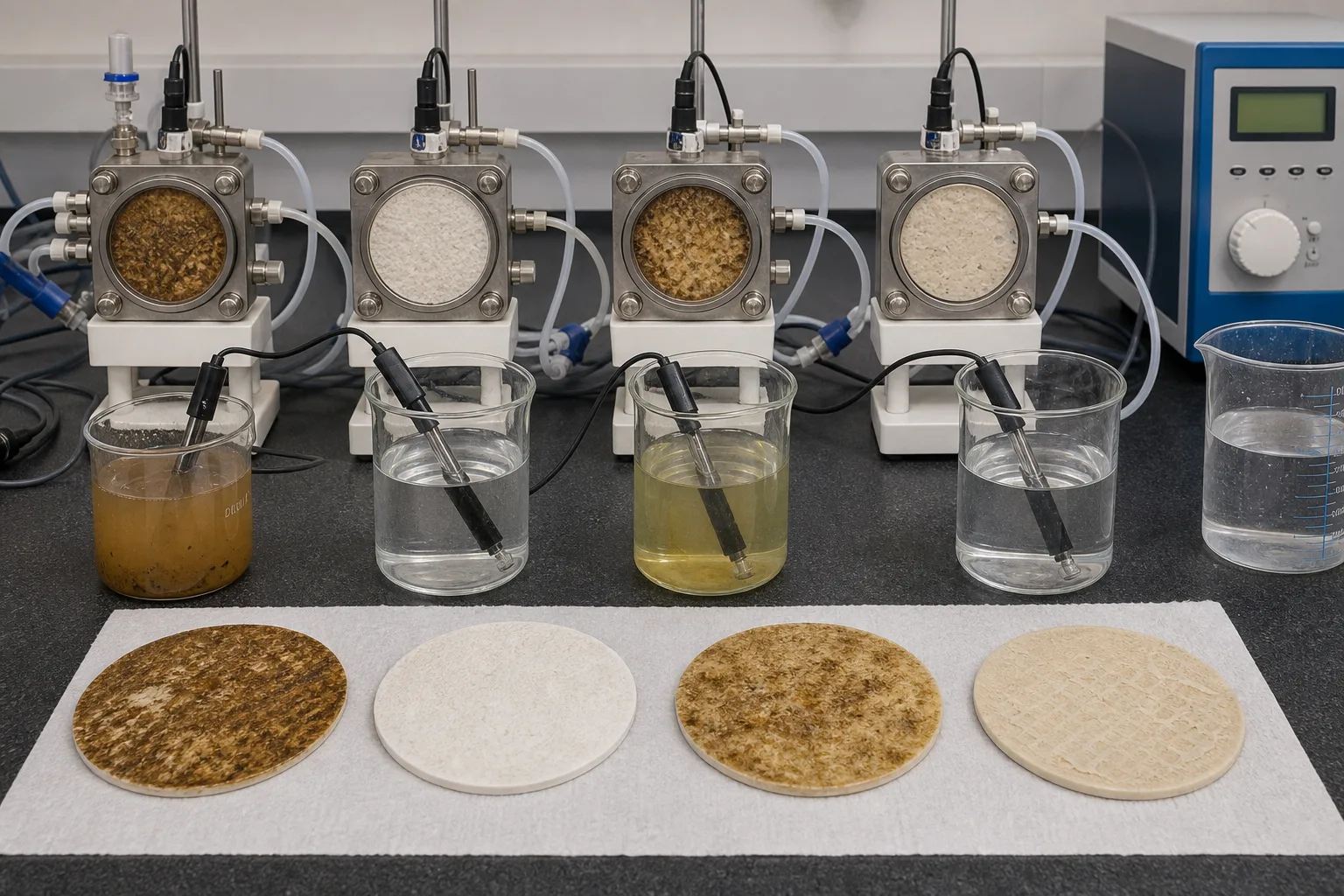 11Untreated composite baseline22Organic/biofilm removal after alkali33Residue after wrong acid-first sequence44Alkali–rinse–acid combined result
What to identify
- 1Untreated composite baseline
- 2Organic/biofilm removal after alkali
- 3Residue after wrong acid-first sequence
- 4Alkali–rinse–acid combined result
What the image proves
pH alone does not guarantee removal; formulation and order decide whether material disperses or fixes/redeposits.
How to verify it
Run compatible coupon tests at equal area, T, velocity and time; compare mass/microscopy and coupon flux/passage.
Before/after coupons, solution samples and normalized data close acceptance
Mineral, organic and clean coupons plus timed pH/turbidity samples connect surface removal to the pilot vessel.
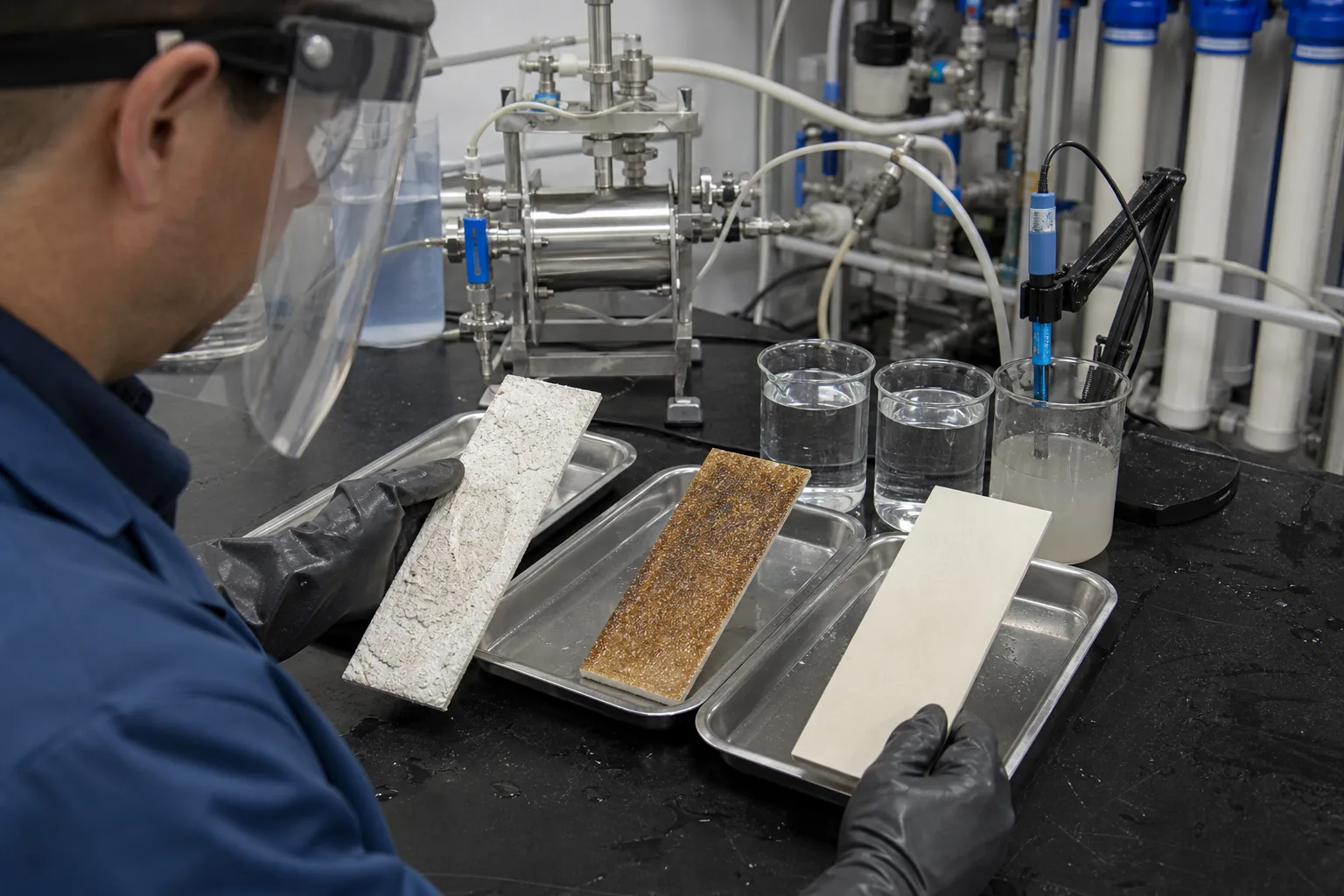 11Mineral coupon and dissolution evidence22Organic/biofilm coupon and dispersion33Rinsed clean coupon and integrity44Timed pH, turbidity, color and samples
What to identify
- 1Mineral coupon and dissolution evidence
- 2Organic/biofilm coupon and dispersion
- 3Rinsed clean coupon and integrity
- 4Timed pH, turbidity, color and samples
What the image proves
Dark solution is not the endpoint; normalized flow, passage and stage ΔP must recover without new integrity damage.
How to verify it
Record stable pre/post normalized metrics. If appearance improves but performance does not, investigate aged scale, compaction, wrong chemistry or damage.
Nine steps from CIP trigger to acceptance
Keep diagnosis, chemistry, hydraulics, safety and results in one batch record.
1. Confirm trigger
Normalized Qp↓ / passage↑ / ΔP↑
Exclude temperature, salinity, pressure, recovery and instrument effects.
2. Localize/sample
Stage profile + water/filter/deposit
Identify organic/biological, mineral, mixed or mechanical causes.
3. Choose recipe/order
Deposit + membrane → cleaner
Usually alkaline then acid; acid first only for confirmed simple carbonate/iron.
4. Make up safely
RO/DI water + chemical + pH/T
Stay inside SDS, compatibility and membrane envelope.
5. Low-flow displacement
Half-flow, low P → discard dilution
Replace process water without pressing dirt onto the surface.
6. Recycle/soak
High-flow shear ↔ intermittent soak
Maintain chemistry and carry loosened deposit back to tank/filter.
7. Monitor/replace
pH/T/Q/ΔP + color/turbidity
Detect depletion, loading and redeposition risk.
8. Flush out
RO/DI water → specified endpoint
Prevent reactions with feed or the next chemistry.
9. Restart/accept
Stable normalized Qp/passage/ΔP
Prove recovery and correct the upstream root cause.
Four deposits and cleaning directions
A starting map, not a replacement for the element manual.
Carbonate and some iron oxides/hydroxides
- Preferred direction
- Acid dissolution/complexation.
- Trap
- Sulfuric acid may precipitate CaSO₄; mixed organic/silica layers complicate acid-first.
- Confirmation
- Elemental/acid-solubility, pH demand, location and normalized recovery.
Organic, oil, colloid and biofilm
- Preferred direction
- High-pH surfactant/chelant/dispersant removal plus crossflow.
- Trap
- NaOH alone may not handle oil, silica or mature EPS; killing is not removal.
- Confirmation
- TOC/ash, microscopy/ATP, solution load and Qp/ΔP recovery.
Silica and sulfate/Ba/Sr scale
- Preferred direction
- Early, manufacturer-specific alkaline chelant/salt or specialty chemistry.
- Trap
- Aged deposits may be poorly recoverable; extreme chemistry risks the membrane.
- Confirmation
- ICP/mineralogy, saturation, last-stage pattern and coupon trials.
Composite layer
- Preferred direction
- Usually alkaline to open matrix, rinse, then acid for remaining mineral.
- Trap
- Acid first can react with silica, humics and biofilm and worsen performance.
- Confirmation
- Stepwise solution analysis, performance response and surface evidence.
FilmTec general cleaning triggers include about 10% normalized flow loss, 5–10% normalized salt-passage increase, or 10–15% normalized pressure-drop increase. They are trend triggers, not universal limits; use the latest manual for the installed element.
Retain four synchronized evidence sets
Pre-clean baseline
Normalized Qp, passage and stage ΔP; feed, SDI/biology, location and recent events.
Chemistry
Lot/active strength, make-up water, initial/return pH, T, time, additions, compatibility and SDS.
Hydraulics/load
Stage Q/P/ΔP, displacement, soak/recycle timing, filter, turbidity/color and replacement points.
Outcome/root cause
Rinse endpoint, waste, stable normalized recovery, integrity and pretreatment/operation correction.
Interpret common observations
- Observation
- First-stage ΔP rise, slimy brown layer, ATP/TOC high
- Likely direction
- Biofilm/organic/colloid composite
- Next action
- Alkaline dispersant clean, stage-wise crossflow, correct pretreatment
- Observation
- Last-stage flow loss, white acid-soluble deposit, supersaturation
- Likely direction
- Carbonate or acid-soluble scale
- Next action
- Confirm mineral and membrane envelope, acid clean, correct recovery/pH/antiscalant
- Observation
- Solution quickly dark/turbid and pH drifts
- Likely direction
- High load or exhausted chemistry
- Next action
- Record demand, dose or replace before redeposition
- Observation
- Surface looks clean but normalized recovery fails
- Likely direction
- Aged insoluble scale, compaction, wrong chemistry or damage
- Next action
- Stop extreme repeat cleaning and analyze coupon/element
Four common mistakes
Acid removes every mineral; alkali every organic
Sulfates, silica, metal-organic complexes and mature biofilm need specific formulations.
Stronger, hotter and longer is better
pH–temperature–time must stay inside the element envelope; loaded cold soak can redeposit.
White deposit means acid first
Color is not mineralogy, and mixed layers can worsen under acid-first cleaning.
Dark return means success
Success is flush quality and normalized performance recovery plus root-cause correction.