Illustrated guides · Biological treatment
Why is denitrification still needed to remove total nitrogen?
Nitrification turns ammonia into nitrate but leaves nitrogen in the water. Under anoxic conditions with nitrate and an electron donor, denitrification reduces NO₃⁻/NO₂⁻ through intermediates to N₂ gas, creating the main biological route for nitrogen to leave the liquid.
Direct answer
Direct answer
Total nitrogen includes ammonia, nitrite, nitrate and organic nitrogen. Nitrification converts NH₄-N to NO₃-N but does not by itself lower TN. When dissolved oxygen is scarce, facultative denitrifiers use NO₃⁻/NO₂⁻ as electron acceptors and biodegradable influent carbon, stored carbon or an external carbon source as the electron donor. The chain NO₃⁻ → NO₂⁻ → NO → N₂O → N₂ lets nitrogen leave the water as gas and recovers part of the alkalinity consumed by nitrification. Stable removal requires delivery of nitrate to an anoxic zone, low oxygen without loss of mixing, and enough—but not excessive—available carbon.
Four conditions must coincide
Anoxic does not mean idle or devoid of electron acceptors; it means low DO with nitrate or nitrite available.
Nitrate must reach the anoxic zone
Pre-anoxic systems return nitrate-rich aerobic liquor; post-anoxic systems treat nitrified effluent. Low recycle, short circuiting or dead zones let nitrate bypass reaction.
DO stays low while mixing continues
Facultative organisms use dissolved oxygen first. Oxygen carryover consumes carbon and anoxic time; mechanical mixers keep nitrate, carbon and biomass in contact without aeration.
Appropriate biodegradable carbon is available
Pre-anoxic zones use influent carbon first; post-anoxic zones often need supplemental carbon after upstream oxidation. Dose depends on nitrate load, carbon COD equivalent and observed yield.
Temperature, pH, contact and biomass fit
Cold water slows rates, while HRT, active biomass, pH and toxicity set completion. Carbon cannot correct severe short circuiting or solids loss.
An anoxic zone organizes mixing, recycle and carbon
Submersible mixers circulate an unaerated basin, a dosing skid stands at left, a large line returns nitrate-rich mixed liquor and an adjacent aerobic lane remains aerated.
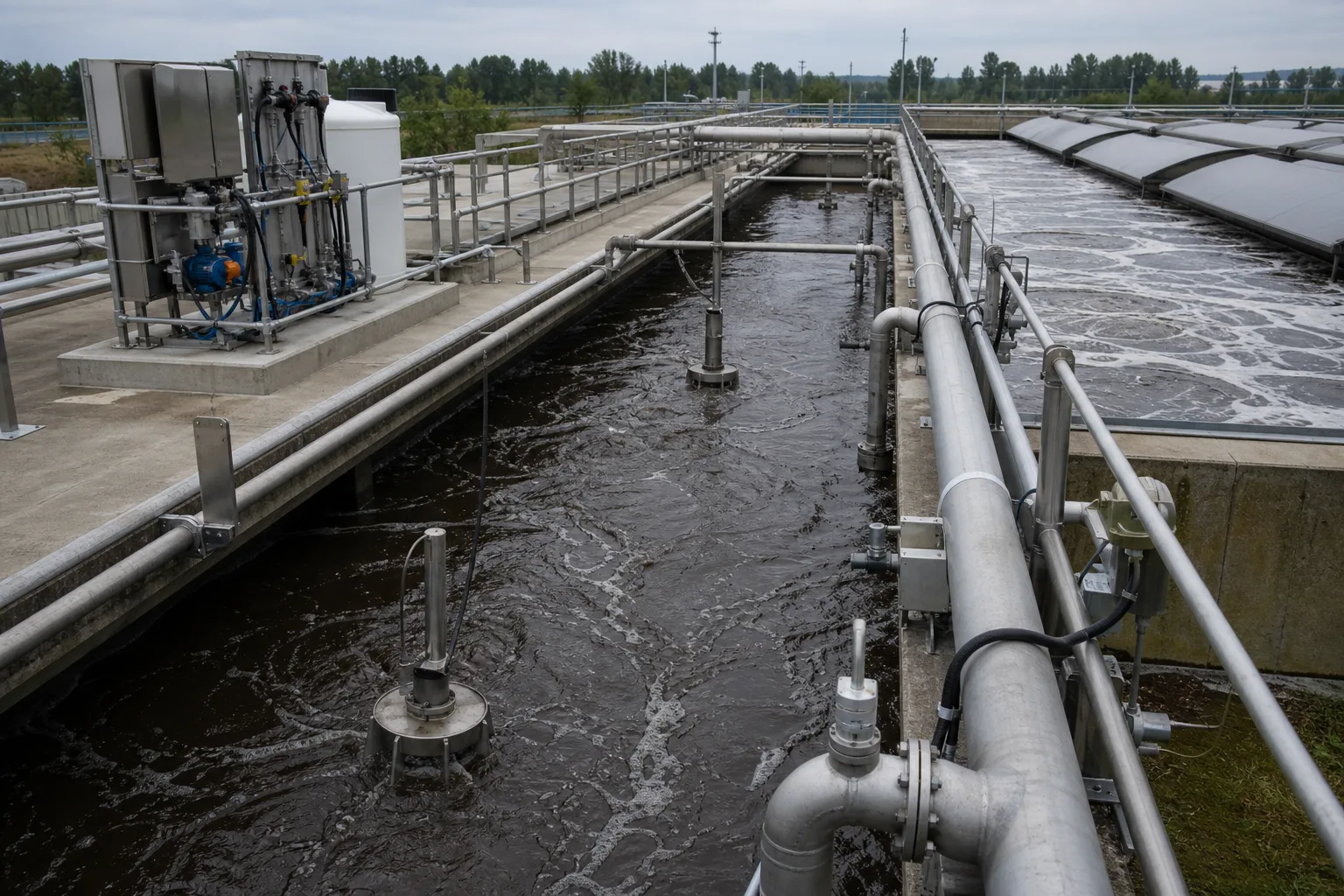 11External-carbon storage and dosing22Unaerated anoxic mixing zone33Nitrate-rich internal recycle44Adjacent aerobic nitrification zone
What to identify
- 1External-carbon storage and dosing
- 2Unaerated anoxic mixing zone
- 3Nitrate-rich internal recycle
- 4Adjacent aerobic nitrification zone
What the image proves
Denitrification is mixed, not stagnant. A pre-anoxic zone receives influent carbon and nitrate recycle; carbon, nitrate, recycle and effective volume set removable load.
How to verify on site
Verify recycle flow and nitrate load, zoned DO/ORP, biodegradable influent COD, actual dosing-pump output and mixer coverage using mass loads, not setpoint alone.
Denitrifiers reduce oxidized nitrogen to gas
A realistic microscopic interpretation shows facultative heterotrophs, nitrogen molecules, usable carbon and bubbles leaving a floc; it explains a pathway, not ordinary microscopy identification.
 11NO₃⁻/NO₂⁻ entering the floc22Facultative denitrifiers33Biodegradable carbon donor44N₂ bubbles leaving
What to identify
- 1NO₃⁻/NO₂⁻ entering the floc
- 2Facultative denitrifiers
- 3Biodegradable carbon donor
- 4N₂ bubbles leaving
What the image proves
Oxidized nitrogen is metabolically reduced, not merely adsorbed. Carbon donates electrons and is oxidized while nitrogen becomes N₂; incomplete chains can elevate nitrite or N₂O.
How to verify on site
Use NO₃-N, NO₂-N, dissolved/tail-gas N₂ or TN load change. Bubble appearance cannot distinguish nitrogen from air or other gases.
Aerobic nitrification and anoxic reduction form one hydraulic loop
The cutaway places an unaerated mixed zone beside a diffuser-equipped aerobic zone and downstream settling; influent and recycles deliver carbon, nitrate and biomass.
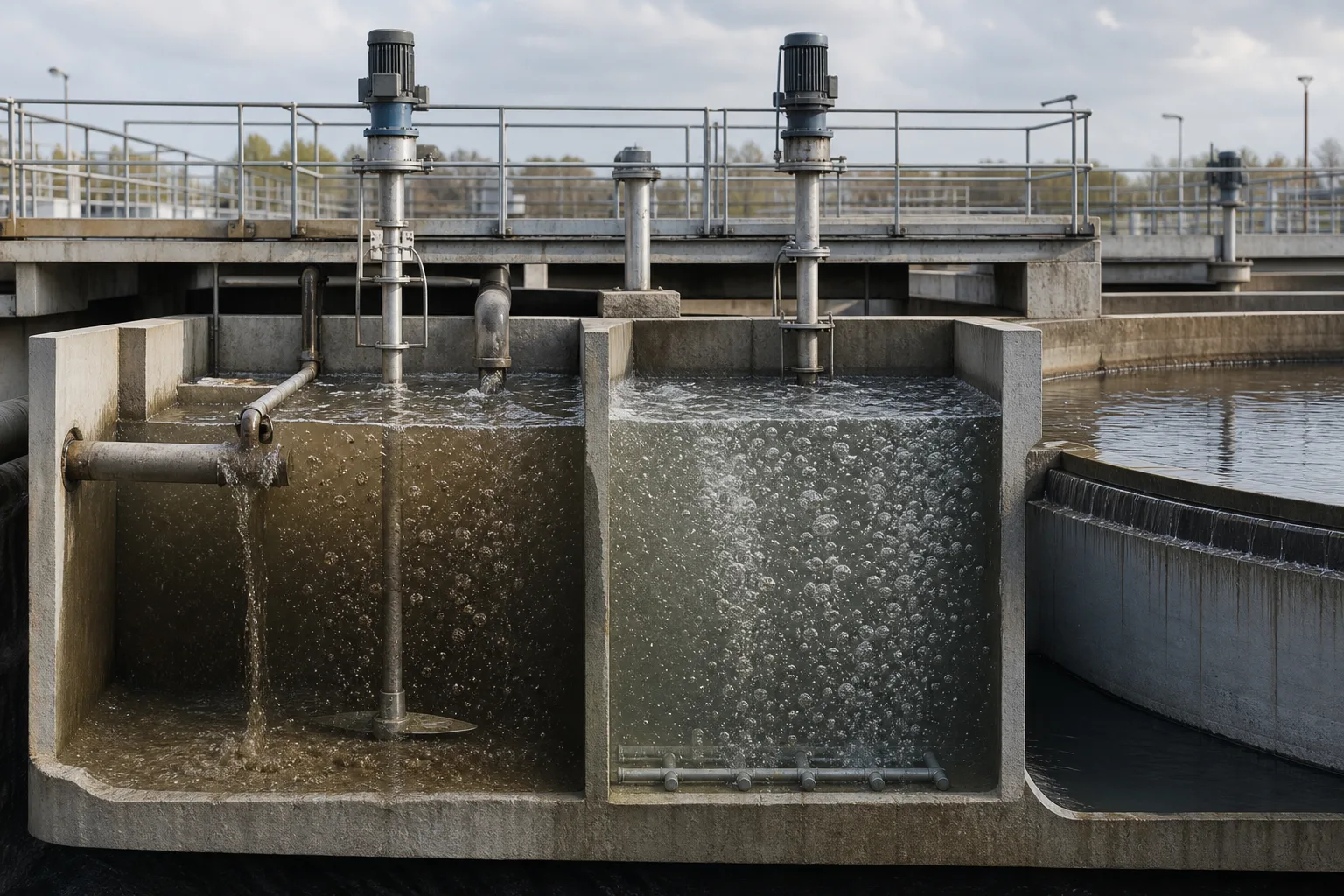 11Anoxic denitrification zone22Mechanical mixing and influent carbon33Aerobic nitrification and nitrate44Settling, recycle and effluent
What to identify
- 1Anoxic denitrification zone
- 2Mechanical mixing and influent carbon
- 3Aerobic nitrification and nitrate
- 4Settling, recycle and effluent
What the image proves
An anoxic tank without nitrate recycle, or nitrification without usable carbon, cannot remove TN. Pre-, post- and multistage layouts differ mainly in where nitrate and carbon meet.
How to verify on site
Map actual flows and sample flow, NH₄/NO₂/NO₃-N and COD in each stream; inspect pumps, gates, short circuits and effective volumes.
Carbon shortage, balance and excess produce different outcomes
Parallel reactors with independent mixers, dosing and probes compare nitrate residual under low carbon, stable removal at a matched load, and excess carbon with COD/biomass risk.
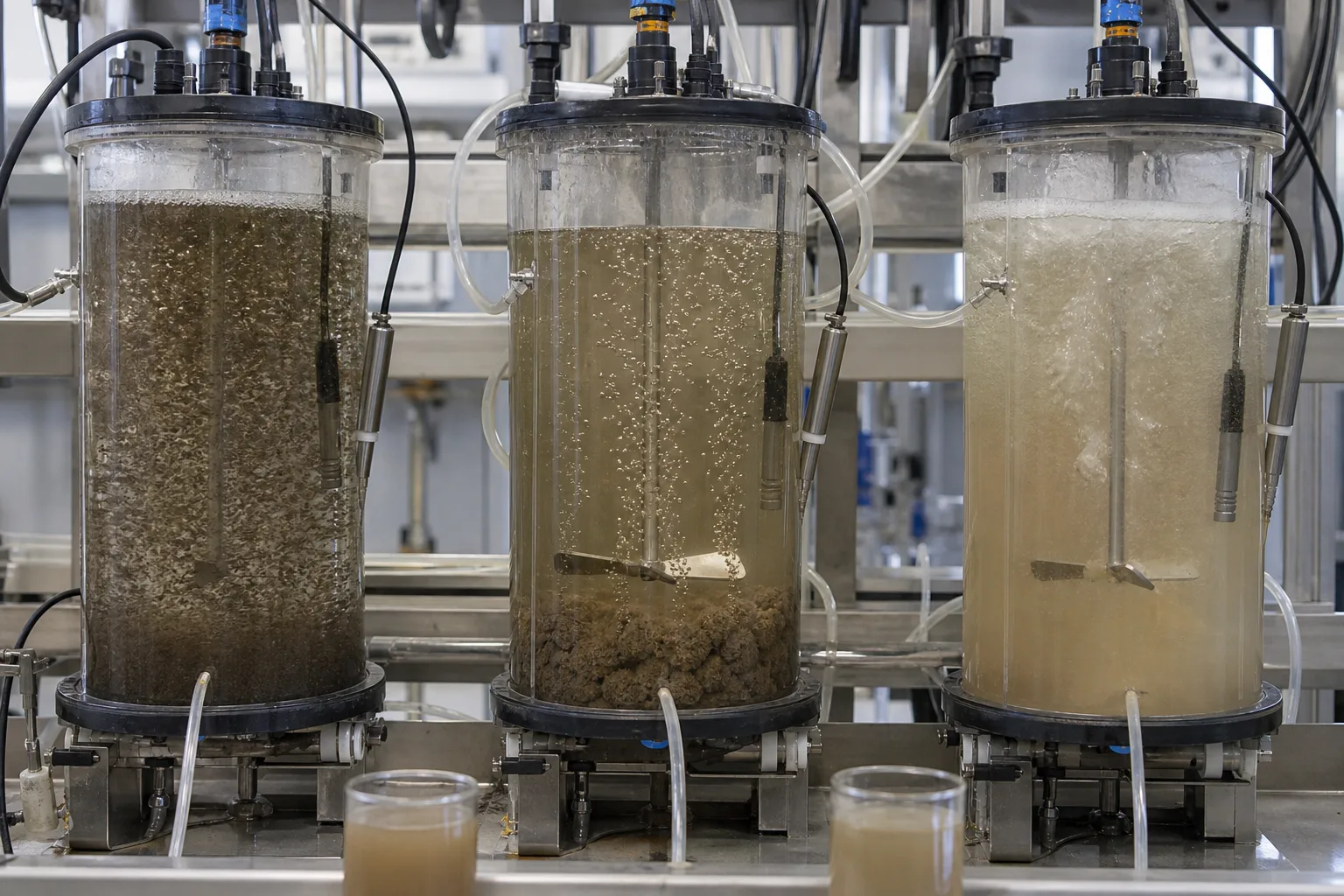 11Carbon-limited nitrate residual22Matched carbon and stable removal33Excess carbon and effluent-COD risk44Mixers, DO/ORP and dosing probes
What to identify
- 1Carbon-limited nitrate residual
- 2Matched carbon and stable removal
- 3Excess carbon and effluent-COD risk
- 4Mixers, DO/ORP and dosing probes
What the image proves
More carbon helps only when carbon is limiting. Too little limits rate; too much raises cost, effluent COD, sludge and downstream oxygen demand.
How to verify on site
Run dose-response tests on the same nitrified water, tracking NO₃/NO₂-N, soluble COD, pH, ORP and time; calibrate the full dosing train.
Floating sludge may be denitrification inside the clarifier
Gas-bearing floc floats on a clarifier while samples and a cleaned probe connect effluent TN, nitrate, blanket behavior and instrument maintenance.
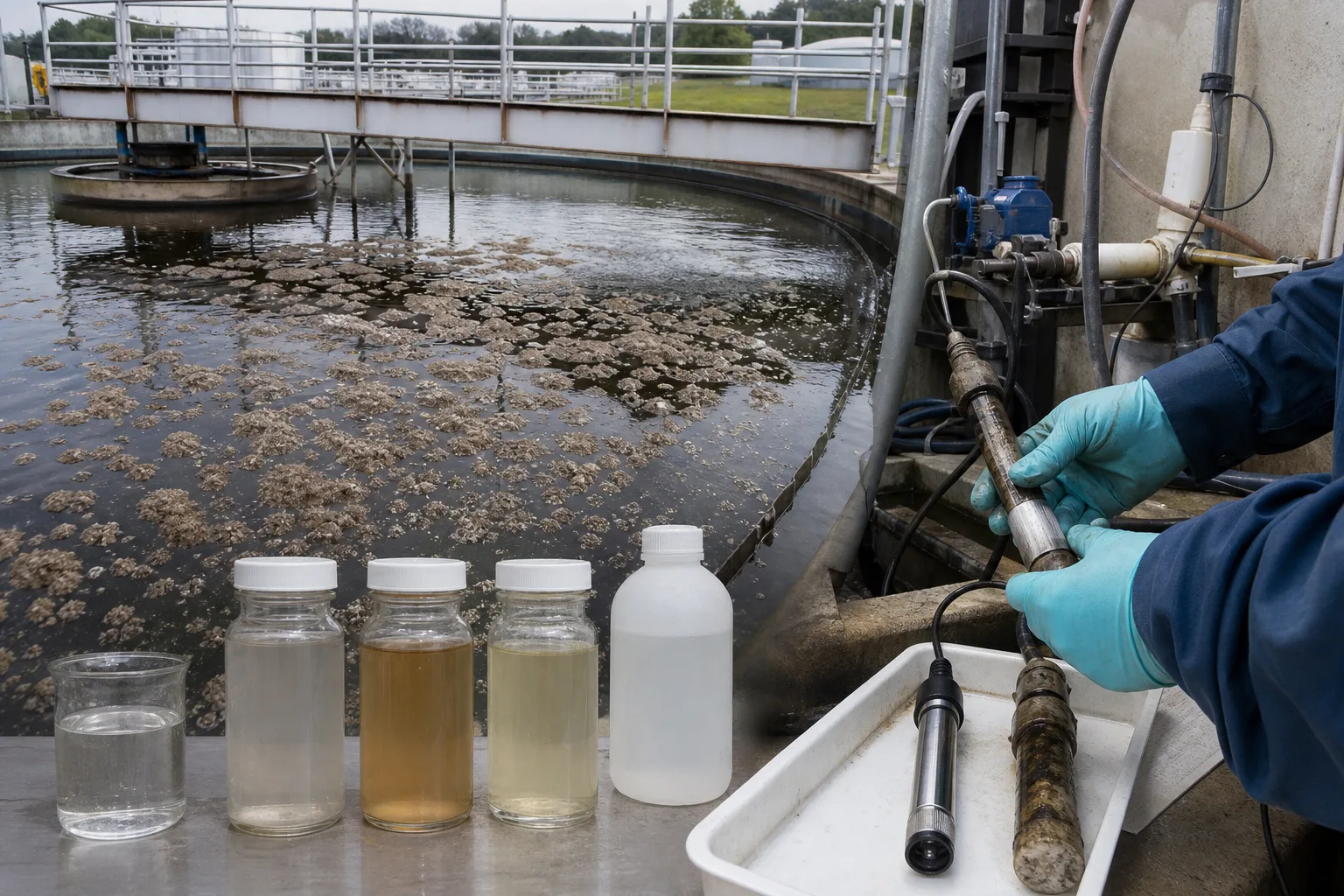 11Gas-lifted sludge floc22Influent/effluent nitrate samples33DO/ORP online probe44Recycle, wasting and carbon equipment
What to identify
- 1Gas-lifted sludge floc
- 2Influent/effluent nitrate samples
- 3DO/ORP online probe
- 4Recycle, wasting and carbon equipment
What the image proves
Nitrate reduction inside a deep, long-retained blanket may lift sludge with N₂ bubbles. It may lower some nitrate but damages separation and is not a controlled anoxic process.
How to verify on site
Check blanket, RAS/WAS, retention, nitrate, effluent TSS, SVI, surface bubbles and probe calibration; distinguish gas lift from bulking and hydraulic overload.
Six steps from nitrate to nitrogen gas
The path shows why nitrification comes first and why recycle and carbon are indispensable.
1 Form oxidized nitrogen
NH₄-N → NO₂-N → NO₃-N
Nitrification creates substrate for denitrification.
2 Deliver nitrate
Aerobic liquor/nitrified effluent → anoxic zone
Recycle or post-anoxic flow connects nitrate with denitrifiers.
3 Supply electrons
Influent/stored/external carbon → cells
Provide electron donor and metabolic energy.
4 Reduce in sequence
NO₃⁻ → NO₂⁻ → NO → N₂O → N₂
Convert dissolved oxidized nitrogen to mainly N₂.
5 Release gas and recover alkalinity
Dissolved N₂ → bubbles/atmosphere
Move nitrogen out of water and offset part of nitrification acidity.
6 Close the TN balance
Influent TN = effluent + sludge N + gaseous N
Separate real removal from dilution, sampling error and solids carryover.
Four key roles in denitrification
Multiple processes coexist, so distinguish acceptor, donor, transport and solids separation.
NO₃-N/NO₂-N acceptor
- Main duty
- Accept electrons and become N₂
- Failure mode
- Low recycle, incomplete nitrification or bypass leaves too little substrate
- Field evidence
- Flow and NO₃/NO₂ loads plus zoned profiles
Biodegradable carbon donor
- Main duty
- Supply electrons and energy
- Failure mode
- Too little leaves nitrate; too much raises COD, sludge and cost
- Field evidence
- rbCOD/VFA, pump calibration, effluent COD and rate tests
Anoxic mixing and low DO
- Main duty
- Contact nitrate, carbon and biomass without oxygen priority
- Failure mode
- Oxygen carryover, leakage or dead zones reduce effective volume
- Field evidence
- Multipoint DO/ORP, mixer current and hydraulic checks
Biomass retention and separation
- Main duty
- Retain active organisms and separate solids
- Failure mode
- Cold, low biomass, washout or clarifier gas lift degrades results
- Field evidence
- SRT/MLSS, blanket, RAS/WAS, TSS and surface signs
Denitrification can also occur in post-anoxic filters, biofilms, unaerated SBR phases or low-oxygen floc interiors. Possibility does not prove reliable compliance; validate it with nitrogen loads, carbon and hydraulics.
Track three evidence groups
Nitrogen and carbon loads
Measure flow, NO₃/NO₂/NH₄-N, TN, rbCOD/VFA and actual external-carbon dose in influent, recycle, zones and effluent.
Anoxic environment and rate
Multipoint DO/ORP, temperature, pH, contact time, mixing and specific denitrification rates separate bad environment from low activity/contact.
Recycle and solids separation
Internal recycle, RAS/WAS, MLSS/SRT, blanket, TSS and floating solids prevent uncontrolled clarifier denitrification from being mistaken for success.
Where should signal combinations lead?
- Signal combination
- High inlet and outlet nitrate with high anoxic DO
- First suspicion
- Oxygen carryover or aeration leakage consumes carbon first
- Next action
- Check recycle discharge, DO profile, air valves and mixing; reduce oxygen input before increasing carbon
- Signal combination
- Low DO, high nitrate and very low soluble effluent COD
- First suspicion
- Available carbon shortage or failed dosing delivery
- Next action
- Check rbCOD/VFA, tank/pump calibration and blockage; dose from nitrate load after a rate test
- Signal combination
- Nitrate falls but nitrite accumulates
- First suspicion
- Incomplete reduction due to carbon, contact, temperature, pH or transient load
- Next action
- Confirm analysis and review zoned ORP/NO₃/NO₂ and carbon residual; do not hide the intermediate with endpoint TN
- Signal combination
- Clarifier float, high TSS and falling blanket nitrate
- First suspicion
- N₂ gas lift from denitrification in the blanket
- Next action
- Reduce blanket residence, adjust RAS/WAS and upstream anoxic removal while excluding bulking/hydraulic shock
Four misconceptions
Complete nitrification means compliant TN
Nitrification only creates nitrate. Without denitrification or another nitrogen sink, TN leaves with the effluent.
Anoxic means no oxygen and no mixing
An anoxic zone has low DO, nitrate and continuous mechanical mixing; stagnant basins settle and short-circuit.
More carbon always lowers TN
Excess carbon raises effluent COD, sludge and cost. Dose to nitrate load, carbon quality, rate tests and feedback.
Floating sludge always means bulking
Deep-blanket denitrification can lift floc with gas; compare nitrate, blanket, SVI, microscopy and hydraulics.