Illustrated guides · Disinfection, oxidation, and micropollutants
Why is sodium hypochlorite useful but demanding to handle?
Sodium hypochlorite is a liquid available-chlorine source that can be stored and metered at ambient pressure, but it decays with time, heat, light, concentration, and contamination and remains a corrosive oxidizer with dangerous incompatibilities.
Direct answer
Direct answer
Sodium hypochlorite is widely used because it can be delivered as a liquid or generated on site from brine, avoiding pressurized liquefied-chlorine cylinders. A tank, metering pump, and injection point create a straightforward flow-paced chlorination chain, and the solution forms the same HOCl/OCl⁻ disinfecting system in water as other chlorine sources. It still demands strict control. Commercial solution is strongly alkaline and oxidizing, corrosive to people and many materials, and can release toxic chlorine gas when mixed with acid or hazardous chloramine gases when mixed with ammonia or amines. Incompatible chemicals therefore require physical separation at unloading connections, piping, containment, and drains. Available chlorine is not constant: age, higher temperature, light, higher concentration, and metal contamination accelerate decay and can increase chlorate. Decomposition gas can lock suction lines, heads, and check valves; crystallized salts and material attack can stop a pump or plug an injection quill. Control begins with measured available chlorine for each delivery or on-site batch, then uses shaded, cool, short-turnover, compatible vented storage, dedicated containment and connections, eyewash/shower, ventilation, and PPE. Calibrated pumps dose by water flow and demand, while injection, contact, residual, and microbial outcome are independently checked. Underdose fails disinfection; overfeeding or blindly compensating for old solution increases corrosion, salt, byproducts, and cost.
Four conditions make a common chemical responsibly usable
Liquid in a tank, a moving pump, or chlorine odor does not prove accurate or safe available-chlorine delivery.
Treat available chlorine as a changing raw material
Manufacture, on-site generation, transport, and storage history change strength. Batch/periodic testing plus inventory-age, temperature, light, and contamination control converts pump volume to real dose.
Physically segregate incompatibles
Acid mixing can release chlorine gas; ammonia or amines can release chloramine gases. Dedicated couplings, clear identification, separate containment, and no shared drain are stronger than instructions alone.
Design storage and feed for a corrosive oxidizer
Tank, hose, valves, seals, head, and quill must suit concentration, temperature, and manufacturer compatibility. Venting, gas management, spill collection, and emergency washing also matter.
Close both process and outcome loops
Calibrate actual pump output, confirm no gas lock, siphon, or crystal blockage, then tune against demand, contact-basin residual, and microbial target. A higher speed can hide equipment failure.
A complete room combines storage, secondary containment, duplex pumps, and emergency washing
A compatible bulk tank sits inside concrete containment, duplex pumps and a calibration column form a switchable feed chain, and the operator uses PPE near ventilation and emergency shower/eyewash.
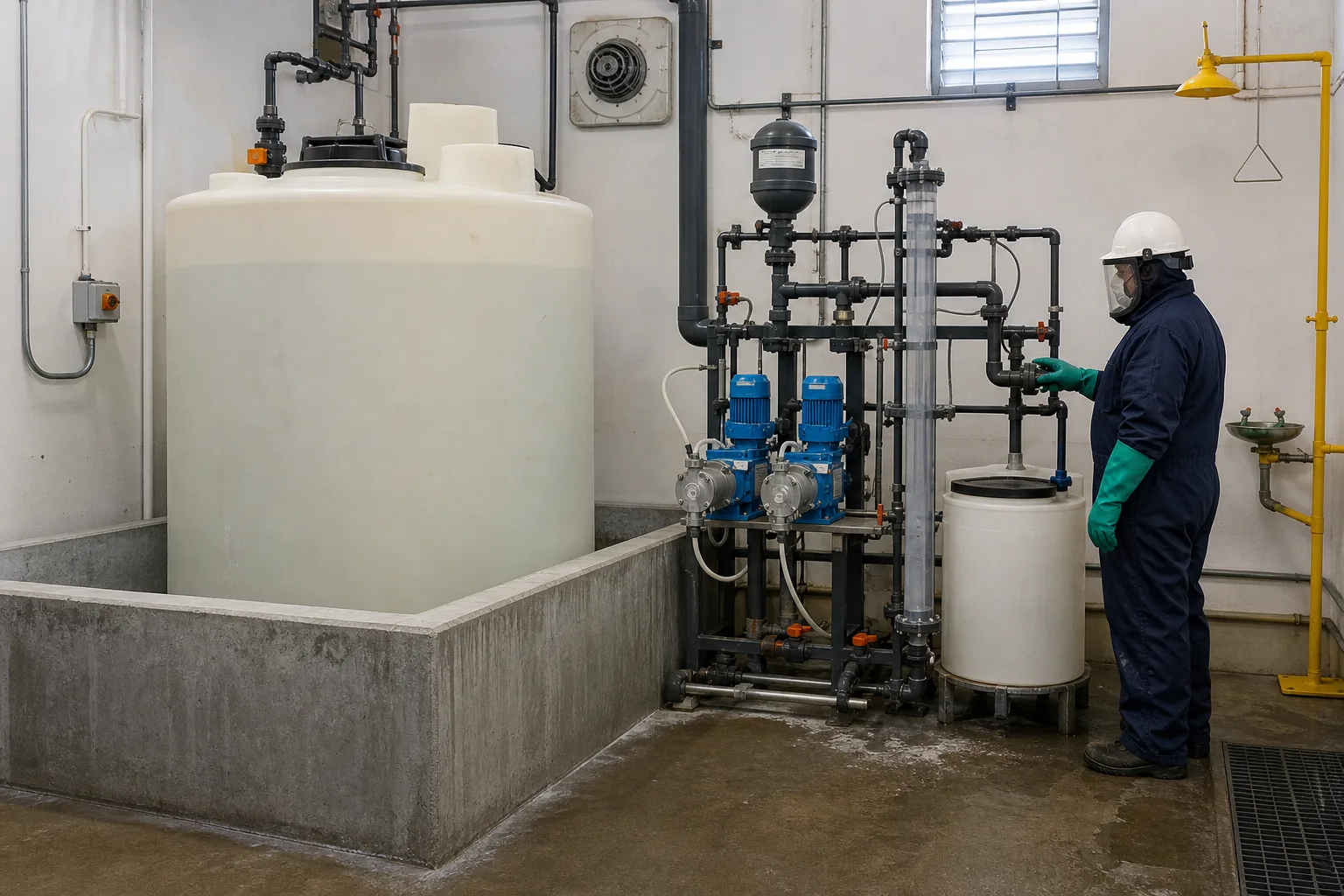 11Shaded compatible storage tank22Dedicated secondary containment33Duplex pumps and calibration column44PPE, ventilation, emergency wash
What to identify
- 1Shaded compatible storage tank
- 2Dedicated secondary containment
- 3Duplex pumps and calibration column
- 4PPE, ventilation, emergency wash
Figure takeaway
Liquid hypochlorite removes cylinders and vaporizers but remains a chemical facility. Containment, ventilation, dedicated materials, standby feed, and emergency equipment are part of system integrity.
How to verify it in the field
Verify SDS/compatibility, vent and high-level alarm, containment volume and drain isolation, pump changeover/calibration, eyewash/shower access, PPE, and spill response materials.
Sample and titration comparisons show storage-dependent strength loss
Titration measures available chlorine while amber bottles represent fresh, aged, heated/light-exposed, or contaminated controls. Color is only a warning and cannot replace analysis.
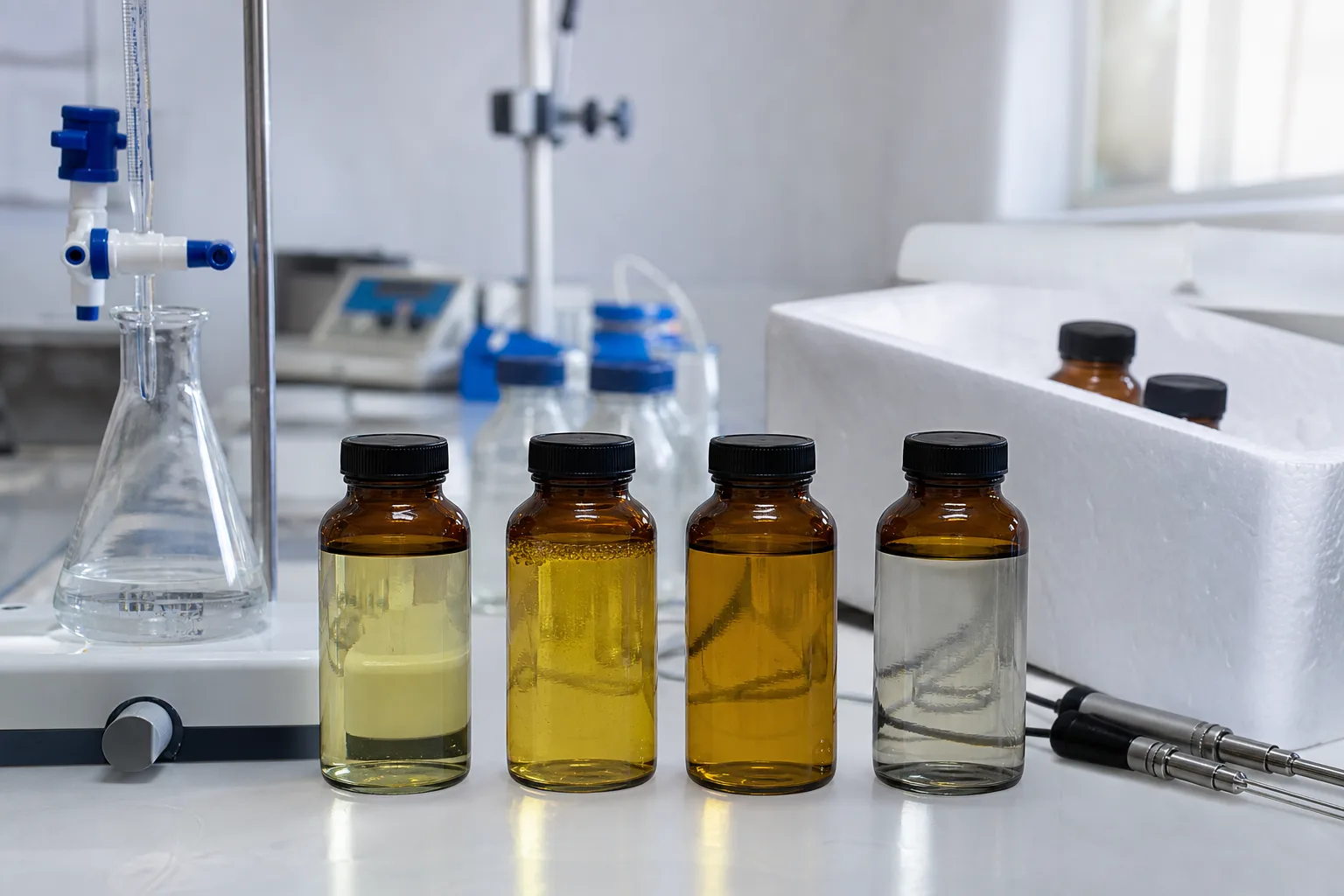 11Available-chlorine analysis22Fresh-batch baseline33Age/temperature comparison44Degraded or contaminated sample
What to identify
- 1Available-chlorine analysis
- 2Fresh-batch baseline
- 3Age/temperature comparison
- 4Degraded or contaminated sample
Figure takeaway
Equal pump volume does not mean equal chlorine mass. Decay silently underfeeds; compensating with speed consumes stock faster and conceals the storage problem.
How to verify it in the field
Test on receipt/generation and through storage. Record batch, sample date, tank temperature, age, and blending; monitor chlorate or relevant impurities where applicable and use first-in/first-out turnover.
Bulk tank, day tank, metering pumps, calibration columns, and injection form a traceable mass chain
Bulk inventory and containment are left, a smaller day/buffer vessel stabilizes suction, duplex pumps and columns verify output, and the right-side flow cell/instrument links feed to process water.
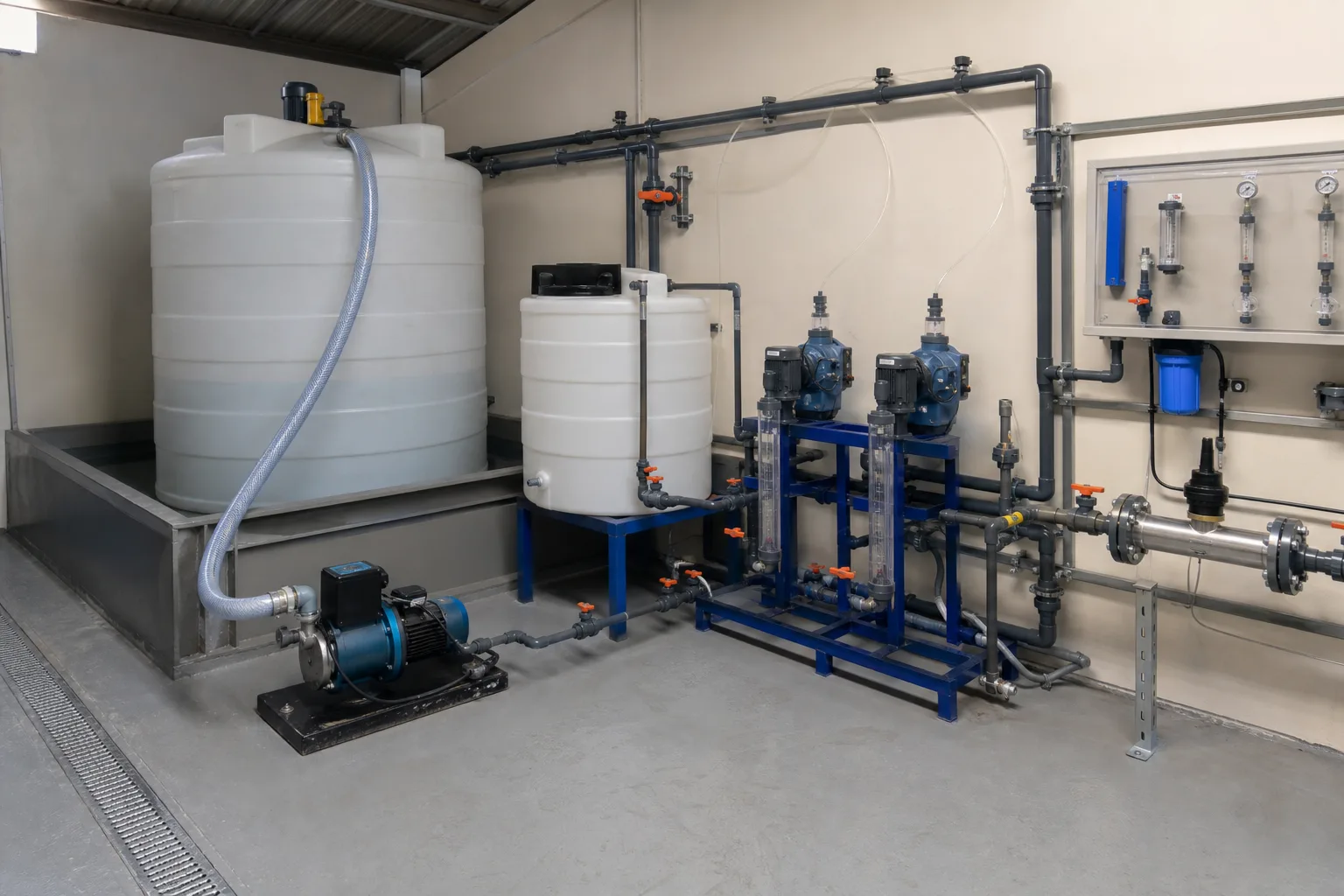 11Bulk inventory and containment22Day/buffer vessel and suction33Duplex pumps, valves, calibration44Injector, process pipe, instrument
What to identify
- 1Bulk inventory and containment
- 2Day/buffer vessel and suction
- 3Duplex pumps, valves, calibration
- 4Injector, process pipe, instrument
Figure takeaway
Actual dose equals measured available-chlorine strength × measured chemical flow ÷ water flow. Nameplate stroke, speed, or level change alone cannot close the tank-to-residual chain.
How to verify it in the field
Measure each pump by column or gravimetry, test backpressure/anti-siphon and standby capacity, inspect suction slope/vent/valves/leaks, and reconcile use with water total and residual.
Parallel tests expose underdose, target treatment, and overfeed/corrosion together
Separate reactors receive different available-chlorine exposures; culture plates, metal coupons, and colorimetric residual tubes compare microbial control, material attack, and residual.
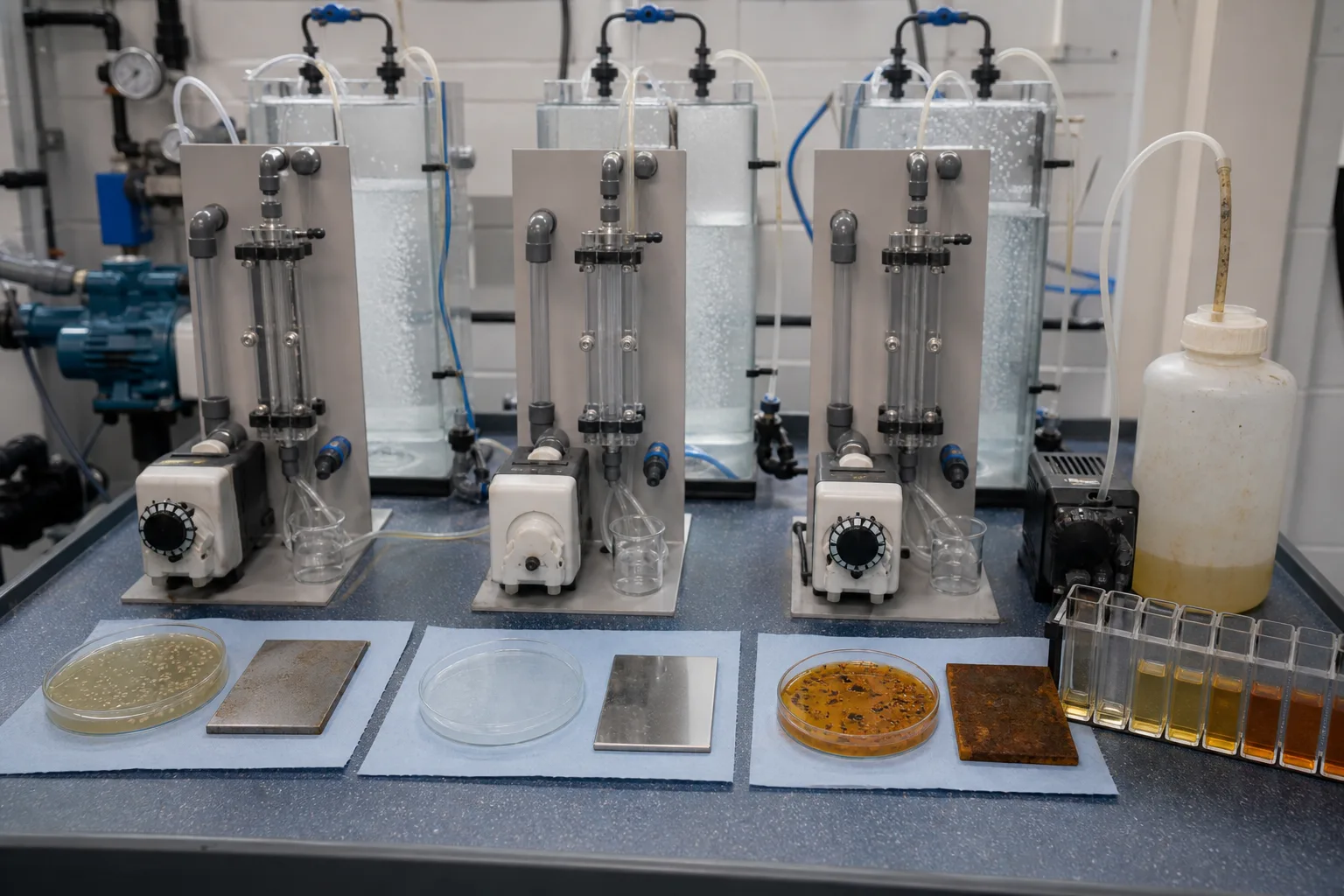 11Underdose/microbial survival22Target dose and contact33Over-residual/corrosion condition44Culture, coupon, and residual evidence
What to identify
- 1Underdose/microbial survival
- 2Target dose and contact
- 3Over-residual/corrosion condition
- 4Culture, coupon, and residual evidence
Figure takeaway
The optimum is not the maximum dose. It meets the microbial target at current water and contact while limiting residual, material damage, and byproducts. Fresh and aged solutions cannot be compared by one pump setting.
How to verify it in the field
Run dose–demand–contact trials with current feed and chemical. Measure free/total residual, microbes, and relevant DBPs; align coupons and maintenance with material and dose.
Crystals and gas lock can turn a running head into zero chemical delivery
Technicians inspect a crystallized quill, pump, and piping while comparing waters. Face shields, gloves, and aprons protect against alkaline oxidizer splash.
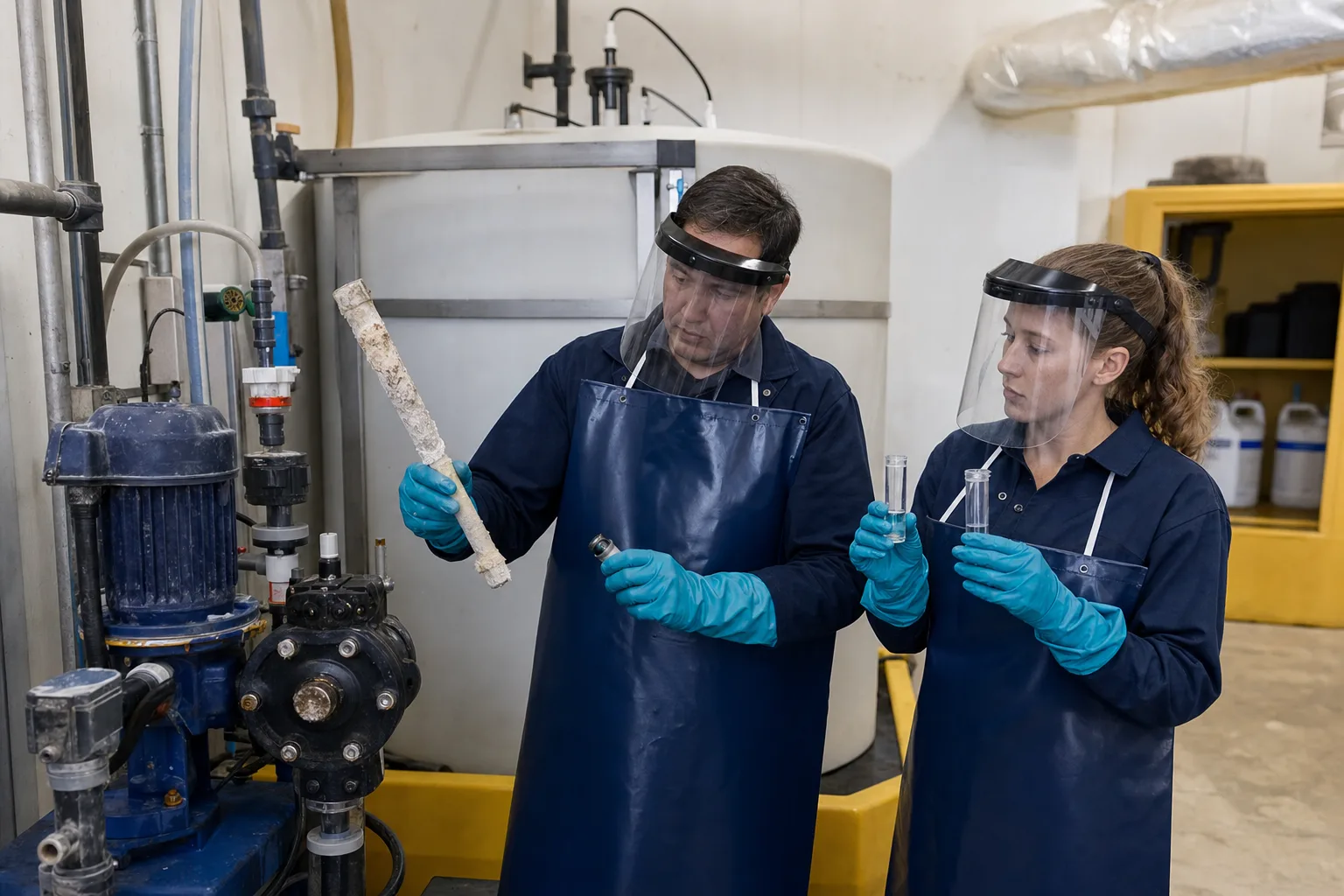 11Metering head and check valves22Crystallized injection component33Face shield, gloves, chemical apron44Stock/process residual samples
What to identify
- 1Metering head and check valves
- 2Crystallized injection component
- 3Face shield, gloves, chemical apron
- 4Stock/process residual samples
Figure takeaway
Decomposition gas, suction air leaks, crystals, or stuck check balls can preserve the stroke signal while eliminating mass flow. Maintenance requires isolation, depressurization, and compatible flushing before opening.
How to verify it in the field
Compare column output with control, watch suction bubbles/head temperature/pulsation, then isolate safely and inspect balls, diaphragm, backpressure valve, and quill using a compatible cleaning procedure.
Six controls from delivery or generation to effective residual
Every step can change available-chlorine mass or introduce a safety hazard.
1 Receive and identify
Dedicated connection → batch/strength check
Prevent incompatible unloading and establish baseline quality.
2 Store safely
Shaded, cool, vented tank + separate containment
Slow decay and control leaks, gas, and exposure.
3 Manage strength and age
Available-chlorine test + FIFO
Convert volume to usable mass and limit chlorate growth.
4 Calibrate feed
Measured strength × measured pump flow
Deliver real mass dose by water flow and demand.
5 Inject and contact
Anti-siphon/backpressure → mix → CT
Avoid backflow, gas lock, and local attack while creating exposure.
6 Verify and maintain
Residual/microbes/DBPs + pump/valve checks
Prove outcome and correct decay, crystals, and corrosion early.
What the four subsystems must do
Chemical safety, stock quality, feed mechanics, and treatment outcome need separate evidence.
Unloading, tank, containment
- Primary role
- Verify identity, isolate acid/ammonia, manage heat/light and spills
- Typical failure
- Wrong connection, shared containment/drain, poor venting, incompatible tank, excessive age, or heat
- Key evidence
- Keyed coupling, labels/SDS, checklist, temperature/age/level, vent, containment, inspections
Stock-solution quality
- Primary role
- Measure available chlorine and manage decay, blending, chlorate, on-site generation
- Typical failure
- Permanent nameplate strength, stratified refill, catalytic contamination, or excessive age
- Key evidence
- Strength tests, batch/generation records, temperature/light, turnover, chlorate, mass balance
Pump, valves, injection
- Primary role
- Provide calibratable flow, prevent siphon/backflow, and mix into water
- Typical failure
- Gas lock, lost prime, diaphragm/ball failure, crystal blockage, low backpressure, material attack
- Key evidence
- Column/weight output, stroke/speed, pressure, bubbles, valves, standby test, injection inspection
Process and outcome control
- Primary role
- Pace to flow/demand and verify contact, residual, microbes, and byproducts
- Typical failure
- Trusting pump signal, analyzer drift, low peak CT, overfeed, or rising precursors
- Key evidence
- Water flow, free/total residual, pH/temp, CT, microbes, DBPs, online/manual check, chemical use
Storage temperature, concentration, materials, containment, and emergency provisions must follow local rules, the SDS, supplier, and equipment manufacturer. Do not transfer household-bleach recipes or one plant's fixed dose into a water facility.
Align three data groups to one stock batch and operating cycle
Chemical and storage
Batch/generation date, measured available chlorine, tank temperature, age, level/refill, light, venting, chlorate or relevant impurities, and spill/containment events.
Metering and hydraulics
Calibrated pump flow, stroke/speed, suction/discharge pressure, gas/prime, valves, injection point, water flow, mixing, and contact; close chemical-use mass balance.
Disinfection and cost
Demand, profile/outlet free and total residual, pH/temp, microbes, DBPs, corrosion/crystals, maintenance, and effective-chlorine cost per water volume.
How combined signals locate abnormal dose or residual
- Combined signal
- Pump volume calibration passes, but inlet residual per stroke declines as tank age/temperature rises
- Suspect first
- Available-chlorine decay or refill dilution, not pump mechanics
- Next step
- Measure strength and recalculate mass dose; review batch, temperature, age, and chlorate; correct turnover rather than hiding with stroke
- Combined signal
- Controller shows running, but column level does not fall or output pulses while suction contains bubbles
- Suspect first
- Gas lock/lost prime or crystallized check valve
- Next step
- Safely switch to standby, isolate/depressurize, inspect suction seals, vent, balls, diaphragm, and crystals, then recalibrate
- Combined signal
- Pump and strength are stable but residual collapses during high turbidity or ammonia
- Suspect first
- Demand spike or chlorine-species change, not storage
- Next step
- Measure ammonia, nitrite, TOC/UV254, turbidity, free/total chlorine, run demand curve, and stabilize pretreatment/control
- Combined signal
- Pungent atmosphere, abnormal gas/pressure, or unknown liquid enters containment
- Suspect first
- Acid/ammonia incompatibility or severe contamination/decomposition—an emergency, not routine maintenance
- Next step
- Do not approach by odor; alarm, evacuate/isolate, follow the site emergency plan, and leave transfer/neutralization to trained responders
Four common misconceptions
Safer than chlorine gas means no major hazard
It avoids pressurized chlorine storage but remains a corrosive oxidizer; acid/ammonia mixing can release toxic gas and splashes can injure.
Label strength remains valid
Available chlorine decays in transport and storage; mass dose needs measured strength, measured chemical flow, and water flow.
A moving pump means chemical entered the water
Gas lock, lost prime, siphon, stuck balls, or crystal-plugged quills separate control signal from mass flow.
Old solution is equivalent if more is fed
Blind compensation adds salt, chlorate, maintenance, and cost and hides inventory/safety problems; verify quality first.