Illustrated guides · Disinfection, oxidation, and micropollutants
Why is ozone such a strong oxidant?
Ozone reacts directly as dissolved O₃ and decomposes through pathways that form fast hydroxyl radicals; generation, transfer, demand, contact, byproducts, and off-gas control determine real performance.
Direct answer
Direct answer
Ozone (O₃) is an energetic, thermodynamically unstable three-oxygen molecule that readily accepts electrons or transfers oxygen, so molecular ozone directly attacks selected double bonds, phenols, sulfides, odor compounds, membranes, and other reactive sites. Ozone also decomposes in water through chain reactions that include short-lived hydroxyl radicals (·OH). Those radicals react faster and less selectively but exist at far lower instantaneous concentration than dissolved ozone. pH, alkalinity, natural organic matter, promoters, and radical scavengers determine the relative pathways, so neither “all effects are ·OH” nor oxidation potential alone predicts removal. A plant must generate ozone on site from clean dry oxygen/air, transfer gas into water through bubbles or injectors, provide real contact, and destroy untransferred off-gas. NOM, nitrite, Fe/Mn, reduced compounds, and solids create ozone demand. Bromide-containing drinking water can form bromate; ozonation can also turn larger organics into biodegradable smaller compounds often managed by biological activated carbon. Ozone decays too quickly to provide a durable network residual, and gas is hazardous, so strong oxidation must be proven by transfer efficiency, actual exposure, target/byproduct data, and safety monitoring.
Four conditions turn strong chemistry into useful treatment
Generator production does not prove that ozone entered the water, reached the target, and stayed within byproduct and exposure limits.
Create stable, measured ozone gas
Clean dry feed gas, generator power, cooling, and gas flow set concentration and mass production. Moisture, contamination, or overheating reduces yield and damages equipment.
Transfer gas efficiently into water
Bubble area, driving force, depth, hydraulics, and temperature set transfer. Close a mass balance among feed ozone, off-gas, dissolved residual, and reaction.
Direct oxidant toward the target
NOM, nitrite, metals, color, and solids compete for O₃/radicals. Real-water dose-contact testing is stronger than a fixed mg/L recipe.
Control byproducts and off-gas
Track bromate in bromide water and organic products/AOC where relevant. Cover contactors and integrate off-gas destruction, ambient alarms, ventilation, and trips.
A complete ozone plant includes feed gas, generation, contacting, and off-gas destruction
Gas preparation/generator skids and controls are left, a bubble contact basin is visible below, and tall vessels at right provide later contact or off-gas destruction.
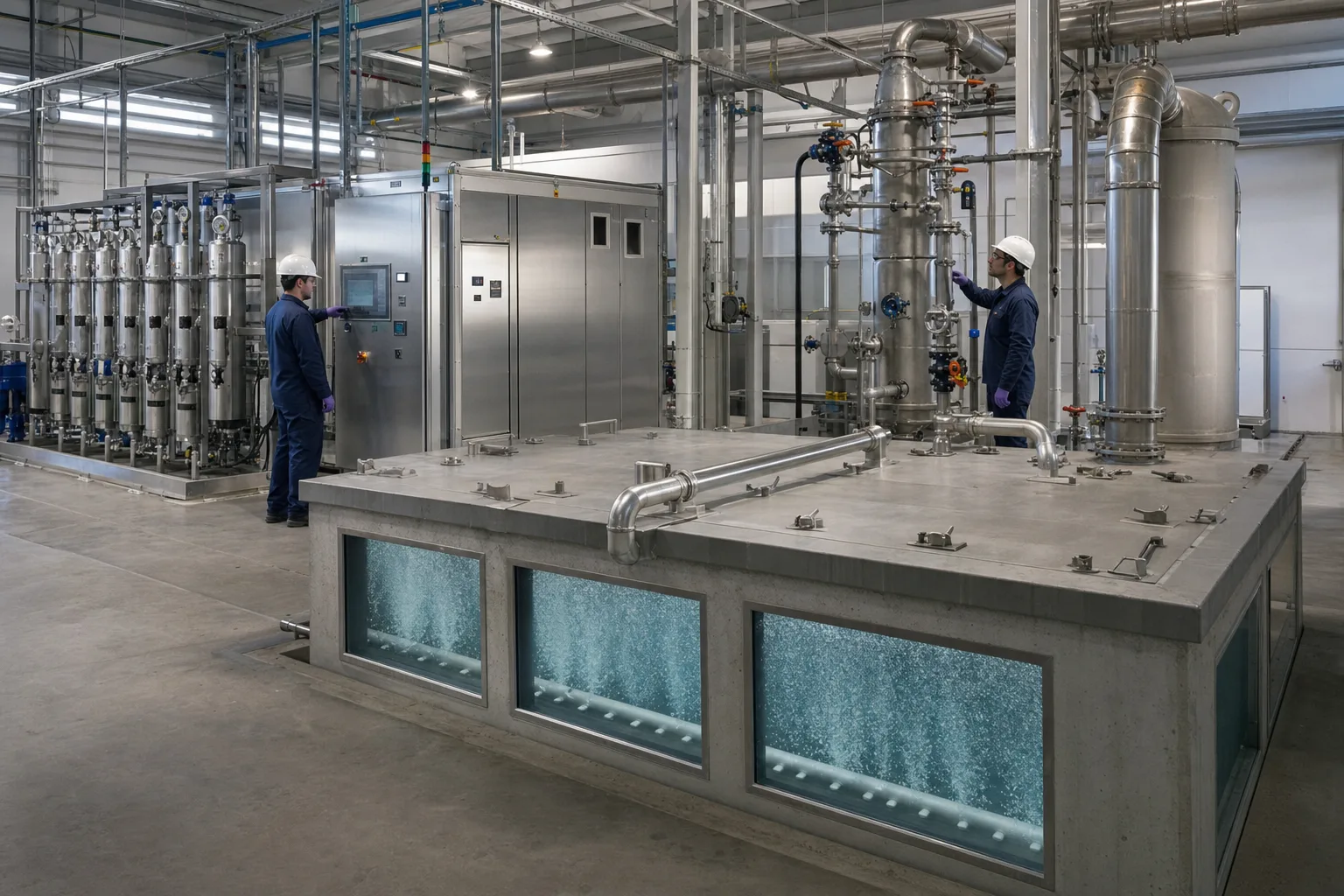 11Dry feed gas and ozone generation22Generator power, cooling, controls33Microbubble contact basin44Later contact/off-gas destruction vessel
What to identify
- 1Dry feed gas and ozone generation
- 2Generator power, cooling, controls
- 3Microbubble contact basin
- 4Later contact/off-gas destruction vessel
Figure takeaway
Ozone is normally generated on site. The boundary extends through contact and ambient-safe off-gas destruction; a generator alone is not a treatment process.
How to verify it in the field
Verify feed-gas dew point/purity/flow, power/cooling, product concentration and mass flow; close feed-water-off-gas balance and test destructor state, ambient alarms, and emergency trip.
Microbubble mass transfer determines how much gas reaches the water
A porous diffuser makes fine bubbles, a side line feeds ozone-rich gas, a water probe reads dissolved ozone/oxidation, and the top captures untransferred gas.
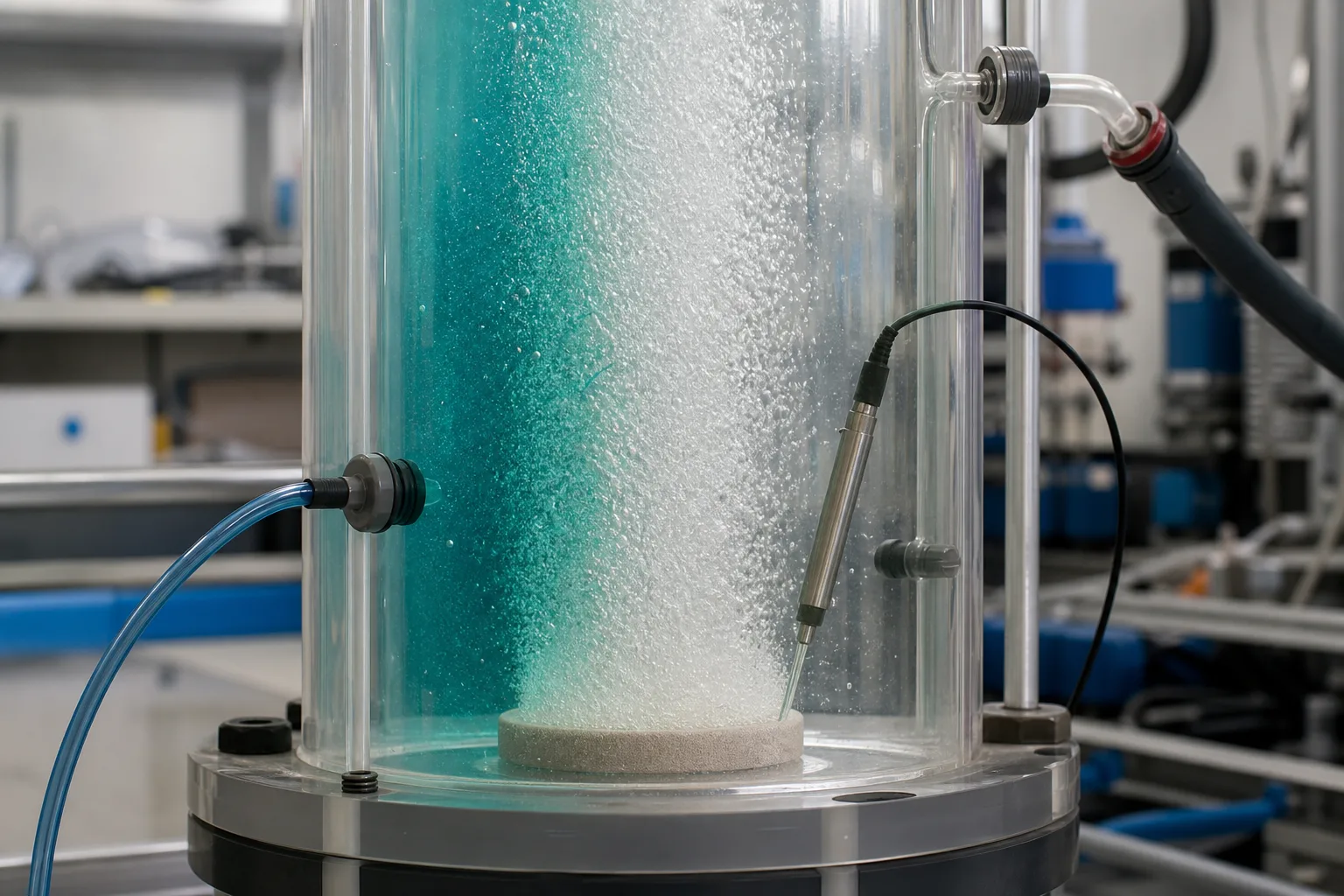 11Porous microbubble diffuser22Ozone-rich gas inlet33Dissolved-ozone/oxidation probe44Untransferred off-gas outlet
What to identify
- 1Porous microbubble diffuser
- 2Ozone-rich gas inlet
- 3Dissolved-ozone/oxidation probe
- 4Untransferred off-gas outlet
Figure takeaway
More visible bubbles do not guarantee more transfer. Size, residence, depth, temperature, fouling, and driving force matter; large bubbles or channels send ozone to off-gas.
How to verify it in the field
Measure inlet/off-gas O₃ concentration and flow, dissolved profile, and water flow; estimate transfer and inspect diffuser pressure, bubble distribution, and fouling. ORP alone is not ozone analysis.
A pilot train separates generation, transfer, reaction, and off-gas measurement
The generator feeds a bubble column, two transparent reactors provide staged contact, and analyzers plus the right-side device monitor product, water residual, and off-gas.
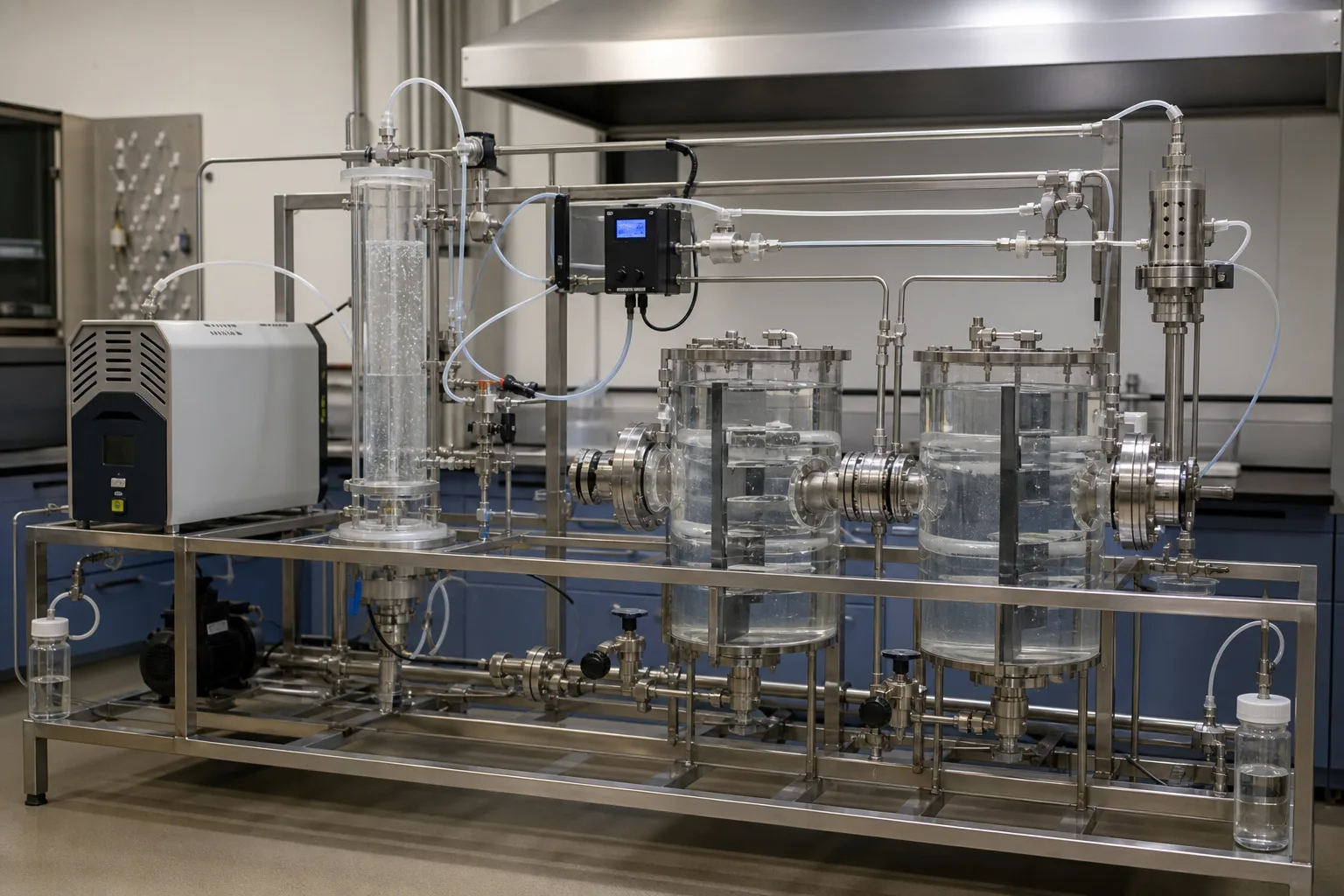 11Pilot ozone generator22Gas-liquid transfer bubble column33Staged contact reactors44Product/water/off-gas measurement train
What to identify
- 1Pilot ozone generator
- 2Gas-liquid transfer bubble column
- 3Staged contact reactors
- 4Product/water/off-gas measurement train
Figure takeaway
A single jar endpoint misses transfer, initial demand, staged residual, off-gas loss, and hydraulic short-circuiting. Pilot data explain why equal generated mass gives different removal.
How to verify it in the field
Time-align ozone mass production, targets/demand, stage residual, off-gas, pH/temperature, and real residence; verify instruments with tracer and mass balance.
Parallel columns show underexposure, target operation, and high demand or off-gas loss
Three columns receive different gas flow, dose, or matrix demand; paired samples show before/after changes while the generator keeps controllable conditions.
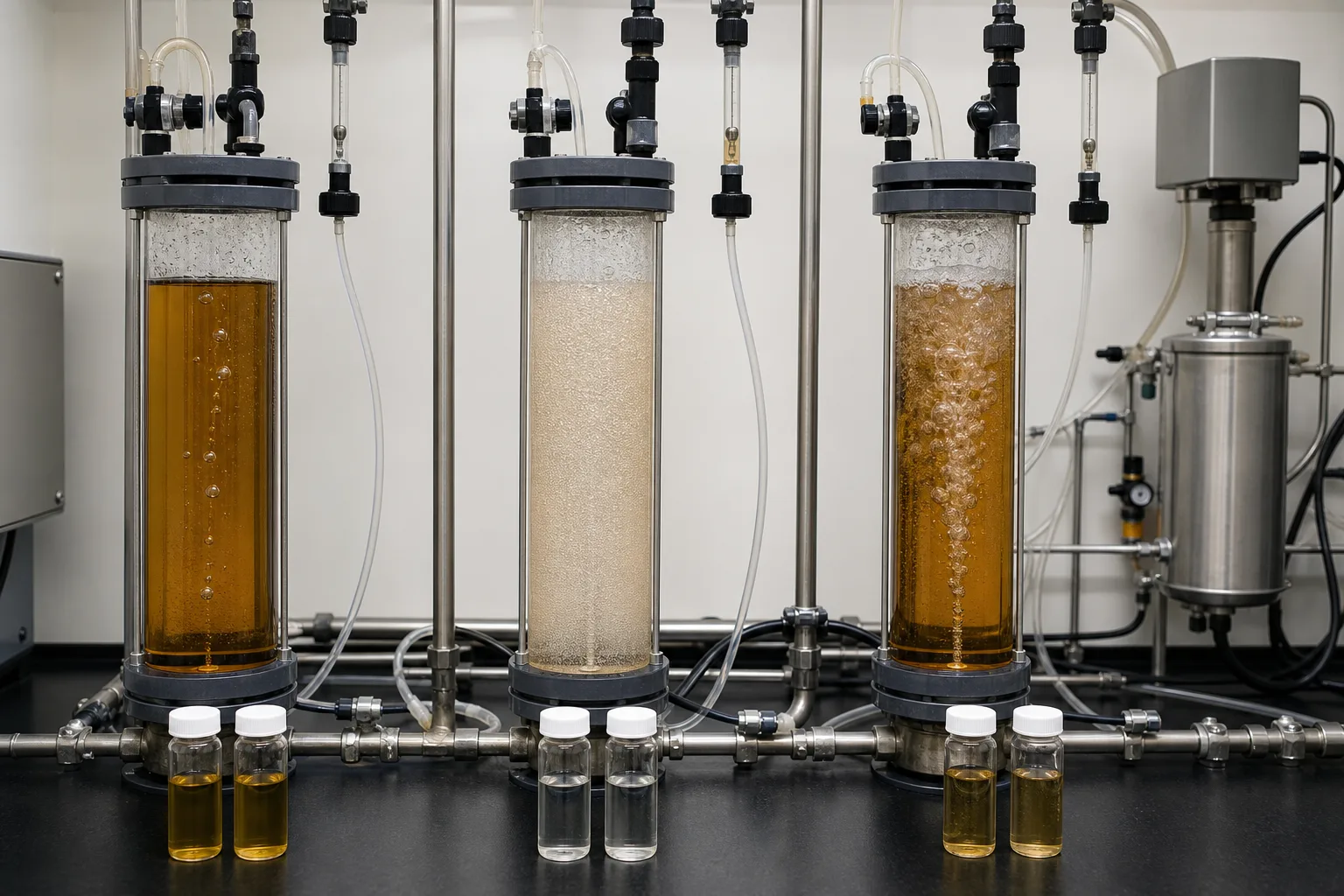 11Low-exposure/target-remains column22Effective transfer and reaction column33High-demand/off-gas-loss column44Paired raw and treated samples
What to identify
- 1Low-exposure/target-remains column
- 2Effective transfer and reaction column
- 3High-demand/off-gas-loss column
- 4Paired raw and treated samples
Figure takeaway
Color loss only shows chromophore oxidation, not mineralization or safety. Too little misses targets; excess can raise energy, off-gas, bromate, and organic byproducts.
How to verify it in the field
Compare target, DOC/TOC, UV254, demand/residual, bromate, aldehydes or AOC/BAC loading and biological effect; normalize to ozone transferred, not nameplate generation.
Scaled diffusers, aged materials, and spent media undermine transfer and safety
Technicians examine a scaled porous diffuser, discolored/cracked tubing or seals, and deposit, catalyst, or dryer-media samples after isolation.
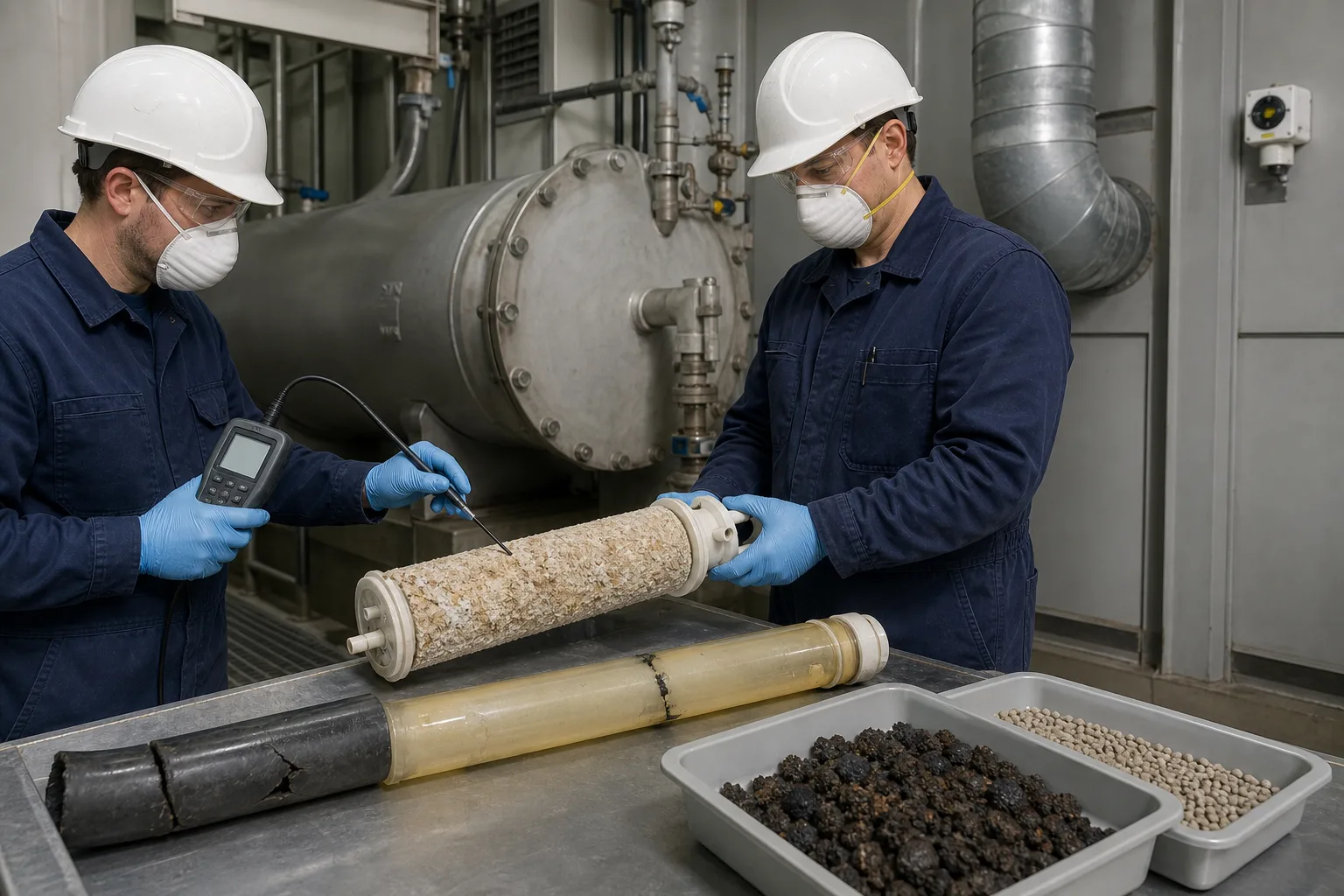 11Scaled, plugged porous diffuser22Aged/cracked ozone-contact material33Deposit/catalyst/dryer-media samples44PPE, gas test, maintenance isolation
What to identify
- 1Scaled, plugged porous diffuser
- 2Aged/cracked ozone-contact material
- 3Deposit/catalyst/dryer-media samples
- 4PPE, gas test, maintenance isolation
Figure takeaway
The oxidant also attacks incompatible elastomers; scale changes bubble size, and wet/poisoned destructor or dryer media loses function. Maintenance protects efficiency and people.
How to verify it in the field
Purge, test gas, de-energize, and follow confined-space controls; verify compatibility, diffuser pressure/bubbles, seal cracks, dryer dew point, and destructor inlet/outlet ozone. Never rely on odor.
Six mass-transfer links from oxygen to target oxidation
Each link loses ozone or changes its pathway.
1 Prepare feed gas
Oxygen/air → cleaning and deep drying
Protect generator and stabilize yield.
2 Generate on site
Corona discharge + cooling → O₃ gas
Create measured ozone mass flow.
3 Transfer to water
Diffuser/injector → dissolved O₃
Move gas-phase oxidant into water.
4 Dual-path reaction
Molecular O₃ + decomposition-derived ·OH
Combine selective and nonselective oxidation.
5 Contact and polish
Actual CT → BAC/downstream barriers
Complete target and remove biodegradable products.
6 Destroy and verify
Off-gas destruction + target/byproduct/safety data
Close mass and risk.
Four ozone subsystems
Strong chemistry matters only when gas supply, transfer, reaction, and off-gas are controlled.
Feed gas and generator
- Role
- Supply clean dry oxygen and stable O₃
- Typical failure
- Wet/contaminated gas, cooling/power fault, low concentration
- Evidence
- Dew point/purity/flow, power, cooling, product concentration and mass
Contact and transfer
- Role
- Provide fine bubbles/mixing and real residence
- Typical failure
- Plugged diffuser, large bubbles, short-circuit, overflow, high off-gas
- Evidence
- Feed/off-gas mass, residual, transfer, pressure/bubbles, flow, tracer T10
Water reaction/polishing
- Role
- Manage direct O₃/·OH toward disinfection or target
- Typical failure
- High background demand, scavenging, bromate/AOC, missed target
- Evidence
- Demand, pH/alkalinity/NOM/bromide, target, microbes, bromate, BAC
Off-gas and safety
- Role
- Capture/destroy residual gas and control exposure
- Typical failure
- Leak, ventilation/destructor failure, alarm drift, no purge
- Evidence
- Destructor inlet/outlet, temperature/pressure, ambient monitoring, trip and permit
Set dose, contact, residual, and bromate/byproduct limits from local rules, intended use, and validated pilot/design work. Ozone systems combine high voltage, enriched oxygen, strong oxidant gas, and confined-space hazards and require trained operation.
Align three data groups for the same water and time
Gas-phase mass
Feed purity/dew point/flow, generator power/cooling, product and off-gas ozone concentration/mass, destructor outlet, and ambient alarms.
Transfer and hydraulics
Water flow, gas:water, diffuser/injector pressure, bubbles, stage residual, temperature, tracer T10, online cells, and transfer efficiency.
Water outcome and cost
Demand, pH/alkalinity, DOC/UV254, bromide, target/microbes, bromate/organic products, BAC load, power, and maintenance.
Diagnose performance or safety abnormalities
- Combined signal
- Normal power but lower product O₃ mass with abnormal feed dew point or cooling
- Suspect first
- Wet/contaminated gas or generator overheating—not water demand
- Next step
- Unload per procedure; verify dryer/filter, purity, gas flow, cooling, then product O₃ before changing water settings
- Combined signal
- Product normal, off-gas rises, dissolved residual/removal falls, and diffuser pressure/bubbles change
- Suspect first
- Plugging, large bubbles, contactor short-circuit, or excess flow reduces transfer
- Next step
- Check gas/water, pressure/bubbles, cells and T10; isolate/clean diffuser and reclose the mass balance
- Combined signal
- Transfer/residual stable but seasonal NOM or nitrite rise reduces target removal
- Suspect first
- Background demand or radical scavenging competes
- Next step
- Run same-water demand-dose-time test with NOM/UV254, nitrite, alkalinity, target; optimize pretreatment/feed point
- Combined signal
- Target passes but bromate, aldehyde/AOC, or ambient ozone alarm rises
- Suspect first
- Byproduct or safety constraint now controls
- Next step
- Respond to gas alarm immediately; for water, review bromide, pH, dose/residual, and BAC and reset operating window
Four common misconceptions
All ozone effects come from hydroxyl radicals
Direct selective molecular ozone and indirect ·OH coexist; water and process set the share.
All generated ozone enters the water
Off-gas, leaks, transfer limits, and rapid background demand separate generation from delivered dose.
Color removal proves full mineralization
Ozone can break chromophores while leaving aldehydes, acids, and biodegradable products that need analysis/polishing.
Fast decay means no safety or byproducts
Ozone gas is hazardous and needs destruction; bromide can form bromate and organics form other products.