Illustrated guides · Physicochemical treatment
How does coagulation make fine colloids form flocs?
Fine colloids remain dispersed not only because they are small, but because surface charge and hydration keep neighboring particles apart. Coagulation destabilizes them; flocculation then grows separable aggregates through controlled collisions.
Direct answer
Direct answer
Clay, natural organic matter and fine suspended solids commonly carry surface charge. Brownian motion keeps the tiny particles moving while like-charge electrical-double-layer repulsion prevents lasting contact. Aluminum or iron salts hydrolyze into positively charged species and metal hydroxide precipitates that can neutralize charge, compress the double layer and sweep-enmesh particles. Polymers can adsorb on multiple surfaces and bridge them. Rapid mixing distributes the chemical before these fast reactions become localized; gentler flocculation then increases collisions without excessive breakage. Raw-water chemistry, pH, alkalinity, temperature, chemical type/dose, addition order and mixing all define the working window. Too little leaves colloids stable, while too much can reverse charge, saturate polymer sites, shift pH and create excess residuals.
Four conditions turn destabilization into separable floc
Chemical addition alone does not prove that destabilization, collision, growth and separation occurred.
Chemical species match the water
Al/Fe hydrolysis depends on pH, alkalinity and temperature; particle loading and natural organics change demand. A universal dose or pH is unreliable.
Rapid mix is fast and uniform
Fast reactions make local overdosing and untreated zones likely if the feed point and mixer do not distribute chemical through the full flow.
Flocculation creates contact without destructive shear
Staged, usually decreasing shear promotes collisions early and protects larger flocs later. Too little energy gives few contacts; too much causes repeated breakage.
The floc fits the downstream separator
Settling favors large dense flocs, flotation needs bubble attachment and filtration also values strength. Optimize final removal, not appearance alone.
A coagulation train links chemical feed, rapid mix, staged flocculation and separation
Storage and metering feed the flow, high-intensity mixing disperses chemical, slower multi-stage mixers grow floc, and only then does separation occur.
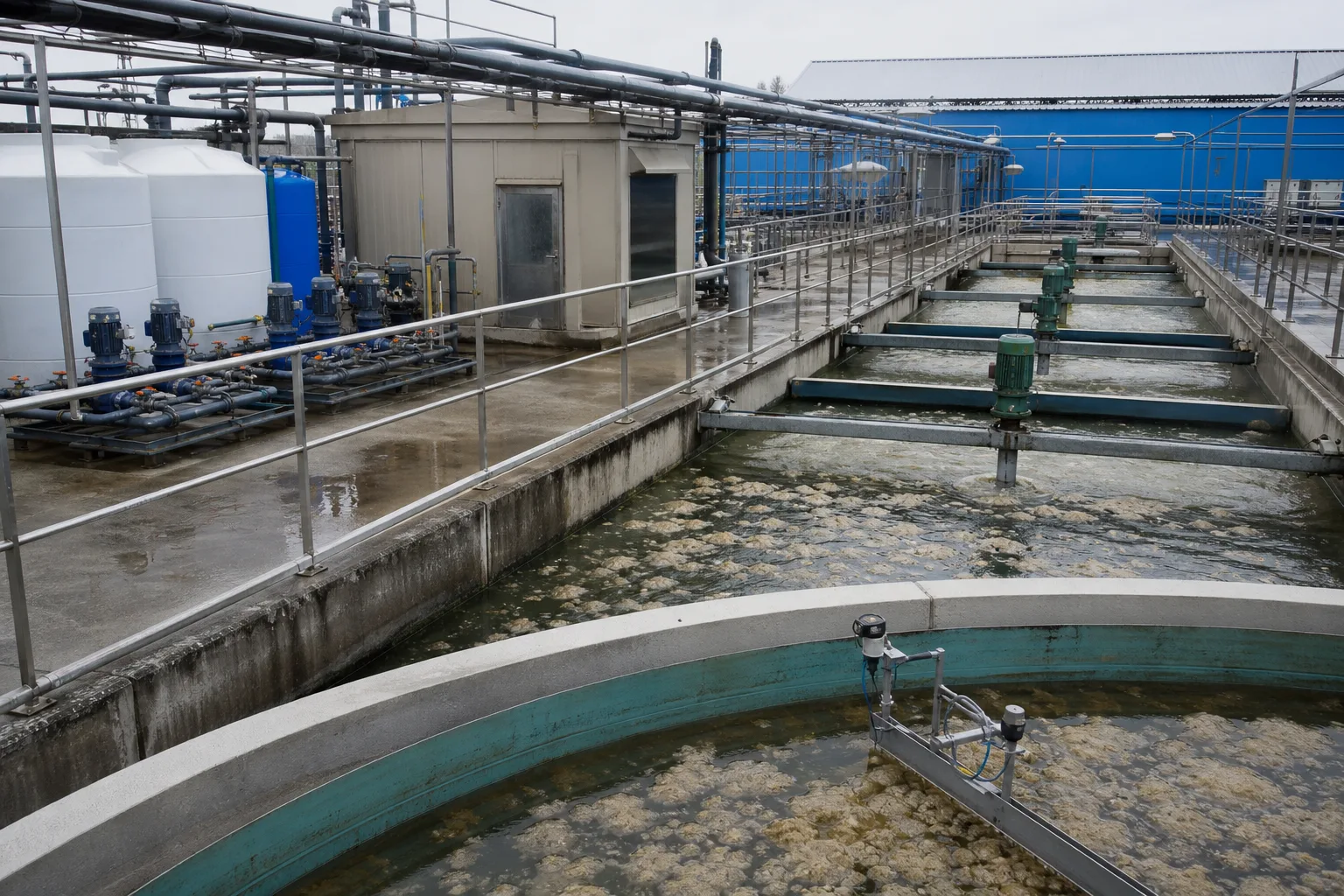 11Chemical storage and metering22Front-end rapid mix33Staged low-shear flocculation44Mature floc/separation inlet
What to identify
- 1Chemical storage and metering
- 2Front-end rapid mix
- 3Staged low-shear flocculation
- 4Mature floc/separation inlet
What the image proves
Coagulation is a reaction train, not one tank. Feed-point delay, poor rapid mix, short circuiting or excessive final-stage shear can make the same dose behave differently.
How to verify on site
Map feed points, rapid-mix residence, mixer speed by stage and separator entry; verify pump calibration, mixer direction/current, level and floc growth across stages.
Microscopically, repulsion is removed before neutralization, sweep or bridging connects particles
A mechanism visualization shows dispersed fines, microfloc, larger aggregates and a network. It is not a literal micrograph of named chemicals.
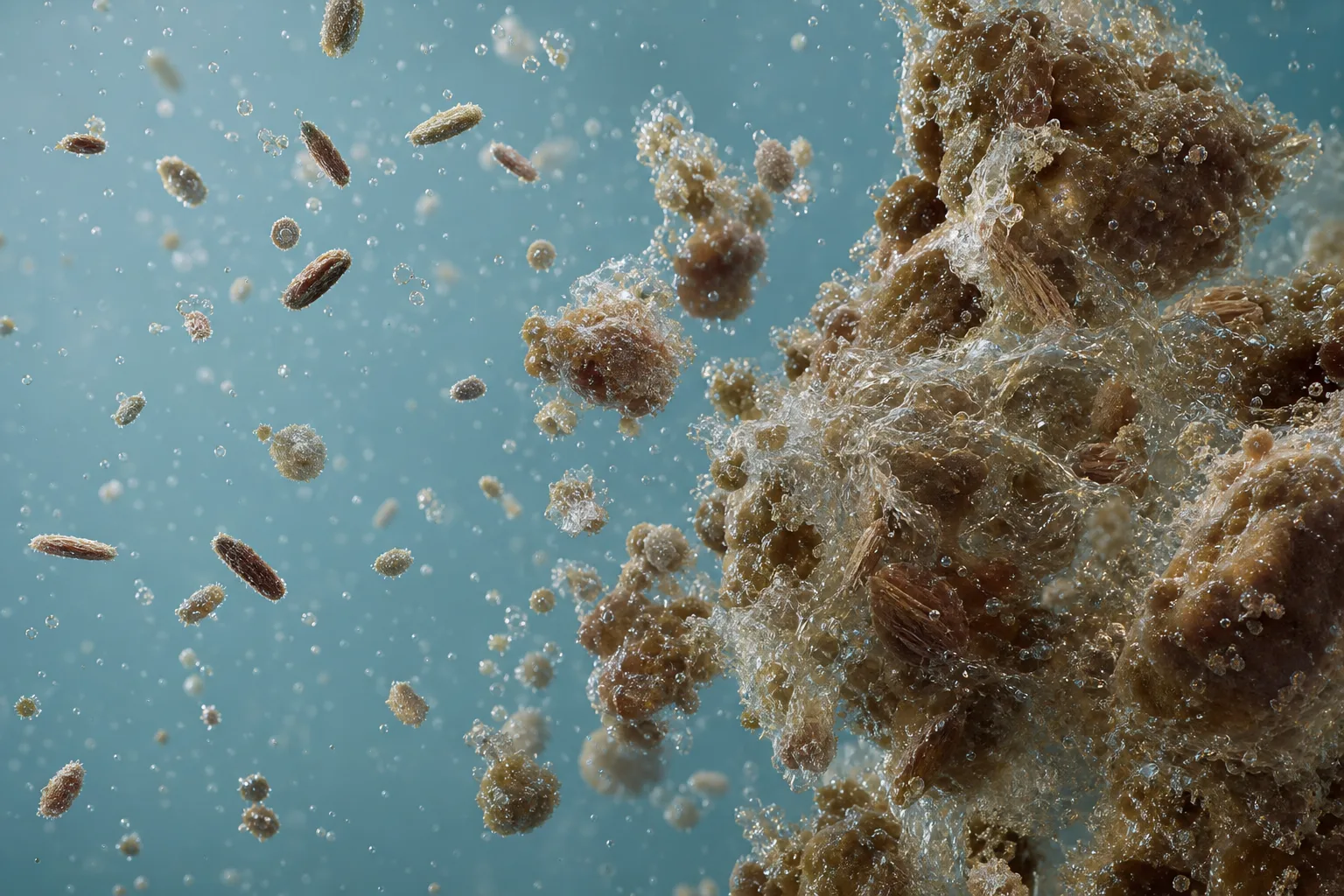 11Stable dispersed fines22Destabilized microfloc33Hydroxide sweep/enmeshment44Polymer bridges and large floc
What to identify
- 1Stable dispersed fines
- 2Destabilized microfloc
- 3Hydroxide sweep/enmeshment
- 4Polymer bridges and large floc
What the image proves
Mechanisms can overlap: adsorption/charge neutralization, hydroxide sweep and polymer bridging dominate in different windows. Not every coagulant behaves like glue.
How to verify on site
Use pH/alkalinity, dose-response, streaming current or zeta potential when available, particle count and floc observation; do not infer mechanism from color.
Flocs grow through staged collisions from rapid to gentle mixing
The cutaway progresses from rapid dispersion through nascent particles and multi-stage growth to clarified water and settled solids, with decreasing permissible shear.
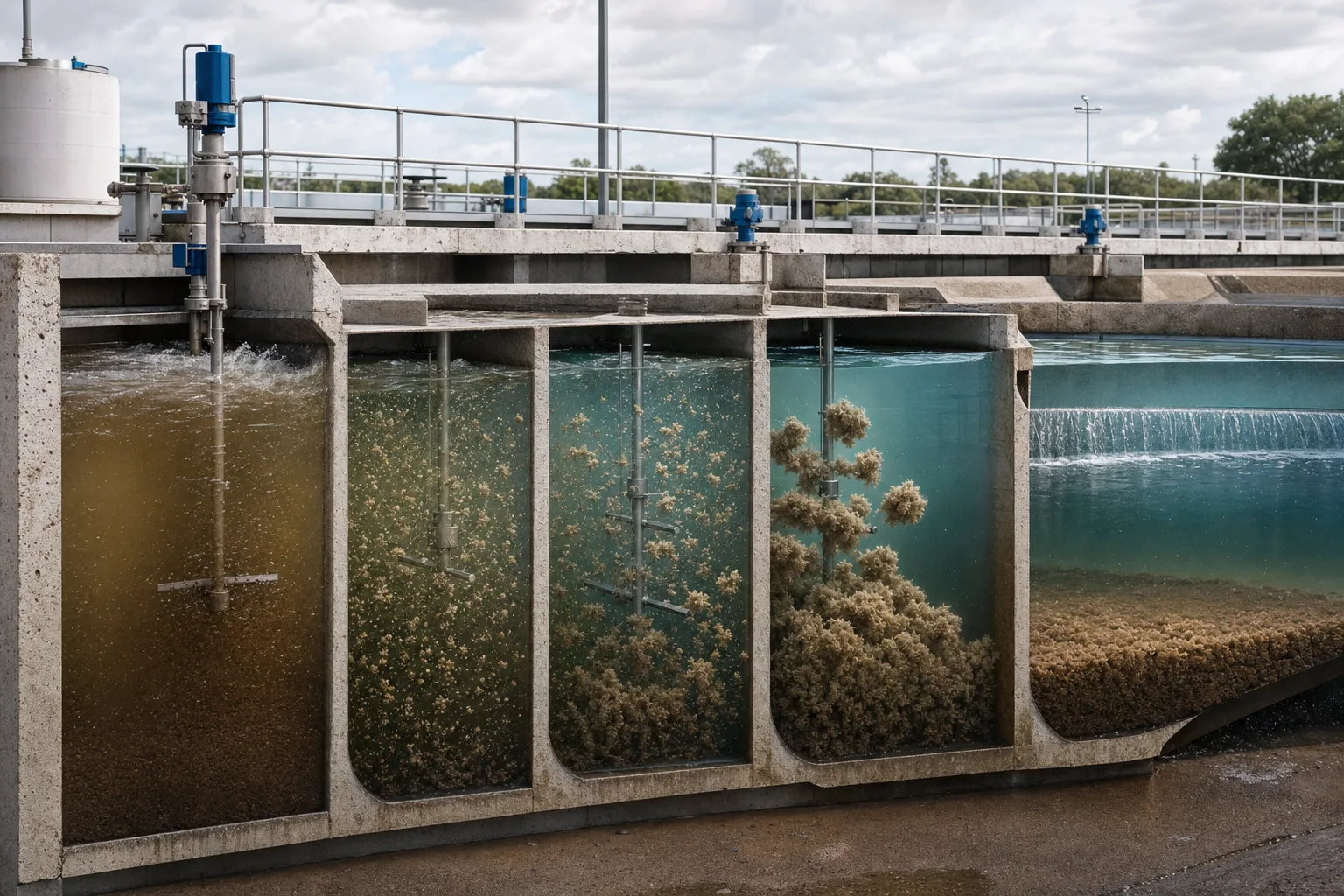 11Instant chemical dispersion22Destabilized-particle collisions33Staged gentle floc growth44Clarified water and sludge
What to identify
- 1Instant chemical dispersion
- 2Destabilized-particle collisions
- 3Staged gentle floc growth
- 4Clarified water and sludge
What the image proves
Rapid mix distributes chemical; it does not maximize floc size. Flocculation raises effective collisions; it is not simply the slowest possible mixing. The optimum balances contact and breakage.
How to verify on site
Verify actual flow, volume, mixer power/speed and head loss; inspect short circuiting, first visible microfloc, final-stage breakage and settling after shutdown.
Jar testing searches for a chemical-hydraulic window, not the prettiest beaker
Three identical-program candidates visualize low-dose turbidity, an apparent floc window, and a high-dose or mismatched condition; measurements must decide.
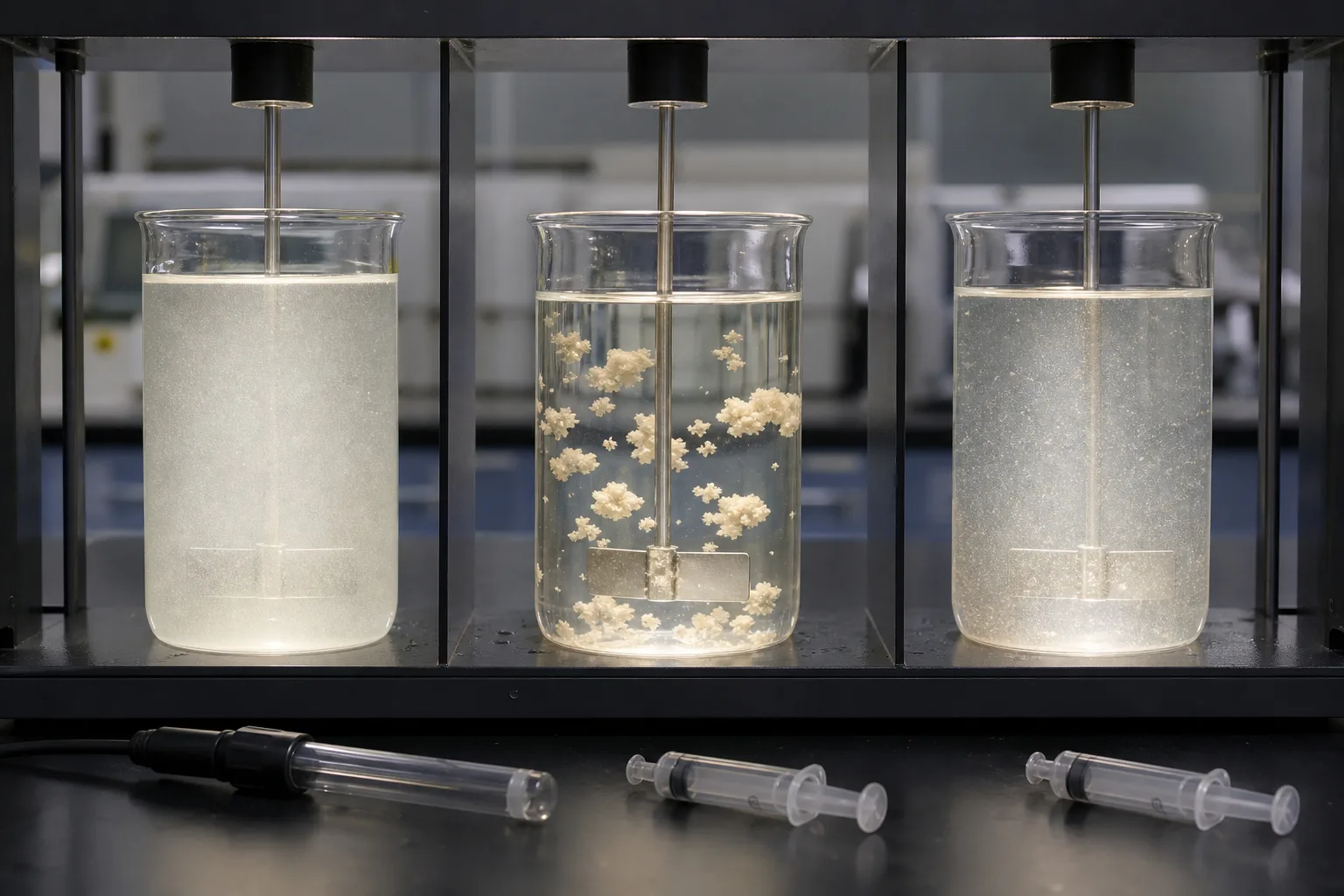 11Low-dose candidate22Working floc window33High-dose/mismatch candidate44Identical rapid/slow mix program
What to identify
- 1Low-dose candidate
- 2Working floc window
- 3High-dose/mismatch candidate
- 4Identical rapid/slow mix program
What the image proves
The largest visible floc may not be best. Compare settled/flotation turbidity, filterability, residual Al/Fe, pH, sludge and target removal under an identical program.
How to verify on site
Hold raw water, temperature, order and mixing constant; include blank and dose steps, use equal settling time, then measure supernatant and record formation/breakage.
Full-scale transfer requires calibrated pumps, sensors, mixing and samples
An operator checks the chemical connection, staged samples, settling test and full-scale floc beside the treatment train.
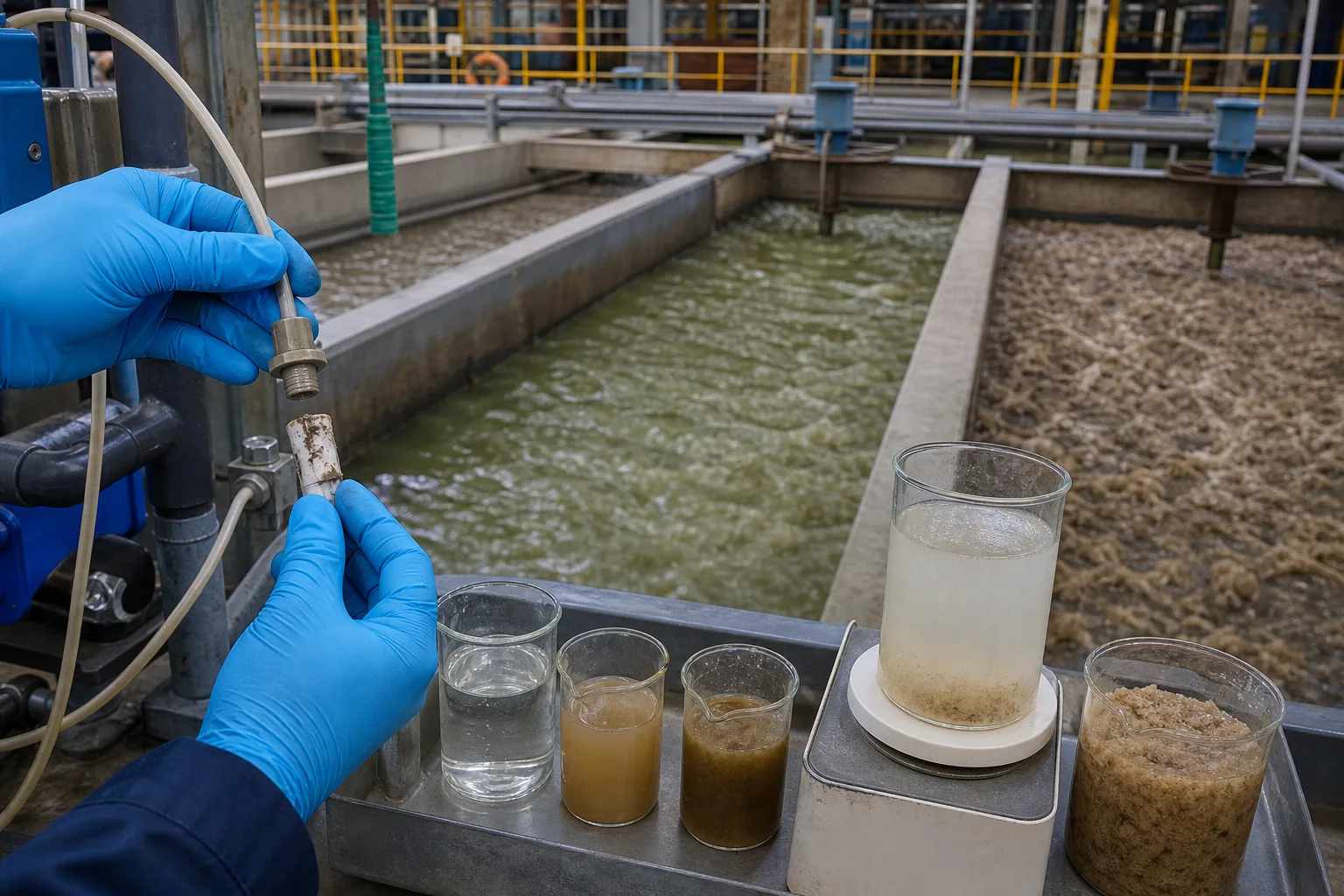 11Pump calibration/feed point22Raw/rapid-mix/final-stage samples33pH, turbidity and settling test44Full-scale floc and hydraulics
What to identify
- 1Pump calibration/feed point
- 2Raw/rapid-mix/final-stage samples
- 3pH, turbidity and settling test
- 4Full-scale floc and hydraulics
What the image proves
Express dose as active chemical mass per actual water volume. Pump percent is not dose; chemical strength, flow error, sensor drift or mixer faults can change the real condition behind an unchanged setting.
How to verify on site
Calibrate pump output and chemical strength, verify flow and pH/turbidity instruments, and take time-aligned samples from raw water through separation.
Six steps from stable colloid to separable floc
Separate chemical destabilization from hydraulic collision to locate failure.
1 Stable dispersion
Charged colloids + hydration
Repulsion and Brownian motion maintain suspension.
2 Chemical addition
Al/Fe salt or polymer → water
Supply hydrolysis species, counterions or bridging chains.
3 Rapid-mix destabilization
Fast dispersion + surface reaction
Reduce repulsion throughout the full flow.
4 Gentle collisions
Microfloc + controlled velocity gradient
Increase useful contact for adsorption, bridging and sweep.
5 Floc maturation
Small → larger, stronger aggregates
Balance growth against shear breakage.
6 Solid-liquid separation
Floc → settling/flotation/filter/sludge
Actually remove particles and captured contaminants.
What each process element must accomplish
Chemistry, hydraulics and separation cannot substitute for one another.
Chemical and water chemistry
- Primary duty
- Provide the appropriate hydrolysis, adsorption or bridging mechanism
- Typical upset
- Under/overdose, wrong pH/alkalinity, degraded chemical or wrong order
- Field evidence
- Raw turbidity/TOC/particles, pH/alkalinity/temperature, strength, residual metals and jar curve
Rapid mix
- Primary duty
- Disperse chemical across the full flow before fast reactions localize
- Typical upset
- Local overdose, lag, dead zone, short circuit or harmful shear
- Field evidence
- Feed geometry, residence/trace, power/gradient, mixer state and post-mix microfloc
Flocculation
- Primary duty
- Use staged shear for collisions, growth and strengthening
- Typical upset
- Too little contact, repeated breakage, short residence or short circuit
- Field evidence
- Stage power/speed, floc size/strength profile, hydraulics and final settling
Separation and feedback
- Primary duty
- Capture floc and return final performance to control
- Typical upset
- Floc/separator mismatch, hydraulic overload, residual or backwash imbalance
- Field evidence
- Turbidity/TSS/particles, filter run/DP, sludge, target removal and residual chemical
Use representative jar or pilot testing and revisit it through seasonal or industrial-water changes. Generic doses and pH values do not replace site tests; chemical changes also require safety, residual, sludge and downstream-impact review.
Align three evidence groups
Raw water and chemistry
Flow, turbidity/TSS, particles or color/TOC, pH, alkalinity, temperature, conductivity, chemical type/strength/batch, active-mass dose and residual Al/Fe.
Mixing and floc profile
Rapid/stage power, speed, level, residence and short circuiting plus microfloc onset, size, strength, breakage/regrowth and settling/flotation response.
Final separation
Clarifier/DAF turbidity/TSS/particles, pre/post-filter turbidity and run/DP, target removal, sludge/scum, chemical use and operating events.
How to localize bad floc
- Combined signal
- No visible microfloc after rapid mix; every stage stays uniformly turbid
- Suspect first
- Chemical/dose mismatch, pH/alkalinity outside the window, feed failure or poor rapid dispersion
- Next step
- Verify active-mass dose, chemical, pump and flow, then run a pH-dose matrix; do not first extend flocculation
- Combined signal
- Many fine microflocs form but do not grow across stages
- Suspect first
- Insufficient collision energy/residence, unsuitable polymer/order or low particle collision opportunity
- Next step
- Check staged gradients, short circuiting, temperature and test polymer point/dose with controlled mixing
- Combined signal
- Large floc appears early but breaks in the last stage or after a pump
- Suspect first
- Localized shear, drop, valve/pump stress or weak floc
- Next step
- Sample along the path to locate breakage, inspect hydraulics and final-stage speed, then test regrowth
- Combined signal
- Jar supernatant is good but full-scale effluent is poor and basins differ
- Suspect first
- Dose/flow scale-up, mixing, flow split, short circuit or downstream separator fault
- Next step
- Translate to active-mass dose and G·t, calibrate each train, and inspect staged samples/hydraulics before changing chemistry
Four common misconceptions
Coagulant is glue
Charge neutralization, double-layer compression, sweep enmeshment and polymer bridging may overlap and change with conditions.
The largest floc is always best
Large loose floc can settle or float poorly and break easily; judge the final separator and target removal.
More chemical always makes clearer water
Overdose can shift pH, increase sludge/residuals, reverse charge or saturate bridging sites and restabilize particles.
Coagulation and flocculation are the same word
Coagulation emphasizes chemical destabilization/rapid dispersion; flocculation emphasizes controlled collisions and growth.