Illustrated guides · Physicochemical treatment
How does ion-exchange resin soften water and regenerate?
Sodium-form strong-acid cation resin exchanges Na⁺ for Ca²⁺ and Mg²⁺ during service, then uses backwash, brine displacement, slow rinse, and fast rinse to restore sodium capacity.
Direct answer
Direct answer
Strong-acid cation resin in a softener has fixed negative sites carrying exchangeable Na⁺. As hard water passes, the resin generally prefers divalent Ca²⁺ and Mg²⁺, so one hardness ion occupies two sites and an equivalent amount of Na⁺ enters the water. Hardness falls, but total dissolved salts and anions are not removed, so softening is not desalination. As hardness loading accumulates, the exchange front moves toward the outlet and leakage begins. A typical regeneration first backwashes to expand and clean the bed, then introduces concentrated NaCl; excess Na⁺ displaces Ca²⁺/Mg²⁺ from the resin. Slow rinse completes displacement and moves spent brine, and fast rinse removes residual salt and stabilizes the bed. Twin vessels can alternate service and regeneration. Usable capacity depends on resin condition, feed hardness and sodium, iron/manganese/particles/organics, oxidants, temperature, flow, salt dose and concentration, contact time, direction, and endpoints. Waste brine carries high Na⁺, Cl⁻, Ca²⁺, and Mg²⁺ and belongs in the water-salt balance and compliant discharge plan. Early timer regeneration wastes salt and water; late regeneration sends hardness to scale-sensitive users.
Four conditions close the service–regeneration loop
Salt in the tank or no visible scale today does not prove capacity, regeneration efficiency, or waste management.
Pretreatment protects the resin bed
Particles plug the bed, while iron, manganese, oxidants, oil, and organics foul or damage resin. Temperature, pH, and disinfectant limits must match the resin and vessel.
Capacity is consumed by hardness load, not a clock
Hardness concentration times treated volume uses capacity. Flow peaks, maldistribution, and inactive resin advance breakthrough; volume control still needs outlet-hardness verification.
Brine concentration, dose, and velocity set regeneration
Salt bridging, air leaks, injector blockage, or insufficient contact leave Ca/Mg loaded. Excess salt only lowers efficiency and increases saline waste.
Backwash, slow rinse, fast rinse, and drainage all matter
Backwash cleans, slow rinse advances displacement, and fast rinse removes salt. Bad sequence or distribution causes channels, resin loss, hardness leakage, or high chloride at startup.
Twin softeners combine continuous service, automatic valves, and a brine system
Two fiberglass vessels alternate service/standby/regeneration, top multiport valves switch flow, and the salt tank and bag on the right prepare regenerant while operators verify controls.
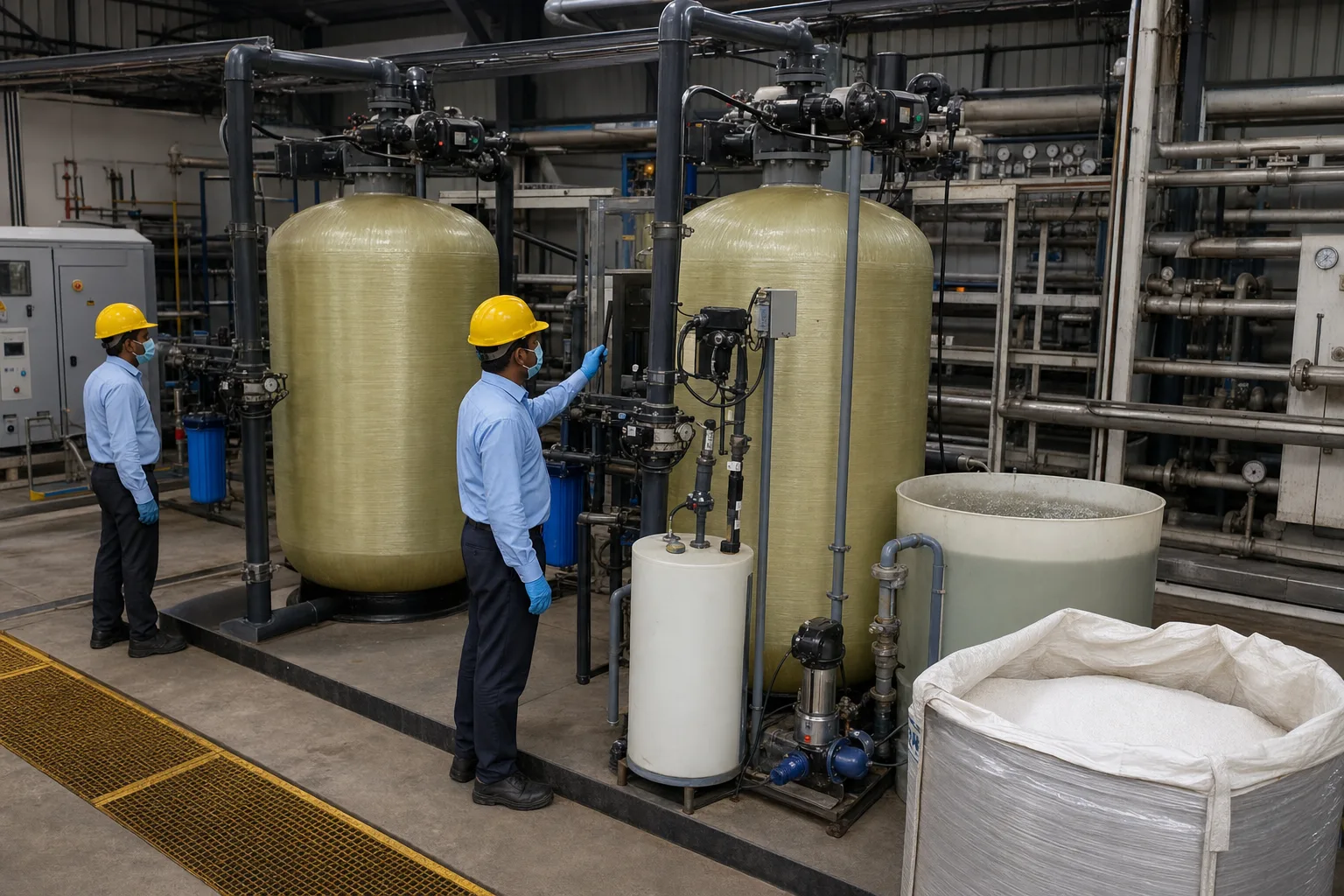 11Online softening vessel22Standby/regenerating vessel33Automatic multiport valves44Salt tank, salt, and brine draw
What to identify
- 1Online softening vessel
- 2Standby/regenerating vessel
- 3Automatic multiport valves
- 4Salt tank, salt, and brine draw
Figure takeaway
A softener is more than a resin vessel. Meter or hardness trigger, valves, injector, salt tank, drain, and twin-vessel handoff determine continuous soft-water quality.
How to verify it in the field
Verify the active vessel and real valve positions. Log flow/pressure, hardness, and treated volume; observe salt/liquid level, brine draw, step times, drain flow, and standby readiness.
Resin beads provide exchange sites while a hardness front moves through the bed
Amber beads form a porous bed with freeboard above. As Ca/Mg load enters, sodium sites convert to hardness form and an exchange front moves toward the lower outlet.
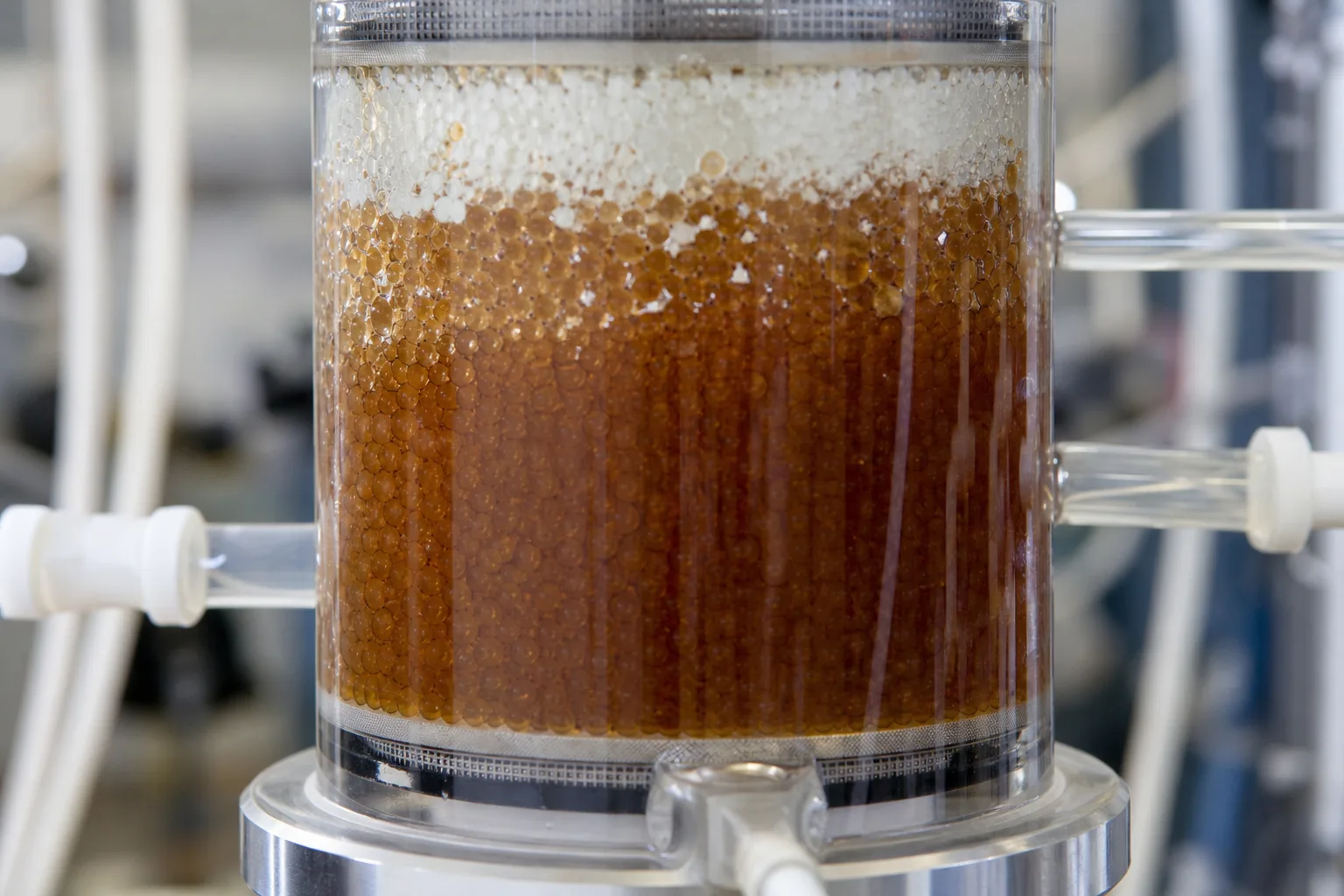 11Freeboard and expansion space22Sodium-form cation beads33Hardness load/exchange front44Lower distribution and resin retention
What to identify
- 1Freeboard and expansion space
- 2Sodium-form cation beads
- 3Hardness load/exchange front
- 4Lower distribution and resin retention
Figure takeaway
Hardness is not strained between beads; it is exchanged reversibly at sites. A bed can remain hydraulically open while chemically exhausted, so differential pressure cannot replace outlet hardness.
How to verify it in the field
Measure feed/effluent hardness, Ca, Mg, Na, conductivity, and flow. Estimate operating capacity from accumulated hardness equivalents and relate breakthrough to resin volume, depth, and rate.
Three clear columns separate service, backwash, and brine displacement
A compact bed represents downflow service, the expanded middle bed represents backwash, and the third column plus dosing and collection represents brine draw, slow rinse, or fast rinse.
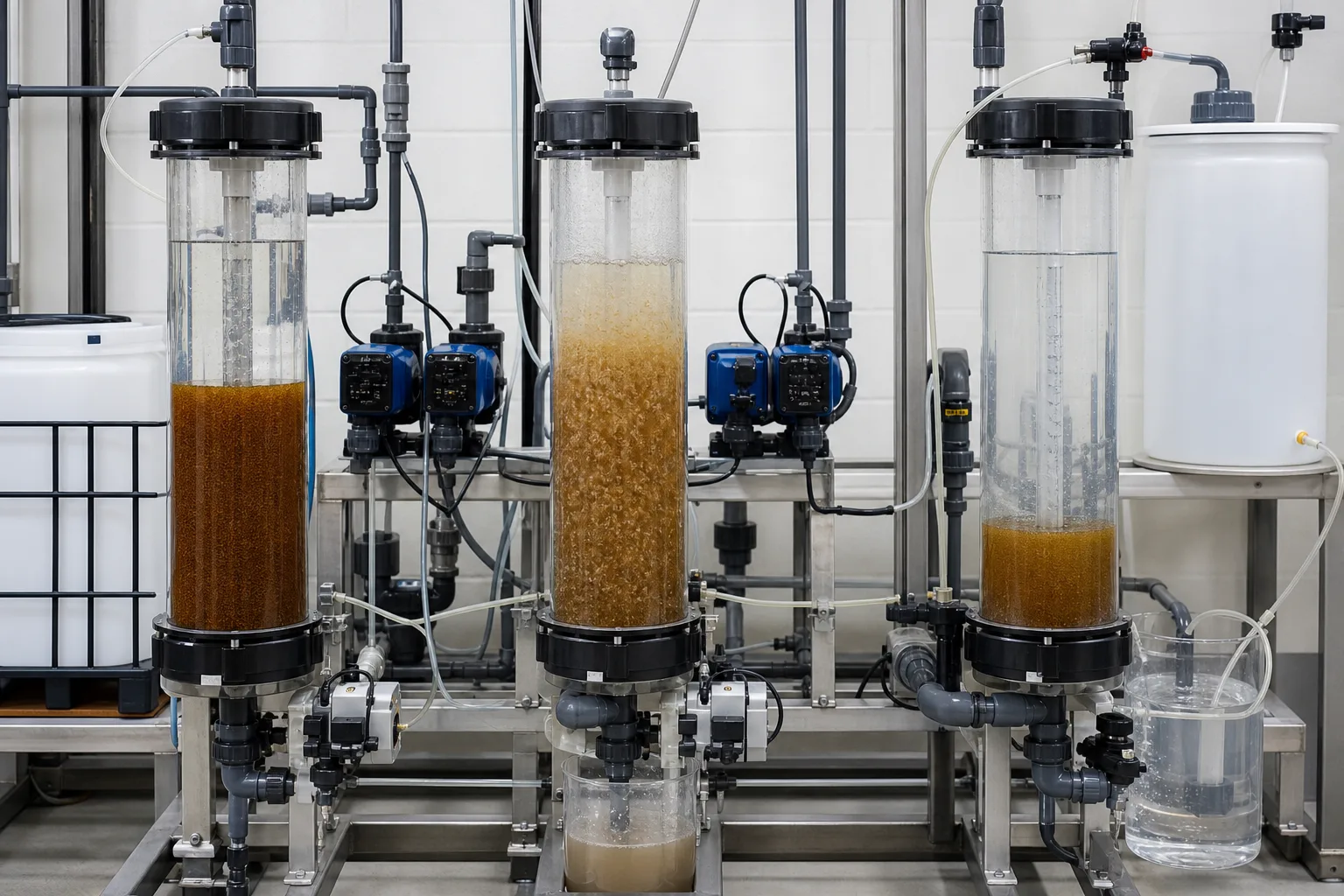 11Service exchange and exhaustion22Expanded backwash and cleaning33Brine displacement/slow rinse44Metering, valves, and drain collection
What to identify
- 1Service exchange and exhaustion
- 2Expanded backwash and cleaning
- 3Brine displacement/slow rinse
- 4Metering, valves, and drain collection
Figure takeaway
Regeneration is a sequenced hydraulic–chemical cycle. Weak backwash leaves deposits, excessive backwash loses resin, and fast brine flow or short slow-rinse time leaves deep Ca/Mg loaded.
How to verify it in the field
Record direction, flow, pressure, and duration for every step. Measure expansion and resin loss; profile drain conductivity, chloride, and hardness to confirm salt and hardness peaks leave as intended.
Paired water and heat-transfer surfaces verify practical softening
A scaled coil, clean coil, small resin column, and paired raw/softened samples show that hardness leakage eventually appears as scale and lost heat transfer.
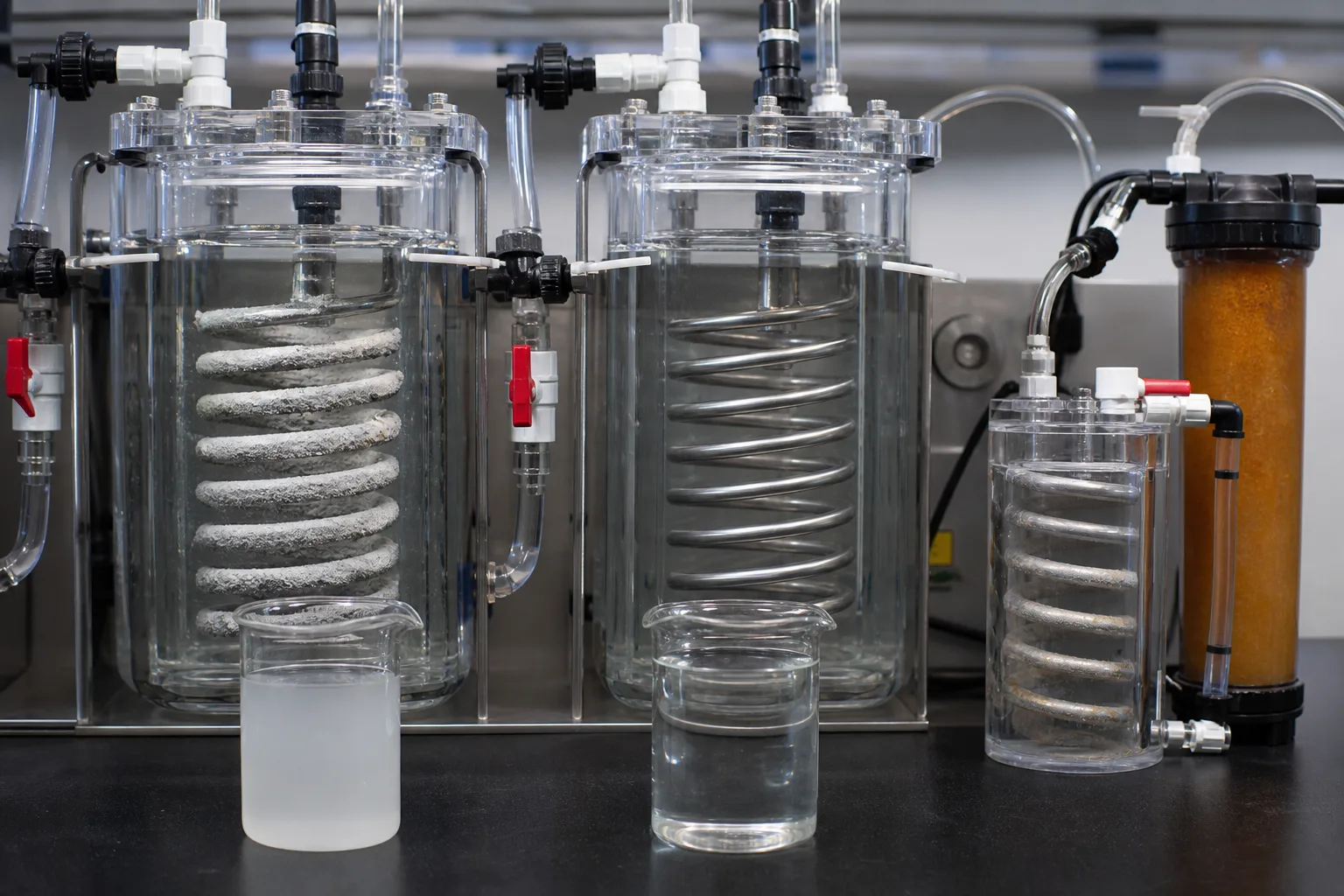 11Hardness-scaled coil22Clean coil protected by softening33Small resin verification column44Paired raw and softened samples
What to identify
- 1Hardness-scaled coil
- 2Clean coil protected by softening
- 3Small resin verification column
- 4Paired raw and softened samples
Figure takeaway
Little conductivity change does not mean failure because Ca/Mg is replaced by equivalent Na. Verify hardness and scale trends; stagnant soft water and other salts still need separate chemistry control.
How to verify it in the field
Test paired samples for hardness, Ca/Mg, Na, conductivity, and alkalinity. Align makeup, blowdown, wall temperature, pressure drop, and scale analysis with each hardness breakthrough.
An open-vessel inspection finds channeling, fouling, broken resin, and distributor faults
Uneven color and elevation are visible in the bed, technicians compare new and used resin, and the removed center pipe, lower distributor, and screens reveal leakage paths.
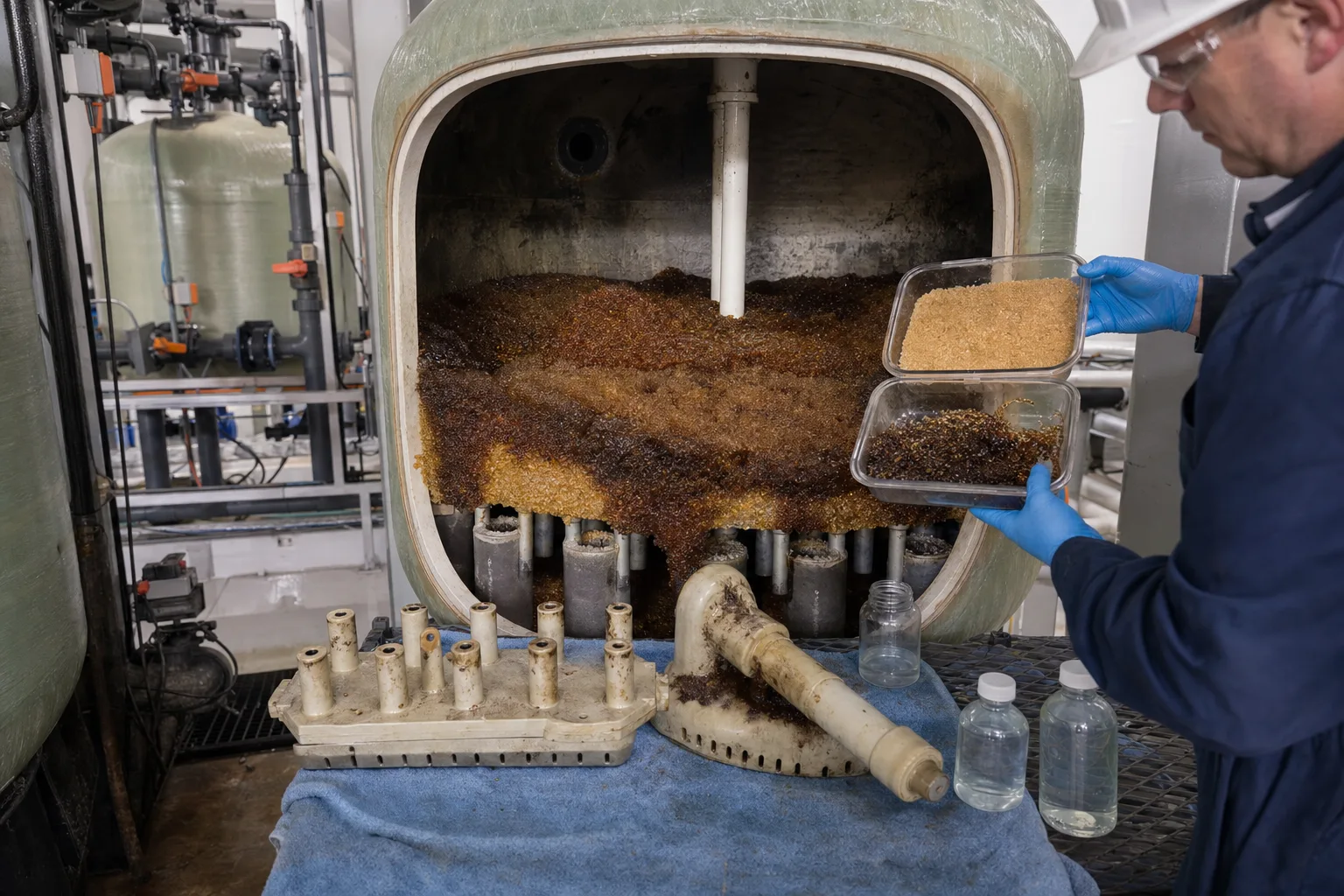 11Bed elevation and color pattern22Center pipe/upper distributor33Lower distributor and screens44New/used resin and water samples
What to identify
- 1Bed elevation and color pattern
- 2Center pipe/upper distributor
- 3Lower distributor and screens
- 4New/used resin and water samples
Figure takeaway
Capacity loss is not always a salt shortage. Iron/organic fouling, oxidative bead breakage, channeling, or damaged distributors cause early breakthrough, pressure trouble, or resin in effluent.
How to verify it in the field
After safe isolation, map bed height and sample zones. Test bead integrity, moisture/capacity, iron/organic fouling; inspect center pipe, screens, seals, and resin trap and reconcile resin additions.
Six steps from hardness exchange to restored resin
Separate service, exhaustion, and each regeneration step to locate leakage.
1 Pretreat/feed
Low-particle hard water → resin
Protect resin and distribute flow evenly.
2 Sodium exchange
2R–Na + Ca²⁺ → R₂–Ca + 2Na⁺
Replace Ca/Mg with Na and reduce hardness.
3 Track exhaustion
Accumulated load → outlet front
Regenerate before controlled hardness breakthrough.
4 Backwash
Clean water ↑ resin bed
Remove debris, loosen, and reclassify the bed.
5 Brine/slow rinse
High NaCl → R₂–Ca/Mg → R–Na
Drive hardness off resin into spent brine.
6 Fast rinse/service
Water → residual salt out → service
Stabilize bed, chloride, and hardness before return.
Responsibilities of four subsystems
Capacity, valve sequence, brine, and drainage constrain one another; filling salt alone is not control.
Feed and pretreatment
- Main job
- Limit particles, Fe/Mn, organics, oxidants, and hydraulic loading
- Typical failure
- Plugging, fouling, oxidation, temperature/pH excursion, or high rate
- Evidence
- Turbidity/SDI, Fe/Mn, TOC, chlorine, temperature, pH, flow, pressure drop
Resin bed/capacity
- Main job
- Exchange Ca/Mg on sodium sites with even flow
- Typical failure
- Capacity decay, early front, channeling, resin loss, or wrong media
- Evidence
- Hardness/Ca/Mg/Na, accumulated load, bed height, capacity/beads, resin trap
Valves and brine
- Main job
- Sequence backwash, brine, slow and fast rinse at an effective dose
- Typical failure
- Valve leakage, salt bridge, injector clog/air leak, weak/excess dose or wrong velocity
- Evidence
- Valve position, step flow/pressure/time, tank level, salt use, brine strength, drain profile
Drain and twin-vessel transfer
- Main job
- Remove hardness/salt, manage brine waste, and maintain service
- Typical failure
- Drain backpressure, salt in product, unready standby, or noncompliant waste
- Evidence
- Drain flow/conductivity/Cl/hardness, handoff events, product hardness, water-salt balance
Sodium-cycle softening raises product sodium but does not reduce TDS like RO and does not remove anions, silica, dissolved organics, or microbes. Drinking, boiler, cooling, and process uses require their own sodium, alkalinity, corrosion/scale, and downstream-treatment review.
Put three evidence groups on one service–regeneration cycle
Feed and capacity load
Flow/volume, hardness, Ca/Mg, Na, TDS/conductivity, Fe/Mn, turbidity, chlorine, temperature, and pressure drop.
Effluent and breakthrough
Per-vessel hardness/Ca/Mg/Na, conductivity, flow, time, and valve position; treated volume and hardness equivalents per resin volume.
Regeneration and brine waste
Backwash/brine/slow/fast flow and time, salt mass/strength, drain conductivity/Cl/hardness peaks, water/salt use, and discharge/recovery.
Diagnose rising softened-water hardness
- Combined signal
- Run length shortens each cycle and pressure drop or resin color also changes
- Suspect first
- Fe/Mn/organic fouling, particle plugging, oxidation, aging, or feed-load change
- Next step
- Compare feed/pretreatment, sample resin for fouling/capacity/integrity, then select targeted cleaning, top-up, or replacement
- Combined signal
- Hardness remains immediately after regeneration and salt level barely falls
- Suspect first
- Salt bridge, blocked brine well, injector/draw-line leak or clog, or no brine step
- Next step
- Observe draw level/flow, inspect injector, hose, check valve and valve position, measure brine strength, then controlled-regenerate
- Combined signal
- Water starts soft but breaks through abruptly and pressure drop may stay low
- Suspect first
- Excess rate, channeling, low bed, distributor failure, or resin loss
- Next step
- Compare at lower flow, inspect bed height/resin trap and distribution, then open and check center pipe/screens
- Combined signal
- Hardness is good but conductivity/chloride is high just after regeneration
- Suspect first
- Insufficient fast rinse, valve cross-leak, drain backpressure, or brine entering product
- Next step
- End fast rinse on conductivity/Cl, inspect valve seals and drain, and verify twin-vessel handoff timing
Four misconceptions
Softening removes all dissolved salts
It replaces Ca²⁺/Mg²⁺ with Na⁺; anions remain and conductivity/TDS usually changes little.
More salt always regenerates better and cheaper
Beyond the useful range it lowers salt efficiency and increases waste; dose, strength, velocity, and contact must be balanced.
Resin cannot fail while salt is present
Fouling, oxidation, channeling, and distributor damage are not repaired by salt and need pretreatment and maintenance.
Timer regeneration is most stable
Load changes with hardness and use; demand/volume control verified by outlet hardness reduces needless salt and water.